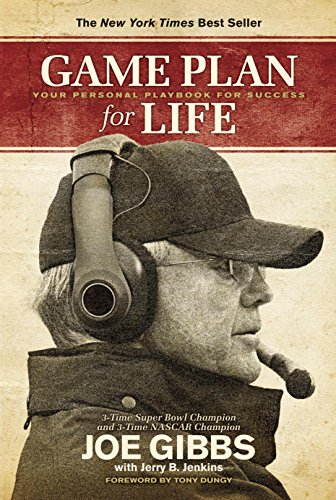
Three-time Super Bowl and NASCAR champion Joe Gibbs’s Game Plan for Life is an “average Joe’s” guide to what the Bible has to say about the 11 most-important topics for men. Topics such as: finances, relationships, living a life of purpose, finding the right vocation, physical, emotional, and spiritual health, and overcoming sin and addictions. Edited by Jerry Jenkins, and featuring contributions from Randy Alcorn, Ravi Zacharias, John Lennox, Tony Evans, Chuck Colson, Josh McDowell, Don Meredith, Walt Larimore, Ron Blue, Ken Boa, and Os Guinness, Game Plan for Life shows readers how to live a balanced, God-centered, purpose-filled life, using examples of Coach Gibbs’s own storied championship careers as a backdrop. A perfect blend of sports and basic theology,Game Plan for Life is designed to bring God’s word home to sports fans of all generations.
GAME PLAN for LIFE
Your personal playbook for successBy JOE GIBBS Jerry B. JenkinsTyndale House Publishers, Inc.
Copyright © 2009 Joe Gibbs
All right reserved.ISBN: 978-1-4143-2979-6Contents
Foreword > Tony Dungy...................................................................................IX1 No Game Plan, No Victory..............................................................................12 My Own Journey........................................................................................133 The Ultimate Playbook Can I Believe the Bible? > Josh McDowell.......................................234 The Coach Who Is God? > Ken Boa......................................................................475 Creation How Did Life Begin? > John C. Lennox........................................................657 Salvation How Do I Get on God's Winning Team? > Charles Colson........................................1078 Relationships What Does God Say about Marriage and Sex? > Don Meredith...............................1279 Finances How Do I Master My Money> Ron Blue..........................................................14510 Vocation 169 Vocation How Do I Build a Successful Life and Career? > Os Guinness.....................16911 Health How Do I Achieve True Health? > Walt Larimore, M.D...........................................18912 Purpose How Do I Get the Most Out of Life? > Tony Evans.............................................20513 Heaven Where Will I Spend Eternity? > Randy Alcorn..................................................22314 Still Battling.......................................................................................245Resources for Further Reading...........................................................................251My Team.................................................................................................255About the Authors.......................................................................................261Notes...................................................................................................263
Chapter One
No Game Plan, No Victory
"Joe, I've got awful news. Sean Taylor was shot early this morning. He's at Jackson Memorial in Miami." It was 6:00 a.m. on a Monday, and I'd just been awakened by a call from my boss, Dan Snyder, the owner of the Washington Redskins.
Sean Taylor was our superstar safety. He'd played in the Pro Bowl in 2006, and now in 2007 he was tied for most interceptions in the NFC, even though he'd missed the last two games. Some in the media said Sean had the talent to become one of the greatest NFL safeties of all time.
"How bad is it?"
"He got shot in the leg, so I'm not sure."
How bad can that be? I wondered. Certainly not life threatening.
Our first-round draft pick in 2004, Sean was having a remarkable season in what was otherwise turning out to be not such a great year for the Redskins. It was November, and we'd just lost to the Tampa Bay Bucs 19-13 at Tampa-our third loss in a row. We were 5-6 on the season, and it sure didn't look like we had a chance to get into the playoff s.
Due to a knee injury, Sean wasn't required to attend the Tampa Bay game. Instead, he was at home with his infant child and her mother in Miami, where he'd grown up.
This was my fourth year back as head coach of the Redskins, and my experience this time around was a long way from what the media had called the "Decade of Dominance," during my first stint as the Redskins' head coach from 1981 to 1992, when we won three Super Bowls.
Now this.
Sean Taylor-nicknamed "Meast" by his teammates because he was "part man and part beast," named by Sports Illustrated as the hardest-hitting player in the NFL-shot in the leg. To my horror and the devastation of our whole team, Sean died from his wounds the next day.
A year later, I was in my office at Joe Gibbs Racing in Charlotte, and the incident with Sean still weighed on me. The 2008 NASCAR season had ended, and I was catching up on business with one of our bankers, a good friend.
Out of the blue, he asked if I knew a certain college football coach. I did. "Well," my friend said, "I think you two have the same spiritual father, George Tharel."
I was more than a little surprised to hear George Tharel's name, because he had died seventeen years earlier in Fayett eville, Arkansas. George had taken me under his wing in 1971, when I was an offensive line coach for the University of Arkansas Razorbacks. My wife, Pat, and I had met George just after we'd moved to Fayett eville and began attending the same local church.
Now here I was in my office in Charlotte-a world away from that college town-learning that the same man who'd had a huge influence on me had also inspired this other coach who had passed through Arkansas early in his career.
You might ask, "What's a spiritual father?" For me, he was the guy who took the time to help me understand the spiritual truths I still live by today.
George Tharel had been my Sunday school teacher for two years. He was a man quietly driven to make an impact on other men. As my career took me around the country, I stayed in regular contact with George, because the wisdom he shared kept me grounded and pointed in the right direction.
To anyone else, George might have looked like an ordinary guy. To me, he was extraordinary. He had a great family, managed the local JCPenney store, and served in his church. Here was someone who had lived his life to the fullest, had a big influence on others, and had been gone for years. That conversation with my banker friend about George Tharel got me thinking.
What had made George's life so significant? Money? No. That he'd worked his way up to manage a local department store? No. That's all forgotten and gone.
That he was some larger-than-life "life coach"? No.
If it was not fame or fortune or reputation, what was it?
What remains of George Tharel is the impact he had on other men's lives. Mine. The college coach my friend was talking about. And every man George took the time to teach spiritual truths throughout the years. His legacy lives through each of us today.
Sean Taylor's death made me realize how fragile life can be. George Tharel's life made me recognize the lasting impact our influence can have on others. As I thought about these two lives, I evaluated the kind of impact I was having on other men. With this book and the project that will follow, I want to pass on some of the truths I've learned and the most important discoveries I've made about life. I hope it will help you avoid some of the mistakes I've made too.
I'll come back to Sean and George again, later in the book. But first, let me set the stage for what's to come.
In the Company of Men
Okay, here's the deal: My whole life has been in the company of other men. I had a brother. I played sports from day one-baseball, basketball, and football in high school, football in college-and I coached in college and the pros. Pat and I have two sons. I now own a NASCAR team.
In short, I know men, and life's not easy for them these days.
Wherever I go-on business or for speaking engagements, sporting events, or whatever-I run into guys who all seem to have the same questions and challenges. I can relate to these men because I've faced many of the same issues in my own life.
Many men see me as a success because of the Super Bowl rings and the NASCAR championships, and I'm not going to pretend I haven't lived what looks like a charmed life. But what guys want to know, everywhere I go, is how they can succeed too. And they're not just talking about becoming rich or famous or winning trophies. They want to be happy. They want to be good husbands and fathers, good people. They want to find true success and relevance in their lives.
Experts tell me that the two sports that have dominated my adult life have about a hundred million fans. Are you one of them? Is that maybe why you picked up this book? Let me tell you right off the bat, I'm gonna be straight with you. I've heard so many questions about life that I gathered a few trusted colleagues and friends, "my guys," and we started talking it through. What is it that men really want to know about, and what do I have to tell them?
See, the bottom line is that I have found something special, something that works, something that has given me a sense of peace and purpose and fulfillment. But despite what a few sportswriters and a kind business associate or two have said along the way, I'm about as far from being an intellectual as you can get. I was a P.E. major. You know, physical education: ballroom dancing and handball!
Sure, there were people who thought I had talent when the college offenses I helped to coach were among the best in the country, and that helped me land an NFL coaching job. And I know it requires some smarts to manage a coaching staff, come up with creative-and successful-game plans, and lead a football team. I'm just saying I'm no scholar. I'm a regular guy who saw his dream come true. I don't apologize for being competitive, striving for excellence, or refusing to quit. But what I want you to know is that it makes sense that my name is Joe. I'm your Average Joe. Forget what you might have seen or read in the media, or anything else you might have heard; I'm not that different from you.
Here's why. Maybe I've got a nice rsum and have created some really special memories, but the best-and hardest-lessons I've learned in my life have come from failures, my own shortcomings, and buying into some of the biggest myths our modern society has to tell. If this book can help you avoid even one of those, I'll consider it a success.
Now, let's get after it.
Winning at the Game of Life
I have thought a lot about life-what is it? Life to me is a game, and you and I are the players. God is our Head Coach, and no one wants to lose in the biggest game of all. I'm going to explain what it takes to win a football game or a car race, but what does it mean to win at the game of life? What is true success?
First, I need to say that when I call life a game, I mean that it's a contest, not that it's trivial or all fun and games. You've learned that by now. But if life is a game, you and I are playing the most important contest of all. All my experience in leading men-as a coach and team builder-has convinced me that to win a game you need a game plan.
If you watch football, you've seen the coach on the sidelines, wearing a headset and carrying a white laminated card. That card is the game plan. While I was with the Redskins, I had thirteen coaches helping me lead the team. We had a coach for the running backs, the quarterbacks, the defensive line-coaches for each of the positions and teams. One of the most important things we did as coaches was come to the office on Monday and Tuesday to craft the game plan for the following weekend.
We coaches would spend dozens of hours working through plays and on-field scenarios. We'd watch the films, study the stats, and scrutinize the opposing players for strengths and weaknesses, matching them to our own. In short, we'd develop a specific game plan to win that game. Playing the Cowboys required a totally different game plan than the one we'd use against the Falcons or the Eagles. Each week, we spent many, many hours-whatever it took-to get the game plan right.
When our players came to Redskins Park on Wednesday, we'd hand each one a two-inch-thick binder that would have everything they'd need to know about the other team and the plays and formations we'd be running. Throughout the rest of the week, we'd start to specify certain plays for certain situations-short yardage, goal line, third down priority plays, and so on.
By the end of the week, we'd have the game plan developed down to the exact plays and formations we'd run in every situation. Nothing was left to chance.
Maybe you watch a lot of football. If so, you've heard the announcers talking about the "red zone"-referring to the area on the field from the 20 yard line to the goal line. Our game plan was so detailed that it divided those twenty yards into five-yard increments, with specific plays for each segment.
Out of hundreds of plays and dozens of formations, my coaches and I picked the best ones for each game and each situation. That was our game plan. As I said, nothing was left to chance.
The same thing is true for a NASCAR race.
Have you ever seen a crew chief sitting on his box with a white card in his hand? Well, he's the head coach of that team, and he's holding the game plan for that race. At Joe Gibbs Racing, we have a game plan for each of our three cars: numbers 11, 18, and 20.
Let me tell you this: there may not be any sport where a game plan is more crucial to victory than in racing.
The crew chief orchestrates a team of about a dozen "assistant coaches"-from the engine tuner to the shock specialist-and through them, a few hundred race team employees back in Charlotte.
Fuel mileage is a key to a racing game plan. If we think the race is going to come down to fuel mileage, our strategy takes into account when we will pit to take on fuel. We also have a tire strategy. We might change two tires sometimes, as opposed to all four. Obviously, the car gains a lot of track position with a shorter pit stop, but we have to weigh that against tire wear and performance.
There are four basic track types in the NASCAR Sprint Cup Series: short tracks, intermediates, superspeedways, and road courses (which aren't the normal oval and require right- and left -hand turns).
Does that matter? You bet it does. It means a whole different car setup if we're racing at Talladega, a superspeedway with speeds near 200 miles per hour, or at Watkins Glen, a road course where we have to worry about the brakes overheating. Different type of track? Different game plan.
As in football, the crew chiefs build flexibility into the racing game plan to adjust for weather. Is the track likely to get hotter and slicker during the race? Or is it going to get cooler and provide more traction?
Our NASCAR race team even has the equivalent of football's special teams.
Track position is everything in racing, so pit stops are incredibly important. Like a special team unit in football, the seven-man pit crew must perform in the crunch. In twelve seconds, these guys jump the wall, change two or four tires, make wedge and rear track bar adjustments, empty two eleven-gallon fuel cans into the tank-and then get out of the way.
If they blow it, there's a good chance we won't win.
We have a designated outdoor area at Joe Gibbs Racing where our pit crews practice their choreographed stops. Watching the guys train, or running into them in the team weight room, reminds me that they are true athletes and that their contribution to winning is as important as our drivers'.
In football, the postseason playoff s lead to the Super Bowl. In NASCAR, the Chase for the Sprint Cup encompasses the last ten races of the season. Only the top twelve drivers compete for the Series Cup in the Chase.
If you are in the running for a championship at the end of the year, finishing high is more important than risking everything to win. You are not going to take the chance of running out of gas to win a race. On the other hand, if you don't have a shot at the championship, you have nothing to lose. You might say, "We're going to stretch our gas mileage and skip the last pit stop to try and win this race." You get the picture.
Whether it's NASCAR, the NFL, or life, when you're playing to win, you have a game plan. If you're serious about winning, nothing-I mean nothing-is left to chance.
You also need a head coach to craft and develop that game plan. He's the one person ultimately in charge of preparing the team to win a game or a race.
That's been my life for more than forty years. As a head coach and team builder I've learned a few things about competition and game plans.
Here's where you come in to the Game Plan for Life.
I told you earlier that you and I are playing the most important game-the game of life. Well here's the deal: yes, there is a game plan, and yes, there is a head coach-God.
Now, listen, don't write me off as "too religious" because I say that God is our Head Coach. Yes, I'm a person of faith, and I'm not trying to sneak up on you with this. If my success in sports has earned me any respect, all I'm asking is that you stay with me. If you really want to get a handle on life, I believe I've got something to offer you.
From the questions men ask me at my speaking engagements, to the discussions I have with my friends, and even to my interactions with my grown sons-J.D. and Coy, now husbands and fathers themselves-it's clear to me there are some common areas most of us struggle with at some time in our lives.
There are also some areas in which men are just looking for guidance, hoping to have successful relationships with their friends, wives, and kids. Maybe they feel stuck in a rut at work. Maybe they feel it is too late to change, or they're sorry for the way they've acted toward their loved ones.
I've struggled in some of these areas myself, as you'll see.
So when I talk about a game plan for life, I've got a good idea about the challenges we face. And as you can tell from my NFL and NASCAR experiences, I'm not really one to leave anything to chance, especially something this important.
So, my guys and I hired a research firm to survey a cross-section of American men to find out what was really on their minds and what they wanted to know more about in their search for success and victory in life.
Why do a poll?
Because coaches like player stats?
Yes-to some degree.
You see, we first wanted to validate our notions of what men are interested in, to see if we were on track. Second, we wanted to see if there were any topics men were concerned about that we hadn't considered. (Answer: yes.)
(Continues...)
Excerpted from GAME PLAN for LIFE by JOE GIBBS Jerry B. Jenkins Copyright © 2009 by Joe Gibbs. Excerpted by permission.
All rights reserved. No part of this excerpt may be reproduced or reprinted without permission in writing from the publisher.
Excerpts are provided by Dial-A-Book Inc. solely for the personal use of visitors to this web site.