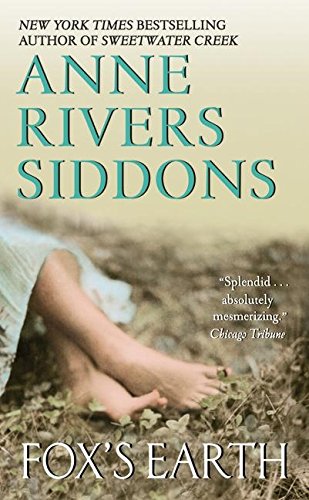
Ruth Yancey was only a small child the first time she saw Fox's Earth, a magnificent three-storied Georgia house that was home to the privileged Fox family. The daughter of a mean, poor mill worker, Ruth vowed that someday she would not only live in such a house, but rule it as her own.
Years later, becoming Ruth Yancey Fox, she does. For decades she will dominate Fox's Earth and its inhabitants with evil manipulation, cruelty, and lies. Until eventually, even she realizes that her secrets will have to come out . . . .
Fox's Earth
By Anne Rivers SiddonsHarperCollins Publishers, Inc.
Copyright © 2005 Anne Rivers Siddons
All right reserved.ISBN: 0061010650Chapter One
By two P.M. they had walked for half and hour, THE man and his family, and the sweat of that sun-blanched September Saturday in 1903 lay sour in waistbands and collars and dampened pale hair and ran rank down thin necks and backs and legs. Pink dust puffed and flew from beneath the wheels of passing wagons and buggies, coating wet skin miserably and mingling with residual traces of cotton lint and waste to catch in the creases of elbows and neck and in hair. The dust was the effluvia of the great brick mill behind them to the south, where they all worked ... all except the small girl and the woman. It had not rained for nearly six weeks, and the small town lay in a near-coma of drought and unrelenting heat.
In the town, in backyards and browning gardens and over fences, the wives of the small merchants and liverymen and smiths and draymen paused over their black-iron washpots, their chicken coops, and their clotheslines. Steaming in closebuttoned, high-collared shirtwaists and long, swathing skirts, viciously bound in viselike, back-laced corsets, they pushed back straggling hair and mopped red faces and sighed to one another.
"Cruel hot, ain't it?" "Will it ever rain?" "Have you got summer sickness at your house? Two of mine are down with it." "Dear Lord, we need rain."
Downtown, their husbands struggled against the relentless pall of dust that lay over their stores and wagons and wares, and hauled water for their stock, and scanned the whitebronze sky a dozen times a day. The bell on the volunteer fire wagon rang frequently, and old Dr. Hopkins's buggy and young Dr. Hopkins's phaeton were seen often on the choking streets. Voices dropped, faces stilled, heads turned slowly when the bell rang and the buggy rolled. With the murderous heat and drought came the threat of the summer murderers: Fire. Typhoid, in stagnant and diminished wells and rain barrels and reservoirs. Infantile paralysis, from no one knew where.
But outside the town, in the rolling pink and green fields, the farmers sweated and stank and stumbled and drank more often from the water wagon ... and smiled.
"Good for the cotton, though, ain't it?" "Cotton looks real good this year. Real good." "Heard in town that cotton might go as high as twelve this fall, maybe higher."
Cotton! In Sparta, and all over the Deep South in that malignant third September of the new century, cotton was once more the lifeblood of the red land. For the first time since the guns of Sumter, in Charleston, tolled the death knell of the great plantations and the slave nation that supported them, southern agriculture was reversing its sickening downward spiral ... or, at least, the descent was becoming markedly less precipitous. And once again it was cotton that fueled the march back to prosperity and former glory. Not cotton in the role it had played before the war, when black backs broke in endless red fields to send the white tide surging north to mills and manufacturers. But cotton in a new role: grown by small farmers on small, poor farms, hauled in their own homemade, iron-wheeled wagons by lean-honed mules into the nearest town, to be sold on marketing day and fed into the maws of the great, forbidding mills that had sprung up across the southern earth like ravenous mushrooms
After the Civil War there had been only a scant handful of crude mills operating in the South; by 1900, four hundred mills bulked dark against the sky. And across the South, more than a quarter of a million of the white tenant farmers and sharecroppers, reduced by poverty of land, purse, and spirit to subsisting at the level of the blacks they despised and, worse, to working side by side with them, had flown for refuge into the mills. Cotton. What was good for cotton was good for the South, and those who damned the heat and drought of early autumn did so in small voices.
Around Sparta, on this late summer afternoon, the roads into town billowed and thundered with a steady stream of mules and white-laden wagons. Farm families sat decorously in large wagons and a few newer buggies, their cotton on the way to market and their purses filled with coins to buy household supplies and a small luxury or two in the shops of town. Saturday. Cotton-market day.
In all the crowd streaming into Sparta that Saturday, only Negroes walked in the dust of the roadside. Negroes and the family of Cater Yancey. None of the families from the rotting, rectilinear mill village owned buggies or wagons, let alone mules to pull them, but there were no other mill families afoot on the road into town that day. They all did their meager shopping at the company commissary, where thinstrung credit could be spun even tauter against the hopelessly small wages that never were enough. The Yanceys alone walked the streets of Sparta, with Cater at their head, his back straight and rigid in the dusty black clawhammer coat he wore, summer and winter, for Sunday preaching and weddings and funerals and town, his blue eyes far-focused and flat with hating. He did not break the long, rolling stride that he had learned on the blue mountains of North Georgia when he took his first steps. Seventy-two hours a week for twentysix years as a spinner in the roaring, radiant hells of two cotton mills had not crushed the long hill stride from his legs nor dimmed the mad blue of his eyes. The cruel, stem God of his Presbyterian ancestry thundered in his head day and night, and the Celtic gods of his ancestral Scotland chanted and howled silently to him of blood and red, sweet pleasures and wild rites in the thin blue air of the Highlands, and both took his tongue in turn on Sundays when he sometimes preached at the unpainted little church in the mill village, when the regular Baptist preacher from town had fatter and sleeker fish to fry.
Continues...Excerpted from Fox's Earthby Anne Rivers Siddons Copyright © 2005 by Anne Rivers Siddons. Excerpted by permission.
All rights reserved. No part of this excerpt may be reproduced or reprinted without permission in writing from the publisher.
Excerpts are provided by Dial-A-Book Inc. solely for the personal use of visitors to this web site.