
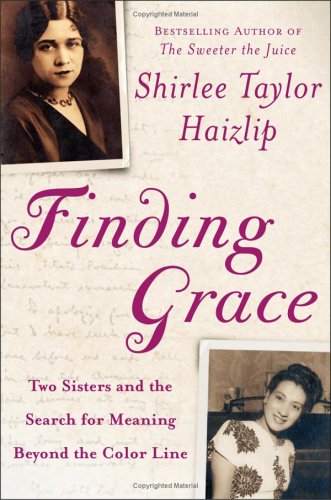
Finding Grace: Two Sisters and the Search for Meaning Beyond the Color Line
Shirlee Taylor Haizlip
ISBN 10: 0743200535 ISBN 13: 9780743200530
Published by Free Press, 2004
Used
hardcover
From
Orion Tech, Kingwood, TX, U.S.A.
Seller rating 5 out of 5 stars

AbeBooks Seller since 18 February 2015
This specific item is no longer available.
About this Item
Description:
Seller Inventory # 0743200535-3-35906554
Synopsis:
In her memoir, The Sweeter the Juice, Shirlee Taylor Haizlip asked us to redefine our concepts of race and family by examining her biracial heritage - how different gradations of dark and light skin led to a split in her mother's nuclear family, and how various relatives have been reunited many years later, some of them previously unaware of their layered racial makeup. In this continuation of her story, Haizlip pushes further into the terrain of family, race, and racial passing. Just over ten years ago, Haizlip's African American mother was reunited with her sister, who had spent her whole life passing for white; both women were in their eighties and had not seen or heard anything about each other since early childhood. Now Haizlip answers the many questions that linger from the previous book: What happened between these long-separated sisters after their reunion? What did they learn about each other, and about themselves? Is it possible to heal the wounds caused by such a rift?
Haizlip contrasts her mother's fulfilling adult life with her aunt's solitary white existence. They lived on opposite sides of the race line, but both women, says Haizlip, were plagued by "America's twin demons: a paranoia about purity and an anxiety about authenticity." These women and other members of the author's extended family come to life in these pages, turning this astute cultural investigation into a highly personal narrative. We learn how Haizlip's mother's abandonment by members of her immediate family affected her daily life; we learn about the lives of relatives who left her behind, and of the members of succeeding generations who knew of the rift, and of those who did not.
After The Sweeter the Juice, Haizlip was flooded by letters in which people shared similar family stories of biracial heritage, passing, and the eventual revelation of an extended racial makeup. She includes some of these letters here, affirming that her own seemingly unusual tale is actually a very familiar, very American story: of the tumultuous, complicated interactions between black and white communities and individuals - interactions marked by fear and distrust, but also by camaraderie, ardor, and love.
Excerpt. © Reprinted by permission. All rights reserved.: Excerpt
Chapter One: A Twice-Told Tale
A Passing Story
In her recently published autobiography, Just Lucky, I Guess, Carol Channing wrote what television promotional spots for a well-watched national show would later tout as "a shocking revelation."
It seems that on the eve of Carol's leaving home to attend Bennington College when she was sixteen, her mother told her that Carol's father had black heritage and had been born in Georgia, rather than in Providence, Rhode Island, as Carol had been led to believe. Her mother shared the information with her, she said, because she wanted Carol to know that she could very well have a child who looked colored.
Carol's paternal grandmother had been a black woman who had a baby with a white man. The baby was light skinned, and the mother fled the state, taking a job as a domestic in Providence. The circumstances of the mother's leaving were not offered, but one could assume that her remaining in the Deep South town with the white man's son was neither prudent nor safe.
At some point, young Channing "crossed over," as the vernacular was then, and passed for white. He attended Brown University on scholarship, served in the First World War as a white man, and returned to have a successful career in journalism. He became a Christian Scientist lecturer on the West Coast as a white man.
As a child, Carol remembers singing with her father songs she thought were hymns but later learned were gospel. Her father, she said, loved music, and the first Broadway show her parents took her to was the all-black production of Green Pastures.
Famed entertainer Ethel Waters became her son's "unofficial" grandmother. One of her best friends and frequent costars on the road was Louis Armstrong, and she appeared in a traveling show with Hines, Hines and Dad, the black family singing-and-dancing act out of which Gregory Hines would emerge a star. She reported that she often went to the Savoy Ballroom in Harlem "to learn the latest steps" and was usually the only white person there. It is clear that Carol Channing had a special affinity for black people.
When CNN television host Larry King asked Channing if her father were black, Channing, looking somewhat perplexed, said, "No, his skin was as white as mine." Like many people in America, Channing paired whiteness with race. In a circuitous few moments, King tried to pin Channing down about her racial history, but she deftly parried his inquiries. She said that she was part of the face of the new America. She admitted to being "proud" of her background and credited it with making her a successful singer and dancer. Demonstrating part of a dance routine, she said that "no white woman could have performed that arabesque" that she danced in the Broadway show Hello, Dolly! Carol included no pictures of her parents, grandmother, or son in her book.
For theater purists and historians, Channing opened a window they did not know existed: She, not Pearl Bailey, had actually been the first black Dolly in the 1960s production.
The Larry King segment suggested that if Channing had shared the story of her heritage early in her career it would have curtailed her future opportunities and she would not have become Carol Channing, the blond icon of Hello, Dolly!, Thoroughly Modern Millie, and Gentlemen Prefer Blondes. With its preference for "traditional casting," the American theater would not have accommodated Carol Channing, no matter how white her skin or skilled her dance steps.
My older sister Mauryne, the same age and coloring as Carol Channing, tried to make it in show business but was relegated to black plays and the black movies called "race films" because she refused to pass. In the few films where she was the female star, my sister looked like a pale white woman, surrounded by brown-skinned men. She played with the famous vaudevillian Flournoy Miller and with Mantan Moreland, who had a long run as the black chauffeur in the Charlie Chan series. Mauryne's forthrightness about her race penalized her and stunted her career.
The Channing revelation and the reaction to it are markers of how American society has changed, being willing to recognize that people other than those designated as black may be "part" this and "part" that. For some, at least, the "one drop of black blood" rule that for hundreds of years dictated on which side of the color line one could stand no longer applies.
I was and still am intrigued by the Channing story and its social implications. I discussed it with many of my white contemporaries. It was if they did not have the vocabulary to articulate their feelings or opinions about this racial shift of a famous person. Mentally, I footnoted the fact that few if any of them had had any kind of personal experience with passing. It was something they all had read about to varying degrees, or remembered from various expositions of the mulatto Julie's role in Show Boat.
One friend, a female, middle-aged producer of plays on Broadway and in regional theater, sort of shrugged her shoulders. "Well, no, Channing would not have gotten the parts she did if it had been known that she was black. Despite the way she looked. You know, the theater then was all about 'traditional casting,' and if you said 'black,' the minds of the directors, producers, and casting people would lock in on some stereotype. Carol would become ten shades darker in their minds." I pressed her. "Well, what can I say? Now, if it had been Elizabeth Taylor..."
On the other hand, "bemused" is how I felt about the casting of the not-quite-swarthy Anthony Hopkins, a white man, to play a black man who was passing for white in the film version of Philip Roth's novel The Human Stain. Hollywood producers found it a compelling enough story to make, but not compelling enough to use a light-skinned black actor in the leading role. It goes without saying that Hollywood was after the buck, and surely Anthony Hopkins, one of the silver screen's most accomplished and best-known luminaries, was a big draw. But still, wouldn't it have been wondrous to put a real, live potential passer in that role? One could argue on the other side, of course, that the producers were making the point that a white actor could indeed pass for a black man. It would seem that, in some circles at least, we have come a long way.
When I was growing up in Connecticut, one of my father's most sophisticated and exquisitely cultured friends was a light-skinned black man who resembled Anthony Hopkins. Having come to Bridgeport with his family from some Southern town, he worked as a high school teacher, although he was qualified to do other things. He was the only one in the family with pass-for-white skin. His wife was brown with curly hair, as were all his handsome children, save one. Each of his sons came to a bad end, two dying of unnatural causes and one in and out of mental institutions. The remaining child, a daughter, became a minister. I surmise now that life for that variegated colored family in the white Connecticut of the '40s must have been complicated.
Then there's the Thomas Jefferson drama, still unfolding. People often ask me how I feel about the reactions of the Jefferson family to the news of their kin of color. First, their story was old news to me. Many black Americans with roots in Washington, D.C., Virginia, or Maryland had grown up with the story, had accepted it as fact, and truly thought little about it. Both my parents told me about it when I was a little girl in the '30s, saying they also knew several other black descendents of various "first families of Virginia." In a certain black set in Washington, people were proud of their connections to the Virginia gentry or to Confederate Civil War heroes. The news was a shock only to white folk.
It is just a matter of time before the entire Jefferson clan will accept the inevitability of their extended family. Annette Gordon-Reed laid out the case of Jefferson's paternity of Sally Hemings's children definitively in her brilliant book Thomas Jefferson and Sally Hemings: An American Controversy. For me, red-haired black people with Jefferson DNA make the argument moot. When I was on my book tour, a descendent of Sally Hemings came out to hear me speak. He later introduced himself to me, and I trembled as I looked into the piercing eyes of Thomas Jefferson that sat above his hooked nose.
Every week, it seems a new revelation colors our white icons. Virginie Amélie Gautreau, the haughty subject of John Singer Sargent's Madame X, painted in 1884 in a strapless black velvet dress, was described as a Creole in Deborah Davis's book Strapless, The portrait, known for its depiction of a red-haired woman with marblelike pale skin, caused a scandal at the time, supposedly, the art historians say, because wearing an off-the-shoulder strap was not a respectable way to appear. And unlike other images of the time, the bareness of the shoulders was without ornamentation or softness. Deborah Davis speculates that Madame Gautreau lost her place in society because of the representation in the painting, which her husband refused to buy. More interesting to me were the accounts of how some believe Madame Gautreau made her skin so white: with a trowel. It was noted that when she bathed in the ocean, the color was not diminished. One wonders if the knowledge of her Creole roots caused people to have uncommon interest in the color of her skin. I have always loved that painting for its beauty and grace. I'm sure I will never look at it again in the same way.
Copyright © 2004 by Shirlee Taylor Haizlip(Continues...)
Excerpted from Finding Graceby Haizlip, Shirlee Excerpted by permission.
All rights reserved. No part of this excerpt may be reproduced or reprinted without permission in writing from the publisher.
Excerpts are provided by Dial-A-Book Inc. solely for the personal use of visitors to this web site.Copyright © 2004 Lionstead Press, Inc.
All right reserved.
"About this title" may belong to another edition of this title.
Bibliographic Details
Title: Finding Grace: Two Sisters and the Search ...
Publisher: Free Press
Publication Date: 2004
Binding: hardcover
Condition: Good
Top Search Results from the AbeBooks Marketplace

Stock Image
Finding Grace: Two Sisters and the Search for Meaning Beyond the Color Line
Seller: More Than Words, Waltham, MA, U.S.A.
Seller rating 5 out of 5 stars
Condition: Like New. Book appears unread. Book is square, clean, and umarked, with crisp pages. Seller Inventory # BOS-U-13e-01336
Stock Image
Finding Grace: Two Sisters and the Search for Meaning Beyond the Color Line
Seller: ThriftBooks-Atlanta, AUSTELL, GA, U.S.A.
Seller rating 5 out of 5 stars
Hardcover. Condition: Good. No Jacket. Former library book; Pages can have notes/highlighting. Spine may show signs of wear. ~ ThriftBooks: Read More, Spend Less. Seller Inventory # G0743200535I3N10
Stock Image
Finding Grace: Two Sisters and the Search for Meaning Beyond the Color Line
Seller: ThriftBooks-Dallas, Dallas, TX, U.S.A.
Seller rating 5 out of 5 stars
Hardcover. Condition: Very Good. No Jacket. May have limited writing in cover pages. Pages are unmarked. ~ ThriftBooks: Read More, Spend Less. Seller Inventory # G0743200535I4N00
Stock Image
Finding Grace: Two Sisters and the Search for Meaning Beyond the Color Line
Seller: ThriftBooks-Atlanta, AUSTELL, GA, U.S.A.
Seller rating 5 out of 5 stars
Hardcover. Condition: Very Good. No Jacket. May have limited writing in cover pages. Pages are unmarked. ~ ThriftBooks: Read More, Spend Less. Seller Inventory # G0743200535I4N00
Stock Image
Finding Grace: Two Sisters and the Search for Meaning Beyond the Color Line
Seller: ThriftBooks-Atlanta, AUSTELL, GA, U.S.A.
Seller rating 5 out of 5 stars
Hardcover. Condition: Good. No Jacket. Pages can have notes/highlighting. Spine may show signs of wear. ~ ThriftBooks: Read More, Spend Less. Seller Inventory # G0743200535I3N00
Stock Image
Finding Grace: Two Sisters and the Search for Meaning Beyond the Color Line
Seller: HPB-Ruby, Dallas, TX, U.S.A.
Seller rating 5 out of 5 stars
hardcover. Condition: Very Good. Connecting readers with great books since 1972! Used books may not include companion materials, and may have some shelf wear or limited writing. We ship orders daily and Customer Service is our top priority! Seller Inventory # S_456067777
Stock Image
Finding Grace: Two Sisters and the Search for Meaning Beyond the Color Line
Seller: HPB Inc., Dallas, TX, U.S.A.
Seller rating 5 out of 5 stars
hardcover. Condition: Very Good. Connecting readers with great books since 1972! Used books may not include companion materials, and may have some shelf wear or limited writing. We ship orders daily and Customer Service is our top priority! Seller Inventory # S_448961075
Stock Image
Finding Grace: Two Sisters and the Search for Meaning Beyond the Color Line
Seller: HPB-Emerald, Dallas, TX, U.S.A.
Seller rating 5 out of 5 stars
hardcover. Condition: Very Good. Connecting readers with great books since 1972! Used books may not include companion materials, and may have some shelf wear or limited writing. We ship orders daily and Customer Service is our top priority! Seller Inventory # S_453526295
Stock Image
Finding Grace
Seller: Better World Books, Mishawaka, IN, U.S.A.
Seller rating 5 out of 5 stars
Condition: Good. Pages intact with minimal writing/highlighting. The binding may be loose and creased. Dust jackets/supplements are not included. Stock photo provided. Product includes identifying sticker. Better World Books: Buy Books. Do Good. Seller Inventory # 807611-6
Stock Image
Finding Grace
Seller: Better World Books, Mishawaka, IN, U.S.A.
Seller rating 5 out of 5 stars
Condition: Very Good. Former library copy. Pages intact with possible writing/highlighting. Binding strong with minor wear. Dust jackets/supplements may not be included. Includes library markings. Stock photo provided. Product includes identifying sticker. Better World Books: Buy Books. Do Good. Seller Inventory # GRP102395839