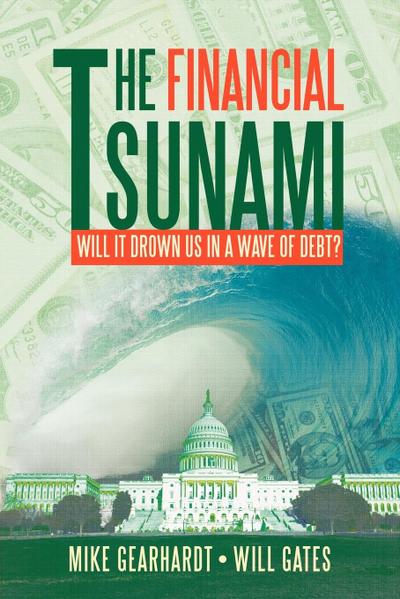
Politicians and the mass media have taken an amorphous view of the financial woes that our nation faces. Frustrated by the lack of facts and political finger pointing Mike Gearhardt and Will Gates felt compelled to research and write The Financial Tsunami. This book offers insightful discussion on what is driving the United State's annual deficits and the national debt to record and unprecedented levels. The Financial Tsunami delves into why the economic problems that our nation faces today are unlike any other financial crisis in the history of America. The book offers a non-political perspective of the fiscal irresponsibility that our country has experienced for the last 40 years. The interrelationships of spending and taxation, is detailed and presented in clear and understandable terms. The book exposes the fallacy in ignoring the $5 trillion intergovernmental debt. The authors detail how intergovernmental debt will become public debt and how it will worsen an already fragile economy. The options that many are advocating to solve our economic problems simply are not feasible and the authors clarify why. How do we survive the tsunami? Mike Gearhardt and Will Gates have developed a well thought out plan to lead our nation toward fiscal responsibility. If there is one book you want to read to understand the economic woes of our nation and what can be done, this is the book.
THE FINANCIAL TSUNAMI
WILL IT DROWN US IN A WAVE OF DEBT?By MIKE GEARHARDT WILL GATESAuthorHouse
Copyright © 2010 Mike Gearhardt and Will Gates
All right reserved.ISBN: 978-1-4520-3909-1Contents
Introduction........................................................................................................................................1The Financial Tsunami We need to act before it's too late!.........................................................................................3Fuzzy Math Is it fuzzy or deceptive?...............................................................................................................9Fiscal Responsibility What does it look like?......................................................................................................15Fiscal Responsibility Has Disappeared Where did it go?.............................................................................................21Recessions Are Inevitable They will happen again and again and again...............................................................................27Affordable Housing and the Housing Crisis A failed government mandate..............................................................................33Cash for Clunkers Was the money well spent?........................................................................................................39The Evolution of Taxes Do higher taxes lead to government expansion, or does government expansion lead to higher taxes?............................43Sources of Revenue Is there really a money tree?...................................................................................................47Who Pays and How Much If 47 million filers didn't pay any taxes in 2007, then who did?.............................................................51Taxes and the Deficit Will increasing taxes eliminate the deficit?.................................................................................57Outlays and Their Impact on the National Debt The government loves to spend our money..............................................................63A Need for Balance and Priority Have we failed to invest, or have we just spent unwisely?..........................................................69On-Budget/Off-Budget Deficits and Surpluses Now you see it; now you don't..........................................................................73Intergovernmental Debt is Really Public Debt You can ignore it, but it is not going away...........................................................77Where Does the Money Go? Our nation has a spending problem!........................................................................................85Social Security Trust Fund The good news is that the SSTF has $27 trillion. The bad news is it is invested in government IOUs......................91Medicare It is in very poor health. Don't call the doctor, because we can't afford one.............................................................97It's Time to Sink or Swim We have the ability to stay afloat, but it will require change and sacrifice.............................................103Appendixes..........................................................................................................................................113Notes...............................................................................................................................................121
Chapter One
THE FINANCIAL TSUNAMI WE NEED TO ACT BEFORE IT'S TOO LATE!
The following chart illustrates that national debt was practically nonexistent prior to 1970. In 2010, it is projected to be $13,786,615,000,000. In five years, it is expected to increase by 43 percent, to almost $20 trillion.
Decades of fiscal irresponsibility due to excessive spending, inconsistent and irrational tax policies, growth in entitlement programs, government intervention into free markets, and inadequate accounting practices threaten to drown our nation's economy under a wave of debt. While the government has failed to take any meaningful actions to address our mounting debt, the magnitude of the problem has been recognized by the U.S. Government Accountability Office (GAO). The following quote from GAO document GAO-09-405SP, Long-Term Fiscal Outlook March 2009, references long-term simulations that show:
Absent policy actions aimed at reforming the key drivers of our structural deficits-health care spending and social security-the federal government faces unsustainable growth in debt. The longer that action to deal with the federal government's long-term fiscal outlook is delayed, the greater the risk that the eventual changes will be disruptive and destabilizing.
"Disruptive and destabilizing"-how much stronger can the statement be? In addition to alerting us to the potential risk, they also identified the key drivers of the problem as health care and Social Security spending. This is not some historical quote taken out of context; it is both current and relevant and is unfortunately being ignored. Certainly no government agency would make such an alarming statement if they did not believe it to be true. This is not a lone department making this comment. Similar comments have been made by other agencies and in other Trustees Reports, including the Social Security Trustees Report. It is unimaginable that more attention isn't being directed toward these issues.
The wave of debt can be as intimidating as the thousands of line items in the federal budget and the amount of dollars the government is forecasting that it will spend. Gaining a basic understanding of the budget process and government accounting is an arduous task. While the full budget detail may be interesting, the simple fact is that Social Security, Medicare and Medicaid, net interest, and defense spending typically account for approximately 65 percent of all federal spending. These four accounts are the focus of this book, as they represent the greatest risk to the future of the nation's economy. An understanding of the current and future spending in these accounts, along with knowledge of government accounting practices and tax policy, is necessary to comprehend just how ominous the nation's financial outlook really is.
2009 Ranking of National Debt-Top Ten Countries
Country National Debt
United States $13,450,000,000,000 United Kingdom $9,088,000,000,000 Germany $5,208,000,000,000 France $5,021,000,000,000 Netherlands $3,733,000,000,000 Spain $2,410,000,000,000 Italy $2,403,500,000,000 Ireland $2,287,000,000,000 Japan $2,132,000,000,000 Luxembourg $1,994,000,000,000
Since the late 1960s, the United States has been a global leader in fiscal irresponsibility as national debt grew from billions to hundreds of billions. In 1982, a new era of debt was ushered in as we crossed the trillion-dollar debt threshold for the first time. In 1986, only four years later, our national debt surpassed the $2 trillion mark. By 1992 it had exceeded $4 trillion; in 2006 it had grown to $8 trillion; and today it is in excess of $13 trillion.
It doesn't stop there. According to President Obama's 2011 budget, released in February 2010, the national debt is expected to be $24.4 trillion by 2019. As a point of reference, the 2010 budget projected the national debt would be $23.1 trillion by 2019. In one year, the debt projection for 2019 grew a whopping $1.3 trillion. This shows the shortcomings of governmental forecasting and just how dramatically the numbers can change.
If the president's estimates prove to be correct, sometime between 2011 and 2012 the size of the federal debt will be greater than the estimated U.S. Gross Domestic Product (GDP). This means that our debt will be greater than the total market value of all goods and services produced in our country in that year. Looking at this from a different perspective, the debt of the United States will approximate the combined GDP of the next three largest economies in the world (China, Japan, and India).
Why should we be concerned now? What's so different today from yesterday? Plenty! This financial tsunami has been growing for decades but has thus far been ignored. Metaphorically, we have been standing on the beach unconcerned because we can't see the gigantic wave of debt about to inundate us, but unquestionably, it is coming.
There are many reasons why we can no longer ignore this financial tsunami. For starters, the debt numbers continue to grow with no end in sight, as evidenced by the president's 2011 budget and Congress's recent increase of the debt ceiling. Another reason for concern is that the government continues to intervene in free-market activities, which have in turn contributed to disruptions and fluctuations in the economy. Bailouts, incentives for consumers, and policy changes are several ways that the government has chosen to intervene in free-market activities. It is not unusual that when problems in free markets arise they are attributed to greed and the opportunity is seized to bash the free-enterprise system. Criticizing banks for causing the housing and subprime crisis was convenient. But the facts show that the government's policies and actions played a significant role and ultimately fueled the collapse of the housing market.
Continuing and growing deficits are another concern. The maturing of Social Security, Lyndon Johnson's Great Society, and years of Ronald Reagan's tax cuts have resulted in our nation borrowing money to fund annual budget deficits. It's similar to paying a home mortgage with a credit card. Incurring additional debt to pay debt just doesn't make sense and only defers the problem.
For most of our nation's history, we experienced budget surpluses. But those days are gone. This growing wave of debt has been building for forty years. Our nation currently projects and budgets for deficits each and every year for at least the next ten years. The ten-year period does not necessarily represent the end of the cycle. It merely represents the duration of the government forecast period. Current government agency reports would indicate that this problem will exist well beyond the ten-year forecast period and may exist for several more decades. The deficits are not funding an economic crisis or war, although these are certainly contributors, but instead are funding programs that artificially support our standard of living. We cannot remain a world leader if we continue on this reckless path.
At the current $13 trillion level, the U.S. national debt equates to $42,000 for every citizen in the country-not every taxpayer, but every citizen. This means that every child born in the United States at the time this book was written was born with $42,000 of debt. No wonder they issue Social Security numbers to infants.
In addition to the $13.8 trillion of national debt, the nation has amassed an unfunded liability that amounts to approximately $70 trillion. This unfunded liability represents the future benefits for Social Security and Medicare. The corresponding projected funding to support these benefits is inadequate to meet the outlays. The difference between the two is the unfunded liability. Why don't we hear more about this? It has to do with the inadequate accounting practices used by the U.S. government.
No one will knock on your door to collect the debt, but it is taxpayer debt that is in the form of U.S. Treasury obligations. We are all going to have to pay the debt with taxes at some point. As a nation, we can't continue to borrow indefinitely, and the magnitude of these numbers should absolutely terrify every citizen of this nation. The continued growth of national debt will encumber future generations, leaving our children and grandchildren to pay for the tremendous financial burden that we have created in less than forty years.
Why is the debt continuing to grow? The reasons are many. Entitlement programs, such as Social Security, Medicaid, and Medicare, that perpetuate increases in spending are just beginning to come of age and will cause outlays to soar in coming years. Many of the programs, in particular Social Security and Medicare, were initiated to provide a safety net for an aging population. As baby boomers access these programs, participation will grow from current levels of fifty-one million to seventy-seven million by 2025, which is more than a 50 percent increase in participation. Many other programs (i.e., Medicare Part D, the subsidized prescription drug program) have been implemented and expanded during periods of rapid economic growth under the assumption that the growth would continue indefinitely. As the debt escalates, the government will have to increase taxes, borrow more, and/or cut spending.
Although future revenue increases will be necessary, caution must be taken to avoid suppressing economic growth. Relying on taxes alone will have a negative effect on economic growth. Increases in taxes reduce the funds available for investment, and reduced investment results in fewer jobs being created. Fewer jobs result in reduced tax revenue, and the government once again will have to increase taxes to generate the same level of revenue. There is only so much money available in an economy. The more the government takes out via taxes, the less there is for investment and, by extension, jobs.
While taxes and spending ran amuck, an inadequate accounting system failed to track the growing liabilities associated with future outlays. The federal government uses a cash accounting system, which is essentially a "pay as you go" system and does not account for known future and past liabilities until they are paid. As a result, liabilities continue to grow with little or no recognition. Under the "pay as you go" system, by the time unfunded growth is recognized, it is already out of control. It is the growth in these unfunded future liabilities, similar to a giant earthquake at the floor of the ocean, that will amplify the financial tsunami. An example of the magnitude of unfunded liabilities is found in the 2009 Board of Trustees of the Federal Hospital Insurance and Federal Supplementary Medical Insurance Trust Funds Report (HI), wherein the board acknowledges that the fund has an estimated unfunded obligation of $36.4 trillion. The report states, "In other words, increases in revenues and/or reductions in benefit expenditures-equivalent to a lump-sum amount today of more than $13 trillion-would be required to bring the HI trust fund into long-range financial balance." It continues, "Extending the calculations beyond 2083 adds $23.0 trillion in unfunded obligations to the amount estimated through 2083."
The problem is growing. The longer we wait to take action, the more drastic the actions will have to be.
FUZZYMATH
IS IT FUZZY OR DECEPTIVE?
Many found the "fuzzy math" reference by presidential candidate George W. Bush in 2000 to be somewhat humorous and shrugged it off, assuming that he was just avoiding a question or being inept. Some believed that he did not have a firm grasp of the issues and chose to jokingly sidestep the question. As we have come to learn, his reference was more truthful than humorous as he saw the problem for what it was. Today, the United States is experiencing "fuzzy math" that can no longer be joked about and ignored. In the face of continuing record deficits, admonishments from trading partners about the magnitude of our nation's debt, high unemployment, and crises in banking, manufacturing, real estate, and elsewhere, the time has come to remove the haze from around the "fuzzy math" and understand what is behind the numbers.
Many of us are functionally illiterate when it comes to understanding the federal government's budget numbers, which range in the trillions of dollars. "Fuzzy math" is the result of this lack of understanding and/or apathy about the financial condition of our nation. Let's look at an example that will help put the federal debt into some perspective.
Suppose you have an insatiable appetite to spend and want to go on a shopping spree with the objective of spending $1,000 per minute. How long would it take to spend the current federal debt of $13,800,000,000,000?
Spending per minute $1,000 Dollars spent per hour $60,000 Dollars spent per day $1,440,000 Dollars spent per year $525,600,000 $13.8 trillion divided by $525.6 million 26,255 years
As the numbers show, it would take 26,255 years to spend the federal debt. That would be quite a shopping spree both in size and duration.
Citizens are not the only ones who need a better understanding of the budget math. It would appear that many of those elected to Congress and other public offices also need to be better educated in the area of budget math and numbers in general. Go to YouTube and listen to Nancy Pelosi's stimulus package speech. On January 24, 2009, prior to passage of the package, she stated, "Every month we don't pass this package, 500 million will lose their jobs."
Talk about not understanding the numbers. There are only 310 million people in the United States, and about 45 percent of those are in the workforce, which means the U.S. workforce in totality is approximately 140 million people. This comment was made by the Speaker of the House, the third-highest elected office in our nation, and was aired on all the networks and thus became a source of "fact" for many. This simple misstated fact was repeated in the news, online, and in conversations. The problem is that such misstatements, if left uncorrected, become facts by default. Often it is these "facts" that are used by those who support or oppose an issue. We accept them as facts since we are hearing them from supposedly reliable sources. While the Speaker's supporters were quick to note that her statement was a mathematical slipup, it was never actually corrected.
If we want to have a strong nation that is recognized as a world leader and capable of protecting and providing for its citizens, our country must learn to live within its means. Programs shouldn't be created or endorsed unless it can be shown that they can be funded. If we can't afford a program, it should be modified or discontinued. Americans need to identify and rally around a systematic long-term plan that will allow our nation to rid itself of the mounting deficits that threaten the way of life for both current and future generations. If we fall into the same short-term thinking as the people of Greece, whose citizens have rioted, burned buildings, called strikes, and protested over increases in taxes and spending reductions, we will have missed the opportunity to persuade our leaders to develop meaningful solutions to our mounting economic problems. Our nation would then suffer a fate similar to other economically irresponsible countries that have failed to develop solutions to remedy their problems. Our nation's creditors will dictate the levels of our spending and taxes just as the European Union (EU) is now dictating the future of Greece's. We would then no longer be an independent and free nation.
(Continues...)
Excerpted from THE FINANCIAL TSUNAMIby MIKE GEARHARDT WILL GATES Copyright © 2010 by Mike Gearhardt and Will Gates. Excerpted by permission.
All rights reserved. No part of this excerpt may be reproduced or reprinted without permission in writing from the publisher.
Excerpts are provided by Dial-A-Book Inc. solely for the personal use of visitors to this web site.