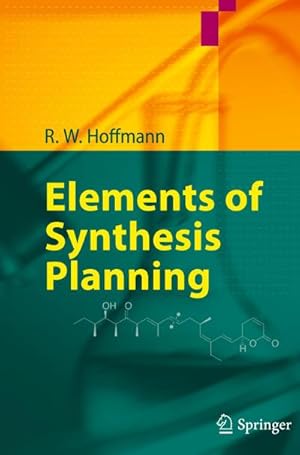
Elements of Synthesis Planning
R. W. Hoffmann
Sold by BuchWeltWeit Ludwig Meier e.K., Bergisch Gladbach, Germany
AbeBooks Seller since 11 January 2012
New - Soft cover
Condition: New
Ships from Germany to U.S.A.
Quantity: 2 available
Add to basketSold by BuchWeltWeit Ludwig Meier e.K., Bergisch Gladbach, Germany
AbeBooks Seller since 11 January 2012
Condition: New
Quantity: 2 available
Add to basketThis item is printed on demand - it takes 3-4 days longer - Neuware -Synthesis is at the core of organic chemistry. In order for compounds to be studied-be it as drugs, materials, or because of their physical properties- they have to be prepared, often in multistep synthetic sequences. Thus, the target compound is at the outset of synthesis planning. Synthesis involves creating the target compound from smaller, readily available building blocks. Immediately, questions arise: From which bui- ing blocks In which sequence By which reactions Nature creates many highly complex 'natural products' via reaction cascades, in which an asso- ment of starting compounds present within the cell is transformed by speci c (for each target structure) combinations of modular enzymes in speci c - quences into the target compounds [1, 2]. To mimic this ef ciency is the dream of an ideal synthesis [2]. However, we are at present so far from - alising such a 'one-pot' operation that actual synthesis has to be achieved via a sequence of individual discrete steps. Thus, we are left with the task of planning each synthesis individually in an optimal fashion. Synthesis planning must be conducted with regard for certain speci - tions, some of which are due to the structure of the target molecule, and some of which relate to external parameters such as costs, environmental compatibility, or novelty. We will not consider these external aspects in this context. Planning of a synthesis is based on a pool of information regarding chemical reactions that can be executed reliably and in high chemical yield. 240 pp. Englisch.
Seller Inventory # 9783540792192
This concise text focuses on the basic considerations that govern the planning and execution of a synthesis. The author details synthetic strategies, provides criteria for ranking different synthesis plans, and provides guidelines for optimizing syntheses.
From the reviews:
“The text is recommended for those with a strong foundation in organic chemistry. ... The book would be quite helpful for those who plan syntheses on a regular basis ... . The text is a useful addition to the library of any synthetic organic chemist or to select undergraduate and graduate curricula. ... Readers will certainly learn more about the chemistry, the logic, and the art of planning a novel synthesis and contributing to a vast and interesting field.” (Bridget G. Trogden, Journal of Chemical Education, Vol. 88, 2011)
From an undergraduate learning perspective the concept of synthesis planning or retrosynthesis can appear to be a daunting prospect. The idea of being asked to think backwards for many is a big leap, despite the vast majority already possessing a well-stocked chemical toolbox and being more than capable to explain a multitude of complex mechanistic transformations. In Elements of synthesis planning, a reworked translation of his original German text, Reinhard Hoffmann sets out to 'demystify' the art of synthetic planning, which is an essential and vital skill practised every day throughout the worldwide organic chemistry community.
In 12 clear and logical chapters, Hoffmann takes the reader from the basic concepts of retrosynthesis (use of synthons, identifying key bond disconnections, unmasking symmetry elements etc) to dedicated chapters on the application of chiral building blocks, strategic planning of complex synthetic sequences and the synthesis of polycyclic ring systems. In the final chapter, all these concepts are brought together to elegantly compare several individual approaches to one of five representative natural products, highlighting the tactics and strategies employed.
As such, this text would ideally complement an advanced undergraduate course on complex organic synthesis, which is beyond the level of most standard organic chemistry textbooks. It would also prove highly useful to postgraduates at the beginning of their research careers in synthesis to inspire creativity and maybe put their ideas into practice.
Gordon Florence , Chemistry World, 2009, 6(8), p. 63
"About this title" may belong to another edition of this title.
Allgemeine Geschäftsbedingungen mit Kundeninformationen
Inhaltsverzeichnis
Geltungsbereich
Vertragsschluss
Widerrufsrecht
Preise und Zahlungsbedingungen
Liefer- und Versandbedingungen
Eigentumsvorbehalt
Mängelhaftung
Anwendbares Recht
Gerichtsstand
Alternative Streitbeilegung
If you are a consumer you can withdraw from the contract in accordance with the following. Consumer means any natural person who is acting for purposes which are outside his trade, business, craft or profession.
Information regarding the right of withdrawal
Statutory right to withdraw
You have the right to withdraw from this contract within 14 days without giving any reason.
The withdrawal period will expire after 14 days from the day on which you acquire, or a third party other than the carrier and indicated by you acquires, physical possession of the last good or the last lot or piece.
To exercise the right of withdrawal, electronically fill in and submit a clear statement on our website, under "My Purchases" in "My Account". We will communicate to you an acknowledgement of receipt of such a withdrawal on a durable medium (e.g. by e-mail) without delay.
To meet the withdrawal deadline, it is sufficient for you to send your communication concerning your exercise of the right of withdrawal before the withdrawal period has expired.
Effects of withdrawal
If you withdraw from this contract, we will reimburse to you all payments received from you, including the costs of delivery (except for the supplementary costs arising if you chose a type of delivery other than the least expensive type of standard delivery offered by us).
We may make a deduction from the reimbursement for loss in value of any goods supplied, if the loss is the result of unnecessary handling by you.
We will make the reimbursement without undue delay, and not later than 14 days after the day on which we are informed about your decision to withdraw from this contract.
We will make the reimbursement using the same means of payment as you used for the initial transaction, unless you have expressly agreed otherwise; in any event, you will not incur any fees as a result of such reimbursement.
We may withhold reimbursement until we have received the goods back, or you have supplied evidence of having sent back the goods, whichever is the earliest.
You shall send back the goods or hand them over to BuchWeltWeit Ludwig Meier e.K., Bergisch Gladbach, Germany, without undue delay and in any event not later than 14 days from the day on which you communicate your withdrawal from this contract to us. The deadline is met if you send back the goods before the period of 14 days has expired. You will have to bear the direct cost of returning the goods. You are only liable for any diminished value of the goods resulting from the handling other than what is necessary to establish the nature, characteristics and functioning of the goods.
Exceptions to the right of withdrawal
The right of withdrawal does not apply to:
Der Versand ins Ausland findet IMMER mit DHL statt. Auch nach Österreich verschicken wir nur mit DHL! Daher Standardversand == Luftpost!
| Order quantity | 5 to 15 business days | 5 to 15 business days |
|---|---|---|
| First item | £ 19.71 | £ 19.71 |
Delivery times are set by sellers and vary by carrier and location. Orders passing through Customs may face delays and buyers are responsible for any associated duties or fees. Sellers may contact you regarding additional charges to cover any increased costs to ship your items.