THE EPISTLES OF CLIO AND STREPHON, being a collection of letters that passed between an English lady, and an English gentleman in France, who took an affection to each other, by reading accidentally one another's occasional compositions both in prose and verse.
Published by London: printed for J. Hooke at the Flower-de-Luce in Fleet-street; F. Gyles against Gray's-Inn Gate in Holborn and W. Boreham at the Angel in Pater-Noster Row, 1720
- Used

Seller: Christopher Edwards ABA ILAB, Henley-on-Thames, Oxon, United KingdomChristopher Edwards ABA ILAB
AbeBooks seller since January 6, 2000
Condition: Used
£ 1,100.00
Quantity: 1 available
Add to basketItem description from seller
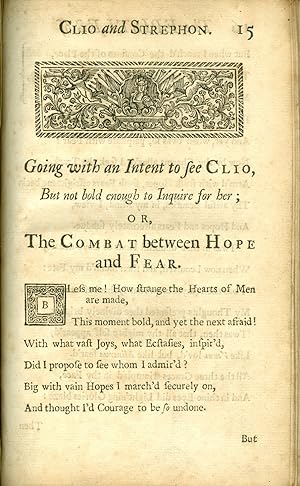
8vo, pp. lxviii, 131; title page short at foredge, and somewhat darkened; occasional browning throughout; in contemporary sheep, rebacked. Esher bookplate. First edition, first issue. This is the principal work of the writer Martha Fowke (d. 1736), written in collaboration with the journalist and poet William Bond (d. 1735). Fowke came from an established Staffordshire family but both her parents died before she was twenty, and she must have been resilient as she then moved to London to live with friends, and began to make a name for herself as a writer. Her biographer in ODNB is quite circumspect about her 'friendships', but Lonsdale is much more specific: 'although she describes these relationships evasively, she evidently became the mistress of several of her suitors, probably including the Duke of Beaufort and later the Duke of Rutland'. Shortly after this book was published, she made an unhappy marriage to a much older man called Arnold Sansom, with whom she had probably already lived for some time. The element of coercion (her brother is said to have urged the match) may have been present because of this book, whose frankness might have seemed compromising for a family with pretensions to gentility. The correspondence consists of 27 letters, five of them in prose but the rest in verse, each answering the other. The titles of many of the epistles are sometimes very specific, if not necessarily very informative: 'Going with an intent to see Clio, but not bold enough to inquire for her; or, the Combat between Hope and Fear' (p. 15); or 'To Strephon; in answer to the foregoing letter, which was kept a whole month by a lady, to whom the care of it was intrusted, before it was delivered to Clio' (p. 35); and 'To Clio, who just after she tells me she give me leave to love, which she expresses in the finest of verses, tells me in a letter just after that she's going to a brother in Spain' (p. 77). Some of Bond's verse is quite racy, as when (p. 73) he imagines finding her 'Sleeping on her Grassy Bed', and stealing a kiss from her 'blushing Lips', but for the most part the talk is of platonic love and the meeting of souls rather than bodies. At one point, Clio is due to go to Spain to see her brother: Thomas Fowke rose high in the army and eventually became Governor of Gibraltar. Both she and Strephon visit France, although at different times one of his letters is dated from Paris, 'Monday Four of Clock in the Afternoon; Sick in Bed' (p. 109). The book is prefaced by a very long dedication to Sir Richard Steele by 'the editor', who was quite possibly Bond himself there is more about Steele and Fowke than about the male half of the collaboration. Steele had apparently met Fowke and had 'often expressed, in several Companies, the singular Value and Esteem you have for her extraordinary Wit'. This is followed by an exceptionally interesting 'critical essay', full of praise for the poems, more than forty pages long, by one John Porter. Fowke was also much admired by Richard Savage and Aaron Hill; but she had sailed too close to the wind, morally speaking, and Eliza Haywood seems to have found her an inviting target for opprobrium, calling her 'Gloatitia' and accusing her of bringing three illegitimate children to her marriage. Fowke's autobiography was not published until 1752, after Aaron Hill's death. For all her talents, and the admiration her poetry attracted at the time, she is surprisingly little known today. See Foxon p. 282; and Lonsdale, Eighteenth-century Women Poets, pp. 84-5. This first edition is found in two issues: the second issue has a cancel title page with the same imprint, but undated. The collection was reprinted 1729 for the same bookseller (reissued in 1732 under another title), and in 1729 Edmund Curll also published what must be a much abridged edition, a 12mo of only 36pp. ESTC locates just twelve copies of both issues of this first edition.…
Seller Inventory # 23288
Bibliographic details
- Title
- THE EPISTLES OF CLIO AND STREPHON, being a collection of letters that passed between an English lady, and an English gentleman in France, who took an affection to each other, by reading accidentally one another's occasional compositions both in prose and verse.
- Author
- [FOWKE, Martha, and William BOND.]
- Publisher
- London: printed for J. Hooke at the Flower-de-Luce in Fleet-street; F. Gyles against Gray's-Inn Gate in Holborn and W. Boreham at the Angel in Pater-Noster Row
- Publication year
- 1720
- Seller catalogs
- Poetry
Christopher Edwards ABA ILAB
Henley-on-Thames, Oxon, United Kingdom
Shipping rates from United Kingdom to U.S.A.
| Item | 14 to 45 business days | 5 to 10 business days |
|---|---|---|
| First item | £ 4.10 | £ 8.85 |
Payment methods
- Money Order
Specialty
English literature, British history, Early continental booksAssociation member
Members of these associations are committed to maintaining the highest standards. They vouch for the authenticity of all items offered for sale. They provide expert and detailed descriptions, disclose all significant defects and/or restorations, provide clear and accurate pricing, and operate with fairness and honesty during the purchase experience.Seller's business information
Christopher Edwards ABA ILAB
United Kingdom
Terms of sale
Usual ABA terms: prices net; postage extra; return within
reasonable time for any reason
Right of withdrawal
If you are a consumer you can withdraw from the contract in accordance with the following. Consumer means any natural person who is acting for purposes which are outside his trade, business, craft or profession.
Information regarding the right of withdrawal
Statutory right to withdraw
You have the right to withdraw from this contract within 14 days without giving any reason.
The withdrawal period will expire after 14 days from the day on which you acquire, or a third party other than the carrier and indicated by you acquires, physical possession of the last good or the last lot or piece.
To exercise the right of withdrawal, electronically fill in and submit a clear statement on our website, under "My Purchases" in "My Account". We will communicate to you an acknowledgement of receipt of such a withdrawal on a durable medium (e.g. by e-mail) without delay.
To meet the withdrawal deadline, it is sufficient for you to send your communication concerning your exercise of the right of withdrawal before the withdrawal period has expired.
Effects of withdrawal
If you withdraw from this contract, we will reimburse to you all payments received from you, including the costs of delivery (except for the supplementary costs arising if you chose a type of delivery other than the least expensive type of standard delivery offered by us).
We may make a deduction from the reimbursement for loss in value of any goods supplied, if the loss is the result of unnecessary handling by you.
We will make the reimbursement without undue delay, and not later than 14 days after the day on which we are informed about your decision to withdraw from this contract.
We will make the reimbursement using the same means of payment as you used for the initial transaction, unless you have expressly agreed otherwise; in any event, you will not incur any fees as a result of such reimbursement.
We may withhold reimbursement until we have received the goods back, or you have supplied evidence of having sent back the goods, whichever is the earliest.
You shall send back the goods or hand them over to Christopher Edwards ABA ILAB, Henley-on-Thames, Oxon, United Kingdom, +44 1491 637701, without undue delay and in any event not later than 14 days from the day on which you communicate your withdrawal from this contract to us. The deadline is met if you send back the goods before the period of 14 days has expired. You will have to bear the direct cost of returning the goods. You are only liable for any diminished value of the goods resulting from the handling other than what is necessary to establish the nature, characteristics and functioning of the goods.
Exceptions to the right of withdrawal
The right of withdrawal does not apply to:
- The delivery of newspapers, journals or magazines with the exception of subscription contracts; and
- The supply of digital content which is not supplied on a tangible medium (e.g. on a CD or DVD) if you accepted when you placed your order that we could start to deliver it, and that you could not withdraw once delivery had started.
Shipping terms
Shipping costs are based on books weighing 2.2 LB, or 1 KG. If your book order is heavy or oversized, we may contact you to let you know extra shipping is required.