.
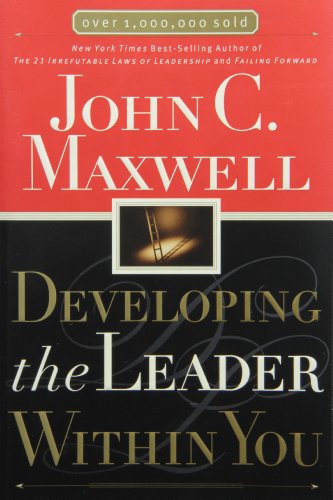
Developing the Leader Within You
By John C. MaxwellThomas Nelson
Copyright © 1993 John C. Maxwell
All right reserved.ISBN: 978-0-7852-6666-2Contents
Introduction.......................................................................vii1. The Definition of Leadership: Influence.........................................12. The Key to Leadership: Priorities...............................................193. The Most Important Ingredient of Leadership: Integrity..........................354. The Ultimate Test of Leadership: Creating Positive Change.......................495. The Quickest Way to Gain Leadership: Problem Solving............................756. The Extra Plus in Leadership: Attitude..........................................977. Developing Your Most Appreciable Asset: People..................................1158. The Indispensable Quality of Leadership: Vision.................................1399. The Price Tag of Leadership: Self-Discipline....................................16110. The Most Important Lesson of Leadership: Staff Development.....................179Epilogue...........................................................................201Notes..............................................................................203About the Author...................................................................208
Chapter One
The Definition of Leadership:
Influence
Everyone talks about it; few understand it. Most people want it; few achieve it. There are over fifty definitions and descriptions of it in my personal files. What is this intriguing subject we call "leadership"?
Perhaps because most of us want to be leaders, we become emotionally involved when trying to define leadership. Or, perhaps because we know one, we try to copy his or her behavior and describe leadership as a personality. Ask ten people to define leadership and you'll probably receive ten different answers. After more than five decades of observing leadership within my family and many years of developing my own leadership potential, I have come to this conclusion: Leadership is influence. That's it. Nothing more; nothing less. My favorite leadership proverb is: He who thinketh he leadeth and hath no one following him is only taking a walk.
James C. Georges, of the ParTraining Corporation, said it quite effectively in a recent interview with Executive Communications:
What is leadership? Remove for a moment the moral issues behind it, and there is only one definition: Leadership is the ability to obtain followers.
Hitler was a leader and so was Jim Jones. Jesus of Nazareth, Martin Luther King, Jr., Winston Churchill, and John F. Kennedy all were leaders. While their value systems and management abilities were very different, each had followers. Once you define leadership as the ability to get followers, you work backward from that point of reference to figure out how to lead.
Therein lies the problem. Most people define leadership as the ability to achieve a position, not to get followers. Therefore, they go after a position, rank, or title and, upon their arrival, think they have become a leader. This type of thinking creates two common problems: Those who possess the "status" of leader often experience the frustration of few followers, and those who lack the proper titles may not see themselves as leaders and therefore don't develop their leadership skills.
My goal with this book is to help you accept leadership as influence (that is, the ability to get followers), and then work backward from that point to help you learn how to lead. Each chapter is designed to place in your hand another principle that will assist your leadership development. This first chapter is designed to expand the level of your influence.
Insights About Influence
Everyone Influences Someone
Sociologists tell us that even the most introverted individual will influence ten thousand other people during his or her lifetime! This amazing statistic was shared with me by my associate Tim Elmore. Tim and I concluded that each one of us is both influencing and being influenced by others. That means that all of us are leading in some areas, while in other areas we are being led. No one is excluded from being a leader or a follower. Realizing your potential as a leader is your responsibility. In any given situation with any given group, there is a prominent influencer. Let me illustrate. The mother may be the dominant influencer over a child in the morning before school begins. Mom may choose what to eat and what to wear. The child who is influenced before school may become the influencer of other children once school begins. Dad and Mom may meet at a restaurant for lunch and both be influenced by the waiter, who suggests the house specialty. The time dinner is served in the evening may be set because of either the husband's or wife's work schedule.
The prominent leader of any group is quite easily discovered. Just observe the people as they gather. If an issue is to be decided, who is the person whose opinion seems most valuable? Who is the one others watch the most when the issue is being discussed? Who is the one with whom people quickly agree? Most importantly, who is the one the others follow? Answers to these questions will help you discern who the real leader is in a particular group.
We Never Know Who or How Much We Influence The most effective way to understand the power of influence is to think of the times you have been touched by the influence of a person or an event. Big events leave marks on all our lives and memories. For example, ask a couple of people born prior to 1930 what they were doing when they heard that Pearl Harbor had been bombed, and they will describe in detail their feelings and surroundings when they heard the terrible news. Ask someone born before 1955 to describe what he or she was doing when the news that John F. Kennedy had been shot was broadcast. Again, you will find no loss for words. A similar response occurs with the younger generation when asked about the day the Challenger blew up. These were big events that touched everyone.
Think also of the little things or people who influenced you in a powerful way. In reflecting on my own life, I think of the influence of a camp I attended as a youth and how it helped determine my career choice. I think of my seventh-grade teacher, Glen Leatherwood ... the bubble lights on our Christmas tree that gave me the "Christmas feeling" every year ... the affirming note I received from a professor in college ... The list is endless. Life consists of influencers who daily find us vulnerable to their impressions and, therefore, have helped mold us into the persons we are. J. R. Miller said it well: "There have been meetings of only a moment which have left impressions for life, for eternity. No one can understand that mysterious thing we call influence ... yet ... everyone of us continually exerts influence, either to heal, to bless, to leave marks of beauty; or to wound, to hurt, to poison, to stain other lives."
This truth also sobers me when I realize my influence as a father. A friend gave me a plaque with this poem on it. Now it sits on my desk:
The Little Chap Who Follows Me A careful man I want to be, A little fellow follows me; I do not dare to go astray For fear he'll go the self-same way. I cannot once escape his eyes. Whate'er he sees me do he tries. Like ME he says he's going to be- That little chap who follows me. I must remember as I go Through summer suns and winter snows, I am building for the years to be- That little chap who follows me.
The Best Investment in the Future Is a Proper Influence Today
The issue is not whether you influence someone. What needs to be settled is what kind of an influencer you will be. Will you grow into your leadership skills? In the book Leaders, Bennis and Nanus say, "The truth is that leadership opportunities are plentiful and within reach of most people."
You must believe that! The rest of this chapter is committed to helping you make a difference tomorrow by becoming a better leader today.
Influence Is a Skill That Can Be Developed
Robert Dilenschneider, the CEO of Hill and Knowlton, a worldwide public relations agency, is one of the nation's major influence brokers. He skillfully weaves his persuasive magic in the global arena, where governments and megacorporations meet. He wrote a book entitled Power and Influence, in which he shares the idea of the "power triangle" to help leaders get ahead. He says, "The three components of this triangle are communication, recognition, and influence. You start to communicate effectively. This leads to recognition and recognition in turn leads to influence."
We can increase our influence and our leadership potential. Out of this conviction I have developed a teaching tool to assist others in understanding their levels of leadership so they can increase their levels of influence (see chart on page 13).
THE FIVE LEVELS OF LEADERSHIP
Level 1: Position
This is the basic entry level of leadership. The only influence you have is that which comes with a title. People who stay at this level get into territorial rights, protocol, tradition, and organizational charts. These things are not negative unless they become the basis for authority and influence, but they are poor substitutes for leadership skills.
A person may be "in control" because he has been appointed to a position. In that position he may have authority. But real leadership is more than having authority; it is more than having the technical training and following the proper procedures. Real leadership is being the person others will gladly and confidently follow. A real leader knows the difference between being the boss and being a leader, as illustrated by the following:
The boss drives his workers; the leader coaches them.
The boss depends on authority; the leader on goodwill.
The boss inspires fear; the leader inspires enthusiasm.
The boss says "I"; the leader, "we."
The boss fixes the blame for the breakdown; the leader fixes the breakdown.
The boss knows how it is done; the leader shows how.
The boss says, "Go"; the leader says, "Let's go!"
Characteristics of a "Positional Leader"
Security is based on title, not talent. The story is told of a private in World War I who shouted on the battlefield, "Put out that match!" only to find to his chagrin that the offender was General "Black Jack" Pershing. When the private, who feared severe punishment, tried to stammer out his apology, General Pershing patted him on the back and said, "That's all right, son. Just be glad I'm not a second lieutenant." The point should be clear. The higher the person's level of true ability and the resulting influence, the more secure and confident he becomes.
This level is often gained by appointment. All other levels are gained by ability. Leo Durocher was coaching at first base in an exhibition game the Giants were playing at West Point. One noisy cadet kept shouting at Leo and doing his best to upset him.
"Hey, Durocher," he hollered. "How did a little squirt like you get into the major leagues?"
Leo shouted back, "My congressman appointed me!"
People will not follow a positional leader beyond his stated authority. They will only do what they have to do when they are required to do it. Low morale is always present. When the leader lacks confidence, the followers lack commitment. They are like the little boy who was asked by Billy Graham how to find the nearest post office. When the lad told him, Dr. Graham thanked him and said, "If you'll come to the convention center this evening, you can hear me telling everyone how to get to heaven."
"I don't think I'll be there," the boy replied. "You don't even know your way to the post office."
Positional leaders have more difficulty working with volunteers, white-collar workers, and younger people. Volunteers don't have to work in the organization, so there is no monetary leverage that a positional leader can use to make them respond. White-collar workers are used to participating in decision-making and resent dictatorial leadership. Baby boomers in particular are unimpressed with symbols of authority.
Most of us have been taught that leadership is a position. Frustration rises within us when we get out into the real world and find that few people follow us because of our titles. Our joy and success in leading others depend on our abilities to keep climbing the levels of leadership.
Level 2: Permission
Fred Smith says, "Leadership is getting people to work for you when they are not obligated." That will only happen when you climb to the second level of influence. People don't care how much you know until they know how much you care. Leadership begins with the heart, not the head. It flourishes with a meaningful relationship, not more regulation.
Leaders on the "position" level often lead by intimidation. They are like the chickens that Norwegian psychologist T. Schjelderup-Ebbe studied in developing the "pecking order" principle that today is used to describe all types of social gatherings.
Schjelderup-Ebbe found that in any flock one hen usually dominates all the others. She can peck any other without being pecked in return. Second comes a hen that pecks all but the top hen, and the rest are arranged in descending hierarchy, ending in one hapless hen that is pecked by all and can peck no one.
In contrast to this a person on the "permission" level will lead by interrelationships. The agenda is not the pecking order but people development. On this level, time, energy, and focus are placed on the individual's needs and desires. A wonderful illustration of why it's so critical to put people and their needs first is found in the story of Henry Ford in Amitai Etzioni's book, Modern Organizations:
He made a perfect car, the Model T, that ended the need for any other car. He was totally product-oriented. He wanted to fill the world with Model T cars. But when people started coming to him and saying, "Mr. Ford, we'd like a different color car," he remarked, "You can have any color you want as long as it's black." And that's when the decline started.
People who are unable to build solid, lasting relationships will soon discover that they are unable to sustain long, effective leadership. (Chapter 7 of this book, "Developing Your Most Appreciable Asset: People," will deal more extensively with this subject.) Needless to say, you can love people without leading them, but you cannot lead people without loving them.
One day one of my staff members, Dan Reiland, shared an insight with me that I have never forgotten: "If level 1, Position, is the door to leadership, then level 2, Permission, is the foundation."
Caution! Don't try to skip a level. The most often skipped level is 2, Permission. For example, a husband goes from level 1, Position, a wedding day title, to level 3, Production. He becomes a great provider for the family, but in the process he neglects the essential relationships that hold a family together. The family disintegrates, and so does the husband's business. Relationships involve a process that provides the glue and much of the staying power for long-term, consistent production.
Level 3: Production
On this level things begin to happen, good things. Profit increases. Morale is high. Turnover is low. Needs are being met. Goals are being realized. Accompanying this growth is the "big mo"-momentum. Leading and influencing others is fun. Problems are solved with minimum effort. Fresh statistics are shared on a regular basis with the people who undergird the growth of the organization. Everyone is results-oriented. In fact, results are the main reason for the activity.
This is a major difference between levels 2 and 3. On the "relationship" level, people get together just to get together. There is no other objective. On the "results" level, people come together to accomplish a purpose. They like to get together to get together, but they love to get together to accomplish something. In other words, they are results-oriented.
They are like a character played by Jack Nicholson, who, while in a restaurant in a famous scene from the movie Five Easy Pieces, is told he cannot get a side order of toast. He comes up with an imaginative solution. First, he orders a chicken salad sandwich on toast. Then he instructs the waitress: "No mayonnaise, but butter ... and hold the chicken."
One of my favorite stories is about a newly hired traveling salesman who sent his first sales report to the home office. It stunned the brass in the sales department because it was obvious that the new salesman was ignorant! This is what he wrote: "I seen this outfit which they ain't never bot a dim's worth of nothin from us and I sole them some goods. I'm now goin to Chicawgo."
Before the man could be given the heave-ho by the sales manager, along came this letter from Chicago: "I cum hear and sole them haff a millyon."
(Continues...)
Excerpted from Developing the Leader Within Youby John C. Maxwell Copyright © 1993 by John C. Maxwell. Excerpted by permission.
All rights reserved. No part of this excerpt may be reproduced or reprinted without permission in writing from the publisher.
Excerpts are provided by Dial-A-Book Inc. solely for the personal use of visitors to this web site.