
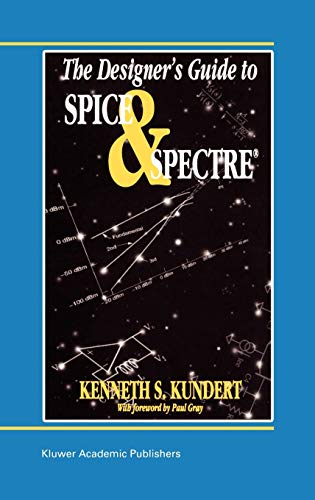
The Designerâ s Guide to Spice and Spectre® (The Designer's Guide Book Series)
Kundert, Ken
ISBN 10: 0792395719 ISBN 13: 9780792395713
Published by Springer (edition 1995), 1995
Used
Hardcover
From
BooksRun, Philadelphia, PA, U.S.A.
Seller rating 5 out of 5 stars

AbeBooks Seller since 2 February 2016
This specific item is no longer available.
About this Item
Description:
It's a well-cared-for item that has seen limited use. The item may show minor signs of wear. All the text is legible, with all pages included. It may have slight markings and/or highlighting. Seller Inventory # 0792395719-11-1
Synopsis:
Engineering productivity in integrated circuit product design and - velopment today is limited largely by the effectiveness of the CAD tools used. For those domains of product design that are highly dependent on transistor-level circuit design and optimization, such as high-speed logic and memory, mixed-signal analog-digital int- faces, RF functions, power integrated circuits, and so forth, circuit simulation is perhaps the single most important tool. As the complexity and performance of integrated electronic systems has increased with scaling of technology feature size, the capabilities and sophistication of the underlying circuit simulation tools have correspondingly increased. The absolute size of circuits requiring transistor-level simulation has increased dramatically, creating not only problems of computing power resources but also problems of task organization, complexity management, output representation, initial condition setup, and so forth. Also, as circuits of more c- plexity and mixed types of functionality are attacked with simu- tion, the spread between time constants or event time scales within the circuit has tended to become wider, requiring new strategies in simulators to deal with large time constant spreads.
Synopsis: "The Designer's Guide to SPICE and Spectre" is an in-depth guide to circuit simulators from a designer's perspective: the pitfalls of circuit simulation, such as convergence and accuracy problems, are explained in terms a circuit designer is comfortable with. This book gives designers insight into why these problems occur and how to avoid them. It also provides practical advice on how to make many difficult measurements with a circuit simulator, such as loop gain of an op-amp or distortion measurements of such clocked circuits as d-to-a converters and sample-and-hold circuits. Finally, suggestions are given about how to handle difficult classes of circuits, such as oscillators, charge-storage or very large circuits.After reading "The Designer's Guide to SPICE and Spectre", you will spend less time fighting your simulator and more time exploring, understanding and designing your circuits. It's intended audience: It is written for practising analog and mixed-signal circuit designers who are already familiar with the basics of operating SPICE.
Useful for anyone who uses a circuit simulator, no matter which, since the focus is on the fundamental characteristics and behaviour of circuit simulators in general.
"About this title" may belong to another edition of this title.
Bibliographic Details
Title: The Designerâ s Guide to Spice and SpectreÂ...
Publisher: Springer (edition 1995)
Publication Date: 1995
Binding: Hardcover
Condition: Very Good
Edition: 1995.