
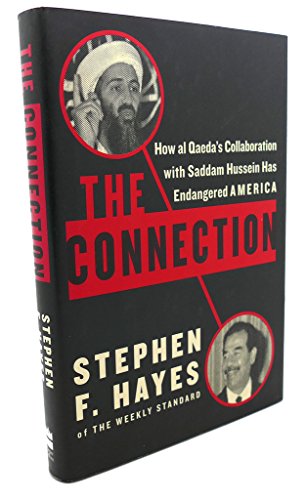
The Connection: How al Qaeda's Collaboration with Saddam Hussein Has Endangered America
Hayes, Stephen F.
ISBN 10: 0060746734 ISBN 13: 9780060746735
Published by HarperCollins, 2004
Used
Hardcover
From
World of Books (was SecondSale), Montgomery, IL, U.S.A.
Seller rating 5 out of 5 stars

AbeBooks Seller since 20 December 2007
This specific item is no longer available.
About this Item
Description:
Good condition ex-library book with usual library markings and stickers. Seller Inventory # 00048416036
Synopsis:
In the wake of 9/11 no one knew when the next attack would come, or where it would come from. America's enemies seemed gathered on all sides, and for several nerve-racking months, we lived in fear that the perpetrators might be plotting another action or, worse, that our most dangerous enemies -- al Qaeda and Saddam Hussein's murderous regime in Iraq -- could be banding together against us.
The Bush administration and CIA director George Tenet warned against complacency and pointed to growing indications that al Qaeda and Iraq were in league. But their case was undercut by unnamed intelligence officials, skeptical politicians, and a compliant media. So America relaxed. A comforting consensus settled in: Osama bin Laden was an impassioned fundamentalist, Saddam a secular autocrat. The two would never, could never, work together. ABC News reported that there was no connection between them, and the New York Times said so too, and pretty soon just about everyone agreed.
Just about everyone was wrong.
In The Connection, Stephen Hayes draws on CIA debriefings, top-secret memos from our national intelligence agencies, and interviews with Iraqi military leaders and Washington insiders to demonstrate that Saddam and bin Laden not only could work together, they did -- a curious relationship that stretches back more than a decade and may include collaboration on terrorist acts, chemical-weapons training, and sheltering some of the world's most wanted radicals.
Stephen Hayes's bombshell Weekly Standard piece on this topic was cited by Vice President Cheney as the "best source of information" about the Saddam-al Qaeda connections. Now Hayes delves even deeper, exposing the inner workings of America's deadliest opponents and providing a clear-eyed corrective to reams of underreported, politicized, and just plain wrong information.
The Connection is both a gripping snapshot of the War on Terror and a case study in how bureaucratic assumptions and media arrogance can put us all at risk.
Excerpt. © Reprinted by permission. All rights reserved.:
The Connection
How Al Qaeda's Collaboration with Saddam Hussein Has Endangered AmericaBy Hayes, Stephen F.HarperCollins Publishers
ISBN: 0060746734Chapter One
Case Open:
Who is Ahmed Hikmat Shakir?
In August 2000, Ahmed Hikmat Shakir, a thirty-seven-year-oldIraqi, quietly began his job as a "greeter" at the Kuala LumpurInternational Airport in Malaysia. The job, a common one inSoutheast Asia and the Middle East, normally involves littlemore than welcoming visiting dignitaries and making certainthat they move smoothly through the laborious entry process.
But Shakir was not a typical greeter. Although he was nominallyemployed by Malaysian Airlines, he had told associateshe had been hired by a contact in the Iraqi embassy. More important,it was his embassy contact, not his employer, whotold him when to report and when to take days off. So whenthe Iraqi embassy contact instructed him to report to work onJanuary 5, 2000, Shakir dutifully obliged. His assignment thatday would later make him the subject of an international manhuntand a suspect in the worst single act of terrorism onAmerican soil.
The events of that day and those that followed provide thegovernment's strongest suggestion that Saddam and al Qaedamay have worked together on September 11. The evidence is far from conclusive, but it cannot be dismissed. Those eventsare also an unfortunate example of the difficulty of maintainingeffective liaison relationships between American and foreignintelligence services, and of how, even in the monthsfollowing the worst intelligence failure in American history,dangerous terrorists were allowed to walk away from theircramped holding cells as free men.
In late December 1999, the Central Intelligence Agency, theNational Security Agency, and the State Department all receivedintelligence about a meeting of al Qaeda?associated terroriststo take place in Malaysia in early January of the nextyear. The NSA had intercepted communications from individualstied to the 1998 al Qaeda attacks on U.S. embassies inKenya and Tanzania. Although the information was incomplete,the intercepts picked up three first names: Khalid,Nawaf, and Salem.
The CIA, on high alert for potential attacks on millenniumcelebrations, immediately sent word to operatives around theworld to track the would-be terrorists. On December 31, 1999,CIA officials in Pakistan cabled to headquarters that they"were following the situation." Nawaf was in Pakistan andKhalid was in Yemen. The CIA determined that they plannedto meet in Kuala Lumpur, Malaysia, arriving on January 4,2000, and established an operation -- to be conducted jointlywith Malaysian intelligence -- to monitor the comings and goingsof the men. CIA officials assumed the meeting was calledto plan attacks in Southeast Asia.
That same day, the CIA obtained a photocopy of the passportbelonging to one of the suspected participants, Khalid alMihdhar. Although al Mihdhar, a Saudi citizen, was known to have connections to al Qaeda and the Yemeni mujahideen, hewas not yet on any terrorist watch lists on April 7, 1999, whenthe U.S. consulate in Jidda, Saudi Arabia, had given him a oneyearvisa granting him multiple-entry privilege to the UnitedStates.
The intelligence on Nawaf al Hazmi, at that point knownonly by his first name, was sketchier. The CIA determined thathe was scheduled to leave Karachi, Pakistan, for Malaysia onJanuary 4, 2000. In fact, he had departed two days earlier.
On January 5, 2000, officials at CIA headquarters in Langley,Virginia, sent a dispatch to operatives around the worldthat "we need to continue the effort to identify these travelersand their activities ... to determine if there is any true threatposed." Information about the meeting was included in the alQaeda?related intelligence given to the most senior officials inthe U.S. government. On at least two occasions, the director ofthe CIA's al Qaeda unit gave briefings to his superiors aboutthe meeting.
Khalid al Mihdhar, a thin, dark-haired man with a slightlycrooked face, arrived at the Kuala Lumpur International Airporton January 5. The airport is an architectural wonder -- aglass-enclosed tribute to modernity that attracts even touristswho arrive elsewhere in the Malaysian capital. The marblefloors are buffed constantly, producing a surface so shiny, it'spossible to catch a glimpse of yourself simply by looking down.Round white beams shoot like three-dimensional spiderwebsfrom the floor to the unfinished ceiling, and Western storessuch as the Tie Rack line the halls of the main terminal.
Ahmed Hikmat Shakir, the Iraqi greeter, met al Mihdharshortly after he deplaned and escorted him through the bureaucratic entry procedures. Malaysian authorities photographedthe arrival.
When they had finished the paperwork, Shakir walked alMihdhar to a waiting car, much as any facilitator would. Butthen, rather than bidding his VIP good-bye and returning towork, Shakir jumped in the car and accompanied al Mihdhar toa condominium owned by Yazid Sufaat, an American-educatedal Qaeda associate, where he was once again photographed byMalaysian intelligence. The Kuala Lumpur condo would serveas the site of a three-day meeting that the CIA later concludedwas the main planning session for the October 12, 2000,bombing of the USS Cole and for the attacks of September 11,2001. It is not yet known whether Shakir took an active part inthe meeting, but he was certainly in fast company. The FBI believesas many as nine top al Qaeda terrorists attended themeeting, including Ramzi bin al Shibh, who later boasted to ajournalist of his role as "coordinator of the Holy Tuesday operation" -- the September 11 attacks.
The meeting ended on January 8, 2000, when three of theparticipants -- Khalid al Mihdhar, Nawaf al Hazmi, and Khalladbin Attash -- left Kuala Lumpur for Bangkok, Thailand. Ofthe three, the CIA was still able to identify only al Mihdhar byhis full name. CIA officials in Kuala Lumpur notified theircounterparts in Thailand and asked them to pick up the surveillance,and the agency's Langley, Virginia, headquarters sentan urgent cable the next day with the same instructions. Thesemessages came too late; the al Qaeda suspects had disappearedinto the busy streets of Bangkok ...
Continues...Excerpted from The Connectionby Hayes, Stephen F. Excerpted by permission.
All rights reserved. No part of this excerpt may be reproduced or reprinted without permission in writing from the publisher.
Excerpts are provided by Dial-A-Book Inc. solely for the personal use of visitors to this web site.
"About this title" may belong to another edition of this title.
Bibliographic Details
Title: The Connection: How al Qaeda's Collaboration...
Publisher: HarperCollins
Publication Date: 2004
Binding: Hardcover
Condition: Good