
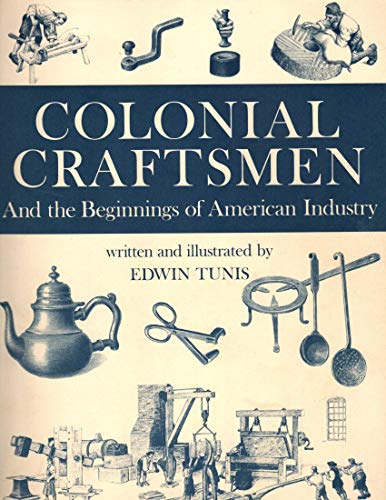
Colonial Craftsmen
Tunis, Edwin
ISBN 10: 0801862280 ISBN 13: 9780801862281
Published by Johns Hopkins University Press, 1999
Used
Paperback
From
ThriftBooks-Atlanta, AUSTELL, GA, U.S.A.
Seller rating 5 out of 5 stars

AbeBooks Seller since 24 March 2009
This specific item is no longer available.
About this Item
Description:
Pages can have notes/highlighting. Spine may show signs of wear. ~ ThriftBooks: Read More, Spend Less. Seller Inventory # G0801862280I3N00
Synopsis:
The vanished ways of colonial America's skilled craftsmen are vividly reconstructed in this superb book by Edwin Tunis. With incomparable wit and learning, and in over 450 meticulous drawings, the author describes the working methods and products, houses and shops, town and country trades, and individual and group enterprises by which the early Americans forged the economy of the New World. In the tiny coastal settlements, which usually sprang up around a mill or near a tanyard, the first craftsmen set up their trades. The blacksmith, cooper, joiner, weaver, cordwainer, and housewright, working alone or with several assistants, invented their own tools and devised their own methods. Soon they were making products that far surpassed their early models: the American ax was so popular that English ironmongers often labeled their own axes "American" to sell them more readily. In the town squares a colonist could have his bread baked to order, bring in his wig to be curled, have his eyeglasses ground, his medicine prescription filled, or buy snuff for his many pocket boxes. With the thriving trade in "bespoke" or made-to-order work, fine American styles evolved; many of these are priceless heirlooms now-the silverware of Paul Revere and John Coney, redware and Queensware pottery, Poyntell hand-blocked wallpaper, the Kentucky rifle, Conestoga wagon, and the iron grillework still seen in some parts of the South. The author discusses in detail many of the trades which have since developed into important industries, like papermaking, glassmaking, shipbuilding, printing, and metalworking, often reconstructing from his own careful research the complex equipment used in these enterprises. The ingenious, liberty-loving artisans left few written records of their work, and only Mr. Tunis, with his painstaking attention to authentic detail and his vast knowledge, could present such a complete treasury of the way things were done before machines obliterated this phase of early American life.
About the Author: Edwin Tunis (1897–1973) was born in Cold Spring Harbor, New York, and spent much of his life in Maryland. A well-known artist, illustrator, and muralist, his work appeared at the Baltimore Museum of Art, the Society of American Etchers, the National Academy of Design, and the Victoria and Albert Museum. His other books include Colonial Craftsmen; Colonial Living; Weapons; Oars, Sails and Steam; and The Tavern at the Ferry, all available in paperback from Johns Hopkins.
"About this title" may belong to another edition of this title.
Bibliographic Details
Title: Colonial Craftsmen
Publisher: Johns Hopkins University Press
Publication Date: 1999
Binding: Paperback
Condition: Good
Dust Jacket Condition: No Jacket