
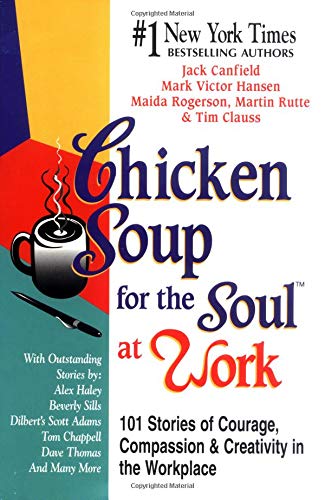
Chicken Soup for the Soul at Work: 101 Stories of Courage, Compassion & Creativity in the Workplace
Rutte, Martin,Clauss, Tim
ISBN 10: 1558744304 ISBN 13: 9781558744301
Published by Hci, 1996
Used
hardcover
From
Half Price Books Inc., Dallas, TX, U.S.A.
Seller rating 5 out of 5 stars

AbeBooks Seller since 15 September 2017
This specific item is no longer available.
About this Item
Description:
Connecting readers with great books since 1972! Used books may not include companion materials, and may have some shelf wear or limited writing. We ship orders daily and Customer Service is our top priority! Seller Inventory # S_442925957
Synopsis:
Work is an important part of living, whether you wait on customers, build a business or cook for your family. As such, we all have important stories to tell about our work. From this rich treasure chest of experiences, Canfield, Hansen and company have gathered a special collection of inspiring tales that share the daily courage, compassion and creativity that take place in workplaces everywhere.
Chicken Soup for the Soul at Work will nourish your spirit with stories of courageous leaders and will foster your creativity with examples of inspiring breakthroughs. It will also teach you how to enrich yourself and your coworkers through heartfelt acknowledgment.
This powerful book gives you new options, new ways to succeed and, above all, a new love and appreciation for yourself, your job and those around you. Share it with your mentor, coworkers or staff, and enjoy renewed joy and pleasure in your chosen vocation.
Special stories by Dilbert's Scott Adams, Beverly Sills, Dave Thomas and many more make this collection complete.
Excerpt. © Reprinted by permission. All rights reserved.:
Chicken Soup for the Soul at Work
By Jack CanfieldHCI
Copyright © 1996 Jack CanfieldAll right reserved.
ISBN: 9781558744301
The Whale Story
Celebrate what you want to see more of
—Tom Peters
Have you ever wondered how the whale and porpoise trainers at Sea World get Shamu, the 19,000-pound whale, to jump 22 feet out of the water and perform tricks? They get that whale to go over a rope farther out of the water than most of us can imagine. This is a great challenge—as great as the ones you and I face as parents, coaches or managers.
Can you imagine the typical American managerial approach to this situation? The first thing we would do would be to get that rope right up there at 22 feet—no sense celebrating shortcomings. We call that goal-setting, or strategic planning. With the goal clearly defined, we now have to figure out a way to motivate the whale. So we take a bucket of fish and put it right above that 22-foot rope—dont pay the whale unless it performs. Then we have to give direction. We lean over from our nice high and dry perch and say, Jump, whale!
And the whale stays right where it is.
So how do the trainers at Sea World do it? Their number one priority is to reinforce the behavior that they want repeated—in this case, to get the whale or porpoise to go over the rope. They influence the environment every way they can so that it supports the principle of making sure that the whale cant fail. They start with the rope below the surface of the water, in a position where the whale cant help but do whats expected of it. Every time the whale goes over the rope, it gets positive reinforcement. It gets fed fish, patted, played with, and most important, it gets that reinforcement.
But what happens when the whale goes under the rope? Nothing—no electric shock, no constructive criticism, no developmental feedback and no warnings in the personnel file. Whales are taught that their negative behavior will not be acknowledged.
Positive reinforcement is the cornerstone of that simple principle that produces such spectacular results. And as the whale begins to go over the rope more often than under, the trainers begin to raise the rope. It must be raised slowly enough so that the whale doesnt starve, either physically or emotionally.
The simple lesson to be learned from the whale trainers is to over-celebrate. Make a big deal out of the good and little stuff that we want consistently. Secondly, under-criticize. People know when they screw up. What they need is help. If we under-criticize, punish and discipline less than is expected, people will not forget the event and usually will not repeat it.
In my opinion, most successful businesses today are doing things right more than 95 percent of the time. Yet what do we spend the majority of our time giving feedback on? Thats right&151the 2, 3, 4, maybe even the 5 percent of things that we dont want repeated and didnt want to happen in the first place.
We need to set up the circumstances so that people cant fail. Over-celebrate, under-criticizeand know how far to raise the rope.
Charles A. Coonradt
1996 Charles A. Coonradt. All rights reserved. Reprinted from Chicken Soup for the Soul at Work; by Jack Canfield, Mark Victor Hansen, Maida Rogerson, Martin Rutte and Tim Clauss. No part of this publication may be reproduced, stored in a retrieval system or transmitted in any form or by any means, without the written permission of the publisher. Publisher: Health Communications, Inc., 3201 SW 15th Street, Deerfield Beach, FL 33442.
Continues...
Excerpted from Chicken Soup for the Soul at Work by Jack Canfield Copyright © 1996 by Jack Canfield. Excerpted by permission.
All rights reserved. No part of this excerpt may be reproduced or reprinted without permission in writing from the publisher.
Excerpts are provided by Dial-A-Book Inc. solely for the personal use of visitors to this web site.
"About this title" may belong to another edition of this title.
Bibliographic Details
Title: Chicken Soup for the Soul at Work: 101 ...
Publisher: Hci
Publication Date: 1996
Binding: hardcover
Condition: Very Good