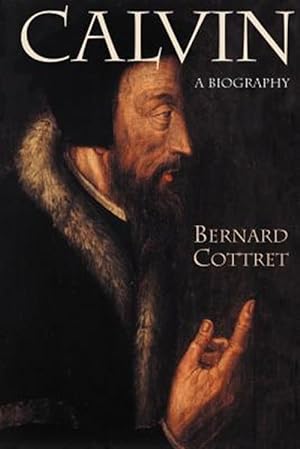
"Modesty, softness, and mildness"-such was John Calvin, in his own words. This brief self-portrait will surprise posterity, quick as it is to detect in Calvin a deeply passionate man of zealous action. Calvin adds elsewhere: "I acknowledge myself to be timid, soft, and cowardly by nature." He repeated the same idea feelingly on the eve of his death, calling himself "timid" and "fearful" before an astounded group of pastors who knew by experience that the old fellow could raise up storms. These various descriptions of Calvin strongly underline the vigor of a character that owed all its energy to God alone. At the same time, the apparent contradictions within Calvin's personality make it hard to capture his true nature. The large number of biographies attempted to date attest to this fact, many of which simply picture Calvin as a rigid fundamentalist or as a totalitarian who ruled Geneva with an iron hand. Such interpretations, however, are much too one-dimensional. This sterling new biography by Bernard Cottret opts for a Calvin "in movement," thus distinguishing itself from works that present Calvin as a man of relatively static character. The aim of this book is simply to recover the truth, or rather to reclaim the intelligibility of a man in his time. This is a historian's Calvin, the work of a university professor who is neither a theologian nor an ordained minister. Cottret's welcome approach sheds new light on the great Reformer's personality by concentrating on the milieu in which Calvin did his life's work. In the largest part of the book, Cottret explores Calvin's life chronologically. We are introduced to the world into which Calvin was born, a Europe in the throes of upheaval owing to the development of the printing press and divergent religious views. We follow Calvin from his birth and childhood in Noyon to his school years in Paris. We accompany Calvin on his humanistic and literary pursuits in Basel, his early ministry in Geneva, and his halcyon Strasbourg years. Finally, we move again to Geneva, where the brunt of Calvin's serious-and better known-life was lived. Along the way we encounter the major issues of Calvin's day-the sacrifice of the Mass, iconoclasm, predestination, the Arianism of Michael Servetus-issues to which he reacted with all his religious emotion. We tarry with him in Geneva and get an up-close look at the governance of Calvinism's "holy city." And we share in Calvin's joys and sorrows through a reading of his prolific correspondence. In the final chapters, Cottret explores thematic aspects of Calvin's persona-Calvin the polemicist, the preacher, and the writer-and looks in greater depth at his foremost work, the Institutes of the Christian Religion. Widely acclaimed in its French edition, this balanced and beautifully written biography will take its place among the best-and most enjoyable-portraits of Calvin's life, work, and lasting influence.
Calvin
A BiographyBy Bernard CottretWm. B. Eerdmans Publishing Company
Copyright © 2000 Bernard Cottret
All right reserved.ISBN: 9780802831590
Chapter One
The Heavens at a Birth: July 10, 1509
Although the stars do not speak, even in being silent they cry out.
JOHN CALVIN
July 10, 1509: "The disposition of the stars in this figure shows that this person should be endowed with good qualities, but that they should be accompanied by several evil characteristics."
F. DE RAEMOND, 1605
Calvin's life was more secular than it seems. The Reformer never aroused theslightest personality cult among his entourage. Theodore Beza, who succeededhim in Geneva, described him with admiration certainly, but without excessiveadulation, never sacrificing to the golden legend. As a friend of the dead man,he did not hesitate to celebrate his eminent role as the "champion" of God or toblacken his adversaries. For Beza Calvin was indeed the scourge of all heresies:"There will be found no heresy ancient or revived, or newly founded in ourtime, which he did not destroy down to its foundations." But his zeal was temperedby the recognition of the faults of the departed. "I do not want to make aman into an angel," he confides in his Life of Calvin, which appeared somemonths after the Reformer's passing. Yes, Calvin was hot tempered and obstinate,"gloomy and difficult." Beza describes the great man's birth with a carefulsobriety: "He was born in Noyon, an ancient and famous town of Picardy, in1509, on July 10, of a respectable family of middle rank. His father was namedGirard Calvin, a man of good understanding and judgment, and therefore ingreat demand in the houses of the neighboring nobility."
This is an "emblematic" sentence, "similar to those which open all biographies."In the second version of Calvin's life, completed by Nicolas Colladon, thesubject is treated laconically: "Let us be satisfied that, God wanting to be servedby him at a certain time, He brought him into the world on the stated day." Heclearly wanted to avoid interpreting Calvin's admittedly unique destiny in termsof the stars: "I will therefore commence with his birth, which was on the tenth dayof July of the year 1509 ? which I note, not in order to search out in his horoscopethe causes of the events of his life, much less the excellent virtues found inhim, but simply from regard for history. And indeed, considering that he himselfhad such a horror of the abuses of judicial astrology ... it would be doing himwrong to give rein to such speculations regarding his character."
Thus is "judicial astrology" rejected, which in our day is called simply astrology,those predictions which claim to use the position of the stars to forecastthe future. The future, according to Calvin, depended only on man himself, or atleast on man listening to God. His first admiring biographers likewise foundthemselves confronted with a particularly arduous task: while maintaining theexceptional, indeed providential character of Calvin's life, they had to reject thetechniques used in the cult of saints or the legends of secular heroes. The biographyof Calvin revived an ancient genre, the lives of illustrious men. It was locatedat the necessarily difficult intersection between the biography of a saint and thecelebration of a great man. A great man, moreover, is not a lay saint; his privatevirtues are less significant than his collective importance. From this perspectiveCalvin's precise influence is difficult to disentangle with accuracy; apart from theimpact of his theological work, which is absolutely undeniable, his effect on thesociety of his time, and in particular on Geneva, is the subject of constant reevaluation.Did these biographers manage in the end to avoid the snare of hagiography?Already in 1567, in a new edition, some accompanying words stated thatCalvin's life was that of "a great servant of God," and added that it concerned "aholy man whom Our Lord has received into his glory." The description alreadysmells of the incense of canonization ? all the more because of pious mention ofthe "falsity of all that the Devil has vomited through his henchmen against thememory" of Calvin. Neither Calvin nor Beza was responsible for these excesses;the refusal of a tomb that can be visited sufficiently marks the Calvinist determinationto nip in the bud any temptation to create a cult of saints. No, Calvin fortunatelysmelled the sulfur too plainly to lend himself to the use of the reliquary.
From the side of his adversaries, Jérôme Bolsec insisted on Calvin's Picardorigins, calling him "John Calvin of Noyon, a man among all others who wereever in the world ambitious, presumptuous, arrogant, cruel, malicious, vengeful,and above all ignorant." But regarding the birth itself, he remained reticent:"Of his birth in the town of Noyon, in Picardy, in the year 1509, I will saynothing more." Bolsec preferred to enlarge on two subjects: John's father, GirardCauvin, who had been "a most execrable blasphemer of God," and his son,the well-known Reformer, who had been "surprised in or convicted of the sinof sodomy" and branded with a hot iron, in lieu of being burned at the stake ashe seemingly deserved. The highly polemical, indeed frankly hateful text ofBolsec contents itself with inverting the traditional saints' lives: "Bolsec saysnothing about Calvin's horoscope, but there are found in him the three pivotalthemes of the entire controversy: Calvin's debauched youth and judicial branding,the botched resurrection, and the death `while invoking the devils'; thesethree facts constitute in essentials ... the reversed pattern of a saint's life."
Astrology, on the other hand, later provided a magistrate of Bordeaux,Florimond de Raemond, with weighty arguments when he attempted at the beginningof the seventeenth century to explain the "birth of heresy": "This man,who was the author of so many evils, was born at Noyon in Picardy on July 10,1509, an unfortunate day, being the birthday of our prolonged miseries."
Raemond thus described the ill-omened Calvin's map of the sky: "First,Saturn in the house of the Virgin shows that he would be a man of eminentlearning, but learning badly based.... Mercury, in the house of the sun, promisedhim a strong memory, and the ability to put things down well in writing ...since although Mercury was combust, this would not prevent him from havingthis good quality, which was also promised him by the heart of the Lion, locateddue south, the heart being the seat of understanding and prudence...."
These excellent qualities were unfortunately squandered. If in fact his co-religionariessaw in him, according to Raemond, a "second Saint Paul" the "Scorpionin the ascendant" decided that he could not "hold rank and station in thetrue church." It was a pity. The saint and the heretic maintain a state of kinshipin Raemond's work; the defender of Satan and the friend of God, good and evilapproach and recede from each other in a complementary relationship within thesecret network of convergences traced by the stars. It is written in the heavens.
Raemond clearly feared that evil thoughts would be imputed to him inturn. Astrology cannot substitute for Providence: "I am not however one ofthose who wish curiously to subject our destinies, our fortunes, and our birthto celestial influences, knowing well that the church, our mistress and conductress,reproves and condemns these opinions."
God is the competitor of the stars. The God of Calvin, more than anyother, broke with the pretensions of "judicial astrology." In 1549 the Reformerexplained: "There has been for a long time a foolish desire to judge everythingthat may happen to men by the stars, and to inquire there and take counsel concerningwhat one should do."
This rejection shows its importance when compared to the tremendous"astrological anxiety" that marked the sixteenth century. No golden legendexisted for the life of Calvin. The destiny of the Reformer took on none of thetraits of the marvelous proper to the lives of saints. It entailed nothing miraculous? just the intimate sense of a calling which came to assume a sacredcharacter. In the end Calvinist hagiography remained limited. Thus the pastorCharles Drelincourt, in the seventeenth century, despite the admiration, indeedthe veneration that the personality of Calvin inspired in him, concluded hisstudy in measured terms by calling the Reformer "A great man, whom God inspiredextraordinarily for the illustration of his truth."
Calvin's vocation was certainly "extraordinary" ? under the theologian'spen the word carries a very strong sense. The "extraordinary" providence ofGod, without being equivalent to a miracle, which is accorded, often and nodoubt wrongly, a spectacular quality, perceptibly approaches it. The "extraordinary"character of a vocation or an event ? this is a miracle without prodigy orspectacle, the direct intervention of God in the course of history.
Calvin's vocation, his intimate sense of a mission which surpassed inimportance the common destiny of men, was therefore not accompanied byany visible stigma. The outcome of this evolution is clearly found in the workof François Guizot in the nineteenth century. The former Protestant ministerof Louis-Philippe had a plan at the end of his life for an illuminatingtetralogy. Besides Calvin, his Lives of Four Great French Christians in the beginningwould have included Saint Louis, Duplessis-Mornay, and Vincent dePaul. Guizot's Calvin apparently lacked warmth; he aroused "admiration"more than "sympathy." Could the laicization of his personality be betterdemonstrated?
Noyon, Provincial Homeland
John Calvin's attachment to his native town of Noyon appears undeniable;the mature man reserved for it the name of "homeland," patria in his Latincorrespondence. In November 1552, learning of the destruction of his townby the Spaniards, he let his bitterness appear: "I have outlived my country,something I could never have believed. The town where I was born has beenentirely destroyed by fire." Some years later, learning of the sack of Saint-Quentin,he unburdened himself similarly in a letter to Melanchthon:"Hardly a day's march separates this town from Noyon.... If the news that isspread is correct, this will be the second time that I will outlive my country"(September 1557).
Calvin, who was saddened on hearing in his Genevan refuge of the ravagesfalling on his Picard homeland, was not at all a rootless man. The cosmopolitanismof his thought and the international character of his enterpriseharked back in him to a French passion: the taste for universality, that utopia ofclarity and transparency that found in his language its point of attachment.Down to the end Calvin remained a man of a native soil, and of a childhood ? ofwhich we know practically nothing because of his reticence. The religioustroubles, the Protestant desacralization of places, and finally the instinctive resistancethis secretive character felt to writing about himself partly explain thisaloofness. It was not until 1888 that anyone devoted a book to the Reformer'syouth. This gospel of youth, despite patches of shadow and certain inaccuracies,depended on documentation that has in part disappeared, destroyed bythe ravages of the First World War.
The nineteenth century returned his psychological depth to Calvin by invokinganew, under cover of historical accuracy, a disavowed spirit of locale. In1897 an article, at once modest and erudite, was published in the Bulletin del'Société l'Histoire du Protestantisme Français entitled "The House Where CalvinWas Born, in Noyon." It undertook to show that a "portion of the house wherehe saw the light survives." From then on it was permissible to meditate:"Thanks to this one can contemplate at least a few points in the family horizonto which the eyes of the child John Calvin were accustomed, and climb thesame steps that he must often have climbed and descended."
The house where Calvin was born, restored in the twentieth century afterthe terrible suffering of the Great War, enables us to realize the Reformer's attachmentto his town. The family home was located in the parish of Sainte-Godeberte.It was by the grain market, between the Rue des Porcelets and theRue Fromentière. The grain market was, along with the cathedral, one of thenerve centers of the episcopal city, divided between its ecclesiastical vocationand its bourgeois aspirations. The important agricultural market of Noyonprovided an outlet for the villages of the Santerre through the Oise Valley. ButNoyon, episcopal seat of the Vermandois, also played a significant administrativerole in the secular world. "Merchants were numerous in Noyon, more orless powerful according to the guild to which they belonged. Outstanding inimportance were the grain merchants who ruled over the wheat market and themerchants of wool and linen. A notable position was also held by the tannersand tawers established on the banks of the Verse and the Versette." YoungJean Cauvin was baptized on July 10 at Sainte-Godeberte. His godfather, Jeandes Vatines, was a canon of the cathedral.
The name "Calvin" is a later corruption of "Cauvin," derived from theLatin "Calvinus." The Cauvin family was of modest origin, a family of Picardwatermen and artisans, for whom the windings of the Oise formed the entirehorizon. The family's anchorage had been the village of Pont-l'Évêque, nearNoyon. The grandfather of our Calvin practiced the trade of cooper there, inthe waning of the Middle Ages. This honest craftsman had several sons. One,Richard, became established as a locksmith in the Auxerrois quarter in Paris.He must have founded a family there, since Jacques Cauvin, a cousin of ourCalvin, practiced the same trade in the Rue du Renard. Another son, Girard, fatherof John Calvin, was established in his own right in Noyon in 1481. Risingone by one through all the degrees of provincial respectability, he achieved thebourgeoisie of the town in 1497.
The rise of the family was directly linked to the protection of a powerfulecclesiastical lord, Charles d'Hangest, bishop of Noyon from 1501 on, followingthe recommendation of Louis XII. In 1525, when he had only three moreyears to live, Charles d'Hangest ceded his office to his nephew, Jean d'Hangest.Lacking sons, why not transmit his bishopric to a nephew? Girard Cauvin, apostolicnotary, figures among the drafters of this document.
What do we know of Girard Cauvin that is not already confused withold wives' tales or with legend? Jacques Desmay, vicar-general of Rouen, cameto Noyon to preach during Lent in 1614. During his stay he assembled thematerial for Remarks on the Life of John Calvin Drawn from the Registers ofNoyon, His Birthplace (1621). Therein he deplored the libertinism of Calvin'sfather, "a sly man, of a sharp and crafty nature, skilled in chicanery, but agreat rascal." The elder Calvin was led by his artful place-seeking "to neglecthis domestic affairs and to manage poorly the fortune his skill advanced himto, being much employed by Messire Charles d'Hangest and Messire Jeand'Hangest, uncle and nephew, bishops of Noyon." Still another belated portraitof Girard Cauvin has been preserved. Jacques Le Vasseur, at the beginningof the seventeenth century, celebrated in the man an "ardent spirit,among the most skilled in the finest practice and algebra of the law." Butmore specifically: "He inserted himself everywhere and intrigued actively inaffairs, for which he was sought out and with which he was finally entrusted,everyone wanting to be served by a man so skilled in such fencing, wholacked neither diligence nor invention. He therefore became apostolic notary,procurator fiscal of the county, scribe in the church court, secretary of thebishop, and prosecutor of the chapter.... In short, he embraced so much thathe burdened himself for the rest of his life."
One embraces so as to hold better. But he who embraces too much burdenshimself in his turn. What true credit should be given to these belatedtestimonies, bordering on proverbs, where stereotypes of men of law, wilyand dishonest, overshadow the elements of proof?
Girard Cauvin certainly showed the exterior signs of success and of anhonest bourgeois competence, rendered still more evident by the modesty ofhis origins. He had married as his first wife Jeanne Le Franc, the daughter of aformer innkeeper of Cambrai, made wealthy in business. Pretty and devout,Calvin's mother undoubtedly habituated her son early to those pious exercisesthat later incurred the sarcasms of his Treatise on Relics. She died in 1515, leavingbehind her an orphan still of a tender age.
It was therefore in a respectable bourgeois provincial milieu that Calvinsaw the light of day. His father Girard had mounted one by one all the steps ofrespectability; a simple town clerk, then recognized by the episcopal court, hehad been an agent fiscal, episcopal secretary, and finally procurator of the cathedralchapter. He lived a laborious life and embarked upon a judicial career, inthe service of the clergy ? who finally condemned him and turned againsthim. Girard died in 1531 in a state of excommunication as a result of his quarrelswith the chapter. It was a struggle even to have him rest in consecratedground. As for Charles, Calvin's older brother who took holy orders, he departedin his turn five years later, refusing the sacraments of the church that hadtormented the last moments of their father's life. Little enough is known, however,about Calvin's two other brothers, Antoine and François. François undoubtedlydied at an early age; Antoine was to go to Geneva, where his wife'slevity earned him the reputation of a cuckold. To these four sons must be addedtwo daughters, issue of a second marriage. Marie later rejoined her brother inGeneva, but hardly even the name of the second is known.
Linked to the church by its financial ties, the Cauvin family certainlycould, according to Émile Doumergue's formula, "be clerical in its appearanceand its functions" while revealing itself to be "extremely anti-clerical in its actsand its spirit." In the spring of 1521 the young Calvin received his first ecclesiasticalbenefice, part of the revenue of La Gésine, the name of one of the altarsof the cathedral; he received several barrels of wheat per year. This picturesquename, La Gésine, commemorated the nativity, or more precisely the confinementof Our Lady. In 1527 there was added the cure of Saint-Martin deMartheville, eight leagues from Noyon, finally exchanged two years later forthat of Pont-l'Évêque. In 1529 La Gésine descended to Antoine, John's youngerbrother, but in 1531 Calvin recovered this benefice. Tiring of simony and nepotism,Calvin officially renounced his church revenues in 1534.
The year of his first ecclesiastical benefice, 1521, apparently correspondsto a cutting of ties. Calvin was barely twelve years old. According to a recent hypothesis,the year of grace 1521 may have marked his departure for Paris andthe Collège de la Marche. The date ordinarily accepted is 1523. Whether itwas 1521 or 1523 matters little (see app. 1 below). Calvin was provided with ecclesiasticalbenefices as he was preparing to undertake his active studies inParis; moreover, he profited from the aristocratic protection of the family ofHangest. The young man must have followed the Monmor children, the companionsof his childhood studies ? Joachim, seigneur de Moyencourt, andYves, seigneur d'Ivoys ? to Paris. It is undoubtedly necessary to add a thirdHangest, Claude, the future dedicatory of the commentary on Seneca's Declementia. Louis d'Hangest, seigneur de Monmor and former grand equerryof Anne de Bretagne, was none other than the bishop of Noyon's brother. Didthis noble protection weigh on the personality of the young Calvin? One maythink that he owed to it in part his humanist formation, and also his haughtycharacter, more inclined to voluntary friendships than to cronyism.
The succession to Charles d'Hangest in the bishopric of Noyon was notwithout conflicts. His nephew Jean d'Hangest, despite the recriminations of thechapter, insisted on sporting a superb beard. Confronted with the hostility of thecanons, the good bishop ended by departing for Rome, where he accumulateddebts. But this effervescent pilosity barely impeded the unleashing of smotheredpassions against the heretics. On January 16, 1534, Bishop d'Hangest addressedthe chapter:
To the deans and chapter:
Because I am informed that these vicious unfortunates multiply more and more and that the scandal grows bigger and more terrible and moreover very close to us, and because the king admonishes us to do what is required by our position, I ask you to hold a procession next Thursday more honorable, if possible, than those preceding, and for my part I engage myself to be found there on the said day doing my duty, with the aid of the Creator, and may He hold you in his holy protection.
Continues...
Excerpted from Calvinby Bernard Cottret Copyright © 2000 by Bernard Cottret. Excerpted by permission.
All rights reserved. No part of this excerpt may be reproduced or reprinted without permission in writing from the publisher.
Excerpts are provided by Dial-A-Book Inc. solely for the personal use of visitors to this web site.