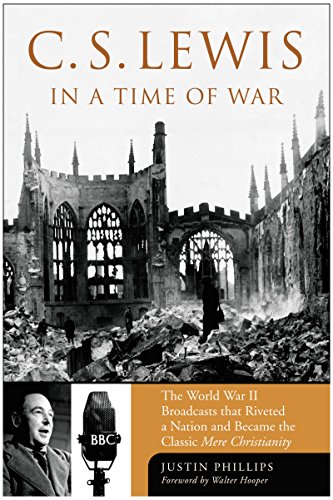
C.S. Lewis In A Time Of War
Phillips, Justin
Sold by HPB Inc., Dallas, TX, U.S.A.
AbeBooks Seller since 15 September 2017
Used - Hardcover
Condition: Used - Very good
Ships within U.S.A.
Quantity: 1 available
Add to basketSold by HPB Inc., Dallas, TX, U.S.A.
AbeBooks Seller since 15 September 2017
Condition: Used - Very good
Quantity: 1 available
Add to basketConnecting readers with great books since 1972! Used books may not include companion materials, and may have some shelf wear or limited writing. We ship orders daily and Customer Service is our top priority!
Seller Inventory # S_463526859
C. S. Lewis is universally recognized as one of the intellectual giants of the twentieth century. A noted scholar, Lewis was able to reach a vast popular audience during his lifetime and continues to attract thousands of new readers every year. But how did Lewis first become a popular public figure? During the most desperate years of World War II, Lewis was asked by the British Broadcasting Corporation's recently created Home Service to give radio addresses on Christianity to a nation shaken by war. The choice was controversial. At first dismissed by critics as a layman who was unqualified to tackle such weighty issues, Lewis proved to be enormously persuasive. These radio talks were eventually published as Mere Christianity, which now ranks as one of the great classics of religious literature.
This rich chapter in Lewis's life, which deals with his love-hate relationship with the "new" medium of broadcasting, has received little attention from biographers and commentators. Yet it was Lewis's work on the radio that made him a household name. By combining narrative skill and adroitly quoting from correspondence, Phillips captures Lewis's reservations, vexations, achievements, and, finally, his enormous success.
C. S. Lewis in a Time of War is a fascinating look at how these talks were created and the enthusiastic response they generated at a time when bombing in London caused many radio stations to be evacuated. This book reveals a rich, previously untapped vein of Lewis's life and work that will intrigue his millions of fans.
On Friday 1 September 1939, the Reverend James Welch was sitting in studio 3E on the third floor of Broadcasting House.1 The BBC's Director of Religious Broadcasting was conducting the daily act of worship in the studio especially designed for religious programmes. The Daily Service was broadcast on BBC radio each morning between 10.15 and 10.20. A slip of paper was quietly passed to him with some breaking news: 'Germany invaded Poland early this morning'. Welch knew exactly what he had to do. 'That paper was the signal to alter our service, and especially our prayers, to meet the wartime needs of our people. We broadcast a prayer for the people of Poland. We added a prayer for trust in God in all that might lie ahead.'2
Broadcasting House is the headquarters of the British Broadcasting Corporation, the BBC, situated at the top end of Regent Street where it meets Portland Place, adjacent to All Souls Church. The building itself is shaped like the stern of a huge ship. The offices run along the outside facing the street and the studios are positioned off corridors along the middle, well away from the noise of traffic. Studio 3E is tucked away in the middle of the building on the same floor as the Director-General's office.
The Daily Service went out live. This means that, unlike a pre-recorded programme, it was possible to change the content even as it was being broadcast on the air. James Welch responded immediately to the words he saw. There was no time to reflect on them or lay them to one side. He led the nation in prayer.
By five o'clock that day the BBC's emergency plans were in operation. As different departments dispersed across the country, religious broadcasting was on its way to its first wartime home in Bristol. It now faced its greatest challenge and in James Welch had a leader willing to take risks and to test new ideas. Welch was fully aware that the traditional programming offered by his department would not be sufficient in wartime. Such radical new circumstances would demand programmes that would attempt to deal with the toughest questions facing listeners as the possibility of war became a reality.
Though the horrors of the Great War of 1914?1918 may have given a shocking taste of what was to follow, nothing could have prepared the British people for the total devastation of the Second World War. It was to be waged not only on the battlefields, but on the streets and in the homes of ordinary people as they found that no one was out of reach of the German bombs. One of the most precious commodities was up-to-date and accurate information. It is impossible to over-estimate the importance of the role BBC Radio played during the war years.
The invasion of Poland had triggered the implementation of a whole series of contingency plans and decisions. One of these was to evacuate over one million children from London to the countryside, to protect them from the anticipated bombing raids that it was assumed would follow from Hitler's act of aggression. The six o'clock evening news gave warning that the evacuation was about to begin. All over Britain, every BBC transmitter station and office was opening sealed orders. In between records, listeners heard the staff announcer repeat the warnings and tell listeners to retune their radio to two designated wavelengths. At 8.15 p.m. the nation heard the BBC's new 'on-air' identification for the first time: 'This is the BBC Home Service'.3
The children evacuate the cities
In London, twelve railway stations were packed with children. The BBC reported their departure and later broadcast interviews with some of them once they had arrived. One cheerful boy used the BBC to send a message to his parents left behind in the city. 'Mum and Dad, don't get worried about us, we're all very happy here and I don't think anyone wants to go home yet.'4 An American broadcasting network, CBS, had sent over its esteemed news correspondent Edward R. Murrow to direct its news coverage. His vivid reporting spoke of a silent city without its children. For six days he had not heard a single child's voice and it felt very strange.5
One of the missing voices belonged to Jill Freud (at that time called Jill Flewett).6 Her school had carried out a full dress rehearsal for evacuation a year before in 1938. She was living in Barnes and at age twelve was evacuated with her two sisters, aged five and fifteen. Jill's mother was given twenty-four hours to make up her mind whether to let all of her children go. Jill recalls that 'at that time, I had no awareness at all of what it must have meant to them. I mean, cheerily waving goodbye and getting homesick but not thinking that I had a mother who didn't have a job and whose whole life was looking after us.'7 She found herself billeted with two Unitarian sisters. It was another two years before she joined an Oxford household -- that of C.S. Lewis.
By 2 September, the first evacuees had arrived in Oxford. C.S. Lewis described them in a letter to his brother, Warnie, as 'very nice, unaffected creatures and all most flatteringly delighted with their new surroundings. They're fond of animals which is a good thing.' Within a week the pleasure of the evacuees was beginning to wane. 'Modern children are poor creatures. They keep on asking ?What shall we do now?? After being told to have a game of tennis or to mend their stockings or write home, when done, they just come looking for more ideas. Shades of our own childhood!' Lewis tells his brother, who had already been conscripted.8 All men between the ages of eighteen and forty-one were liable for conscription into military service. By the end of 1939, one and a half million conscripts were in uniform. . . .
Excerpted from C.S. Lewis in a Time of Warby Justin Phillips Copyright © 2006 by Justin Phillips. Excerpted by permission.
All rights reserved. No part of this excerpt may be reproduced or reprinted without permission in writing from the publisher.
Excerpts are provided by Dial-A-Book Inc. solely for the personal use of visitors to this web site.
"About this title" may belong to another edition of this title.
If you are a consumer you can cancel the contract in accordance with the following. Consumer means any natural person who is acting for purposes which are outside his trade, business, craft or profession.
INFORMATION REGARDING THE RIGHT OF CANCELLATION
Statutory Right to cancel
You have the right to cancel this contract within 14 days without giving any reason.
The cancellation period will expire after 14 days from the day on which you acquire, or a third party other than the carrier and indicated by you acquires, physical possession of the the last good or the last lot or piece.
To exercise the right to cancel, you must inform us, HPB Inc., 3860 La Reunion Parkway, 75212, Dallas, Texas, U.S.A., +1 214-819-9556, of your decision to cancel this contract by a clear statement (e.g. a letter sent by post, fax or e-mail). You may use the attached model cancellation form, but it is not obligatory. You can also electronically fill in and submit a clear statement on our website, under "My Purchases" in "My Account". If you use this option, we will communicate to you an acknowledgement of receipt of such a cancellation on a durable medium (e.g. by e-mail) without delay.
To meet the cancellation deadline, it is sufficient for you to send your communication concerning your exercise of the right to cancel before the cancellation period has expired.
Effects of cancellation
If you cancel this contract, we will reimburse to you all payments received from you, including the costs of delivery (except for the supplementary costs arising if you chose a type of delivery other than the least expensive type of standard delivery offered by us).
We may make a deduction from the reimbursement for loss in value of any goods supplied, if the loss is the result of unnecessary handling by you.
We will make the reimbursement without undue delay, and not later than 14 days after the day on which we are informed about your decision to cancel with contract.
We will make the reimbursement using the same means of payment as you used for the initial transaction, unless you have expressly agreed otherwise; in any event, you will not incur any fees as a result of such reimbursement.
We may withhold reimbursement until we have received the goods back or you have supplied evidence of having sent back the goods, whichever is the earliest.
You shall send back the goods or hand them over to us or HPB Inc., 3860 La Reunion Parkway, 75212, Dallas, Texas, U.S.A., +1 214-819-9556, without undue delay and in any event not later than 14 days from the day on which you communicate your cancellation from this contract to us. The deadline is met if you send back the goods before the period of 14 days has expired. You will have to bear the direct cost of returning the goods. You are only liable for any diminished value of the goods resulting from the handling other than what is necessary to establish the nature, characteristics and functioning of the goods.
Exceptions to the right of cancellation
The right of cancellation does not apply to:
Model withdrawal form
(complete and return this form only if you wish to withdraw from the contract)
To: (HPB Inc., 3860 La Reunion Parkway, 75212, Dallas, Texas, U.S.A., +1 214-819-9556)
I/We (*) hereby give notice that I/We (*) withdraw from my/our (*) contract of sale of the following goods (*)/for the provision of the following goods (*)/for the provision of the following service (*),
Ordered on (*)/received on (*)
Name of consumer(s)
Address of consumer(s)
Signature of consumer(s) (only if this form is notified on paper)
Date
* Delete as appropriate.
| Order quantity | 4 to 14 business days | 2 to 6 business days |
|---|---|---|
| First item | £ 2.80 | £ 5.21 |
Delivery times are set by sellers and vary by carrier and location. Orders passing through Customs may face delays and buyers are responsible for any associated duties or fees. Sellers may contact you regarding additional charges to cover any increased costs to ship your items.