
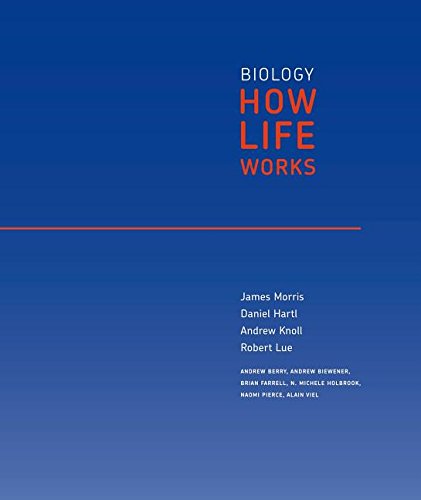
Biology: How Life Works
James R. Morris, Daniel L. Hartl, Andrew H. Knoll, Robert A. Lue
ISBN 10: 1319056911 ISBN 13: 9781319056919
Published by W. H. Freeman, 2015
Used
Hardcover
From
BookHolders, Towson, MD, U.S.A.
Seller rating 5 out of 5 stars

AbeBooks Seller since 19 June 2001
This specific item is no longer available.
About this Item
Description:
[ No Hassle 30 Day Returns ][ Ships Daily ] [ Underlining/Highlighting: NONE ] [ Writing: NONE ] [ Edition: First ] Publisher: W. H. Freeman Pub Date: 7/24/2015 Binding: Hardcover Pages: 1200 First edition. Seller Inventory # 6307233
Synopsis:
Rethinking biology means rethinking the text, the visual program, and assessment.
Ordinarily, textbooks are developed by first writing chapters, then making decisions about art and images, and finally, once the book is complete, assembling a test bank and ancillary media. This process dramatically limits the integration across resources, and reduces art, media, and assessments to ancillary material, rather than essential resources for student learning.
Ordinarily, textbooks are developed by first writing chapters, then making decisions about art and images, and finally, once the book is complete, assembling a test bank and ancillary media. This process dramatically limits the integration across resources, and reduces art, media, and assessments to ancillary material, rather than essential resources for student learning.
Biology: How Life Works is the first project to develop three pillars—the text, the visual program, and the assessment—at the same time. All three pillars were developed in parallel to make sure that each idea is addressed in the most appropriate medium, and to ensure authentic integration. These three pillars are all tied to the same set of core concepts, share a common language, and use the same visual palette. In this way, the text, visual program, and assessments are integral parts of student learning, rather than just accessories to the text.
RETHINKING THE TEXT
Integrated
Biology: How Life Works moves away from a focus on disparate topics, towards an integrated approach. Chemistry is presented in context, structure and function are covered together, the flow of information in a cell is introduced where it makes the most conceptual sense, and cases serve as a framework for connecting and assimilating information.
Selective
Biology: How Life Works was envisioned not as a reference book for all of biology, but a resource focused on foundational concepts, terms, and experiments. This allows students to more easily identify, understand, and apply critical concepts, and develop a framework on which to build their understanding of biology.
Biology: How Life Works was envisioned not as a reference book for all of biology, but a resource focused on foundational concepts, terms, and experiments. This allows students to more easily identify, understand, and apply critical concepts, and develop a framework on which to build their understanding of biology.
Thematic
Biology: How Life Works was written with six themes in mind. Introduced in Chapter 1 and revisited throughout, these themes provide a framework that helps students see biology as a set of connected concepts. In particular, the theme of evolution is emphasized for its ability to explain and predict so many patterns in biology.
Biology: How Life Works was written with six themes in mind. Introduced in Chapter 1 and revisited throughout, these themes provide a framework that helps students see biology as a set of connected concepts. In particular, the theme of evolution is emphasized for its ability to explain and predict so many patterns in biology.
RETHINKING THE VISUAL PROGRAM
Integrated
Across Biology: How Life Works—whether students are looking at a figure in the book, watching an animation, or interacting with a simulation—they always see a consistent use of color, shapes, and design.
Across Biology: How Life Works—whether students are looking at a figure in the book, watching an animation, or interacting with a simulation—they always see a consistent use of color, shapes, and design.
Engaging
Every image—still and in motion—engages students by being vibrant, clear, and approachable. The result is a visual environment that is expertly designed to pull students in, deepens their interest, and helps them see a world of biological processes.
Every image—still and in motion—engages students by being vibrant, clear, and approachable. The result is a visual environment that is expertly designed to pull students in, deepens their interest, and helps them see a world of biological processes.
A Visual Framework
To help students think like biologists, the visual program is designed to be a framework for students to hang the concepts and connect ideas. Individual figures present foundational concepts; Visual Synthesis figures tie multiple concepts across chapters together; animations bring these figures to life; and simulations let students interact with the concepts. Collectively, this visual framework allows students to move seamlessly back and forth between the big picture and the details.
To help students think like biologists, the visual program is designed to be a framework for students to hang the concepts and connect ideas. Individual figures present foundational concepts; Visual Synthesis figures tie multiple concepts across chapters together; animations bring these figures to life; and simulations let students interact with the concepts. Collectively, this visual framework allows students to move seamlessly back and forth between the big picture and the details.
RETHINKING THE ASSESSMENT
Range
Developed by a broad community of leading science
Range
Developed by a broad community of leading science
Review: "I think the best selling point is that the text focuses on helping students make connections between the sub-fields of biology." - Cindee Giffen, University of Wisconsin-Madison, USA
"I really like the streamlined approach and emphasis on ideas and concepts rather than details and facts." - Scott Solomon, Rice University, USA
"I love love love the integration throughout of evolution and real case studies. Very powerful." - Rebecca Safran, University of Colorado at Boulder, USA
[on the Visual Synthesis Map] "My initial reaction was 'wow.' It helped me visualize the spatial relationships associated with information flow at the cellular level, and I think it is thus likely to really help undergraduates." - Dave Kubien, University of New Brunswick, USA
"There is a clear connection between the pedagogical approach of the textbook and the assessment materials." - Sonja Pyott, University of North Carolina Wilmington, USA
"About this title" may belong to another edition of this title.
Bibliographic Details
Title: Biology: How Life Works
Publisher: W. H. Freeman
Publication Date: 2015
Binding: Hardcover
Condition: Good