
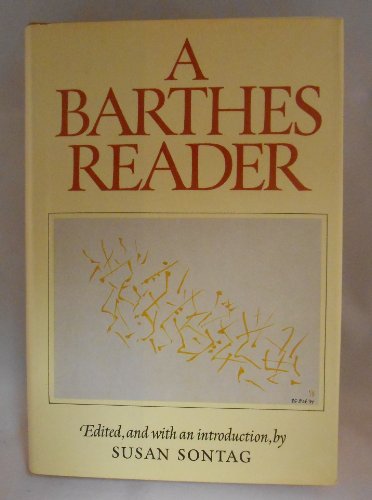
A Barthes reader
Roland Barthes
ISBN 10: 0809028158 ISBN 13: 9780809028153
Published by Hill and Wang December 1981, 1981
Used
Trade Paperback
From
Hennessey + Ingalls, Los Angeles, CA, U.S.A.
Seller rating 4 out of 5 stars

AbeBooks Seller since 8 April 2013
This specific item is no longer available.
About this Item
Description:
Hardcver edition. Very nice clean, tight copy free of any marks. Seller Inventory # 228021
Synopsis:
A Barthes Reader gives one the image of Barthes as one of the great public teachers of our time, someone who thought out, argued for, and made available several steps in a penetrating reflection on language sign systems, texts- and what they have to tell us about the concept of being human. Susan Sontag's prefatory essay is one of her finest acts of criticism, informed by intellectual sympathy and a sure sense of the contours of the mind she is describing.
Review:
"Roland Barthes must be counted the most characteristic and important French intellectual of the structuralist generation that gained worldwide attention in the 1960s. Yet as an intellectual authority--"maitre a penser," as the French tend to say--he cut a curious figure. He detested all forms of authority, worried about the power wielded by the teacher, and called his main subject, literature, 'a grand imposture.' He could be assertive, but always in the mode of counterstatement, affirming the inverse of society's accepted dogmas and myths. . . .
"A Barthes Reader" gives one the image of Barthes as one of the great public teachers of our time, someone who thought out, argued for, and made available several steps in a penetrating reflection on language sign systems, texts--and what they have to tell us about the concept of being human. His work is always partial, passionate underneath its cool, and preliminary, ready to be superseded or contradicted, yet its pedagogical power is durable. . . . Susan Sontag's prefatory essay is one of her finest acts of criticism, informed by intellectual sympathy and a sure sense of the contours of the mind she is describing."--Peter Brooks, Yale University
Roland Barthes must be counted the most characteristic and important French intellectual of the structuralist generation that gained worldwide attention in the 1960s. Yet as an intellectual authority--maitre a penser, as the French tend to say--he cut a curious figure. He detested all forms of authority, worried about the power wielded by the teacher, and called his main subject, literature, 'a grand imposture.' He could be assertive, but always in the mode of counterstatement, affirming the inverse of society's accepted dogmas and myths. . . .
A Barthes Reader gives one the image of Barthes as one of the great public teachers of our time, someone who thought out, argued for, and made available several steps in a penetrating reflection on language sign systems, texts--and what they have to tell us about the concept of being human. His work is always partial, passionate underneath its cool, and preliminary, ready to be superseded or contradicted, yet its pedagogical power is durable. . . . Susan Sontag's prefatory essay is one of her finest acts of criticism, informed by intellectual sympathy and a sure sense of the contours of the mind she is describing.--Peter Brooks, Yale University"
Roland Barthes must be counted the most characteristic and important French intellectual of the structuralist generation that gained worldwide attention in the 1960s. Yet as an intellectual authority--maitre a penser, as the French tend to say--he cut a curious figure. He detested all forms of authority, worried about the power wielded by the teacher, and called his main subject, literature, 'a grand imposture.' He could be assertive, but always in the mode of counterstatement, affirming the inverse of society's accepted dogmas and myths. . . .
A Barthes Reader gives one the image of Barthes as one of the great public teachers of our time, someone who thought out, argued for, and made available several steps in a penetrating reflection on language sign systems, texts--and what they have to tell us about the concept of being human. His work is always partial, passionate underneath its cool, and preliminary, ready to be superseded or contradicted, yet its pedagogical power is durable. . . . Susan Sontag's prefatory essay is one of her finest acts of criticism, informed by intellectual sympathy and a sure sense of the contours of the mind she is describing. Peter Brooks, Yale University
"A Barthes Reader" gives one the image of Barthes as one of the great public teachers of our time, someone who thought out, argued for, and made available several steps in a penetrating reflection on language sign systems, texts--and what they have to tell us about the concept of being human. His work is always partial, passionate underneath its cool, and preliminary, ready to be superseded or contradicted, yet its pedagogical power is durable. . . . Susan Sontag's prefatory essay is one of her finest acts of criticism, informed by intellectual sympathy and a sure sense of the contours of the mind she is describing. "Peter Brooks, Yale University""
"Roland Barthes must be counted the most characteristic and important French intellectual of the structuralist generation that gained worldwide attention in the 1960s. Yet as an intellectual authority--maitre a penser, as the French tend to say--he cut a curious figure. He detested all forms of authority, worried about the power wielded by the teacher, and called his main subject, literature, 'a grand imposture.' He could be assertive, but always in the mode of counterstatement, affirming the inverse of society's accepted dogmas and myths. . . .
A Barthes Reader gives one the image of Barthes as one of the great public teachers of our time, someone who thought out, argued for, and made available several steps in a penetrating reflection on language sign systems, texts--and what they have to tell us about the concept of being human. His work is always partial, passionate underneath its cool, and preliminary, ready to be superseded or contradicted, yet its pedagogical power is durable. . . . Susan Sontag's prefatory essay is one of her finest acts of criticism, informed by intellectual sympathy and a sure sense of the contours of the mind she is describing." --Peter Brooks, Yale University
"A Barthes Reader gives one the image of Barthes as one of the great public teachers of our time, someone who thought out, argued for, and made available several steps in a penetrating reflection on language sign systems, texts--and what they have to tell us about the concept of being human. His work is always partial, passionate underneath its cool, and preliminary, ready to be superseded or contradicted, yet its pedagogical power is durable. . . . Susan Sontag's prefatory essay is one of her finest acts of criticism, informed by intellectual sympathy and a sure sense of the contours of the mind she is describing." --Peter Brooks, Yale University
"About this title" may belong to another edition of this title.
Bibliographic Details
Title: A Barthes reader
Publisher: Hill and Wang December 1981
Publication Date: 1981
Binding: Trade Paperback
Condition: Used - Very Good