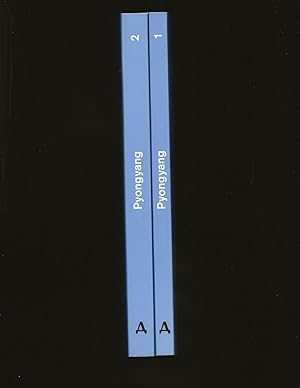
"Ambitiously designed community buildings, faceless mass housing developments, and a monumental emptiness are the defining features of Pyongyang - a city of three million inhabitants rising from rubble after the Korean War of the 1950s. This guide offers unprecedented insights into the capital of what is probably the most isolated country in the world, ruled in the third generation by a 'first family' stubbornly upholding its own brand of stone-age communism."
PYONGYANG: ARCHITECTURE AND THE PROWESS OF PROPOGANDA
Pyongyang is the perfect model for the urban-utopian ideal. Solitary and self-contained, the capital of North Korea rises above the rural landscape into a forest of white skyscrapers and a flora of evenly planted municipal multiplexes. Published and edited by German-based DOM, the Architectural and Cultural Guide: Pyongyang is truly a diamond in the rough, with a bevy of photos previously inaccessible to Western eyes. After all, how often do you come across a two-volume guide to an unknown place that resembles Lando Calrissian's Cloud City?
North Korea and the Pyongyang cityscape subscribe to the Juche ideology of self-reliance. Within Juche philosophy and the tenants of socialism, it is the duty of the architect to serve the people, since it's the masses that represent the state in socialist systems. Dually, the architects' responsibility is to balance history with the future, reflection with transformation. The "Urban Revolution" was a socialist expression of the commitment to cultural openness and to showcasing nationalism.
Over the past century, Korea has been a nation divided through Japanese colonialism, World-War II, and Soviet intervention, ending finally with the Korean War (1950-1953). Since then, much of the city has been rebuilt; Architectural and Cultural Guide: Pyongyang subsequently chronicles North Korea's progress by organizing the guide into various chapters ranging from Residential Buildings to Cultural Venues to Monuments and Transportation Infrastructure.
As North Korea's first Prime Minister, Kim Il-sung saw his principal duty as reducing the differences in the quality of life for workers and peasants and to promote communal life as an alternative to life in nuclear families. Images of the capital started to emerge out of peace-talks in 2000 between Kim Jong-il and Kim Dae-jung. South Koreans reacted to their northern brother with bewilderment and surprise: "We had not been prepared to encounter this glowing, progressive face of the North Korean capital." The periphery of Pyongyang is devoted mostly to public buildings and multi-story residential complexes. After North Korea's liberation from Japanese forces in the late 1940's, all attention focused on satiating the people's most fundamental needs: housing and a place to cook and eat. The country soon adopted the architectural theories and urban design principles of the occupying Soviet forces. The project of building detached family homes was soon dropped due to the drastic housing shortage in favor of Soviet-inspired multi-story buildings.
As the guide explains in "Volume Two: Korean Architecture," "[Pyongyang's] low-density sets it apart from capitalist metropolitan cities, but it is not exclusively a reflection of the ideals of socialist urban planning. Rather, it is also a consequence of the dichotomy between North and South Korea. The strained political relations between the two Korean states prompted North Korea to minimize the danger of damage to buildings in possible acts of war by allowing for greater distanced between buildings. Thus Pyongyang is not only a socialist city, but also a city designed to cope with warfare."
Socialist design principles were thus adopted: Sufficient natural light and fresh-air, a solid balance between private and working areas, a communal kitchen, day care centers, kindergartens, and schools. The codification of urbanization started in the 1970's with several aims: opening road traffic, enlarging parks, showcasing the cultural heritage, planning public cultural facilities and protecting residential areas against environmental pollution to underscore the uniqueness of socialism. The Architectural and Cultural Guide: Pyongyang truly stands out amongst all other design reads because it manages to capture this seemingly paradoxical "uniqueness of socialism" beautifully through over 300 pages of color photographs.
PYONGYANG: ARCHITECTURE AND THE PROWESS OF PROPOGANDA
Pyongyang is the perfect model for the urban-utopian ideal. Solitary and self-contained, the capital of North Korea rises above the rural landscape into a forest of white skyscrapers and a flora of evenly planted municipal multiplexes. Published and edited by German-based DOM, the Architectural and Cultural Guide: Pyongyang is truly a diamond in the rough, with a bevy of photos previously inaccessible to Western eyes. After all, how often do you come across a two-volume guide to an unknown place that resembles Lando Calrissian's Cloud City?
North Korea and the Pyongyang cityscape subscribe to the Juche ideology of self-reliance. Within Juche philosophy and the tenants of socialism, it is the duty of the architect to serve the people, since it's the masses that represent the state in socialist systems. Dually, the architects' responsibility is to balance history with the future, reflection with transformation. The "Urban Revolution" was a socialist expression of the commitment to cultural openness and to showcasing nationalism.
Over the past century, Korea has been a nation divided through Japanese colonialism, World-War II, and Soviet intervention, ending finally with the Korean War (1950-1953). Since then, much of the city has been rebuilt; Architectural and Cultural Guide: Pyongyang subsequently chronicles North Korea's progress by organizing the guide into various chapters ranging from Residential Buildings to Cultural Venues to Monuments and Transportation Infrastructure.
As North Korea's first Prime Minister, Kim Il-sung saw his principal duty as reducing the differences in the quality of life for workers and peasants and to promote communal life as an alternative to life in nuclear families. Images of the capital started to emerge out of peace-talks in 2000 between Kim Jong-il and Kim Dae-jung. South Koreans reacted to their northern brother with bewilderment and surprise: "We had not been prepared to encounter this glowing, progressive face of the North Korean capital." The periphery of Pyongyang is devoted mostly to public buildings and multi-story residential complexes. After North Korea's liberation from Japanese forces in the late 1940's, all attention focused on satiating the people's most fundamental needs: housing and a place to cook and eat. The country soon adopted the architectural theories and urban design principles of the occupying Soviet forces. The project of building detached family homes was soon dropped due to the drastic housing shortage in favor of Soviet-inspired multi-story buildings.
As the guide explains in "Volume Two: Korean Architecture," "[Pyongyang's] low-density sets it apart from capitalist metropolitan cities, but it is not exclusively a reflection of the ideals of socialist urban planning. Rather, it is also a consequence of the dichotomy between North and South Korea. The strained political relations between the two Korean states prompted North Korea to minimize the danger of damage to buildings in possible acts of war by allowing for greater distanced between buildings. Thus Pyongyang is not only a socialist city, but also a city designed to cope with warfare."
Socialist design principles were thus adopted: Sufficient natural light and fresh-air, a solid balance between private and working areas, a communal kitchen, day care centers, kindergartens, and schools. The codification of urbanization started in the 1970's with several aims: opening road traffic, enlarging parks, showcasing the cultural heritage, planning public cultural facilities and protecting residential areas against environmental pollution to underscore the uniqueness of socialism. The Architectural and Cultural Guide: Pyongyang truly stands out amongst all other design reads because it manages to capture this seemingly paradoxical "uniqueness of socialism" beautifully through over 300 pages of color photographs.
http: //flaunt.com/blogs/pyongyang-architecture-and-prowess-propoganda. FLAUNT Magazine
The well-publicized (albeit failed) launch of a satellite by North Korea last month sent a signal to the international community: Kim Jong-un is carrying on in the brinksman-like tradition of his father Kim Jong-il. Between them, they've built and maintained what is arguably the most isolated country on the planet - the Democratic Peoples Republic of North Korea or DPNK. Most of us will never visit the country, or see the grand monuments or stadia of its capital, Pyongyang. Philipp Meuser is an architect and general planner for several German embassies. He's also head of Dom Publishers, and the editor of a beautiful and eerie two volume architectural and cultural guide for North Korea's capital city.
NPR interview of publisher Philipp Meauser on the show Word of Mouth May 2, 2012
North Korea Has Some Of The World's Most Spectacular Architecture
German architect Philip Meuser offers a rare glimpse into one of the most secretive states in the world in his book Architectural and Cultural Guide Pyongyang.
"Part of my motivation for this book was to do a guide book to a place that you can't even visit," Meuser said in an interview with Aaron Britt of Dwell. "I want to show that North Korea is real and that Pyongyang is real, but for an American they're also totally virtual. It's like Google Street View. You see things all over the world, but you never really leave your computer."
Meuser also points out that because Pyongyang was almost completely destroyed after the Korean War, most of the buildings were built in the last 60 years and are "interpretations of historical Korean architecture."
Dina Spector - Business Insider June 2, 2012 - quote is from an interview by Aaron Britt for Dwell - Feb 9, 2012.
Chances are, you aren't going to North Korea any time soon. But armchair travelers can take a virtual tour with "Architectural and Cultural Guide Pyongyang," edited by Philipp Meuser (DOM Publishers, $49.95).
It's a two-volume set, the first of which contains photographs and descriptions from the North Korean government's Pyongyang Foreign Languages Publishing House. The contract required Mr. Meuser to run the images with the official captions, without critical commentary. So volume two provides more photos, history and context, with essays on topics like urban planning, mass gymnastics and propaganda posters.
"Setting aside the glaring issues of human rights and social self-determination, Pyongyang is arguably the world's best preserved open-air museum of socialist architecture," writes Mr. Meuser, who visited the country three times while researching the book. It is "a cabinet of architectural curiosities."
Chances are, you aren't going to North Korea any time soon. But armchair travelers can take a virtual tour with "Architectural and Cultural Guide Pyongyang," edited by Philipp Meuser (DOM Publishers, $49.95).
It's a two-volume set, the first of which contains photographs and descriptions from the North Korean government's Pyongyang Foreign Languages Publishing House. The contract required Mr. Meuser to run the images with the official captions, without critical commentary. So volume two provides more photos, history and context, with essays on topics like urban planning, mass gymnastics and propaganda posters.
"Setting aside the glaring issues of human rights and social self-determination, Pyongyang is arguably the world's best preserved open-air museum of socialist architecture," writes Mr. Meuser, who visited the country three times while researching the book. It is "a cabinet of architectural curiosities."
A version of this article appeared May 26, 2012, on page C18 in the U.S. edition of The Wall Street Journal, with the headline: Visions of the Hermit Kingdom
Architectural and Cultural Guide Pyongyang from DOM Publishers is actually made up of two guides: Volume 1 is a guide from the Pyongyang Foreign Languages Publishing House, published without comment; Volume 2 features illustrated essays by editor Philip Meuser and other contributors, focusing on urban and architectural history, propaganda, spatial production, and an outsider's experience of the city of 3 million. The former is clearly a means of propaganda by the North Korean government (the guide's publication date coinciding with the 100th anniversary of Kim Il-sung's birth, aka "Year 1 of the new era," can also be read in this way), but one that functions differently than other guidebooks: Instead of existing as a companion to a visit, it is a substitute for seeing the city in person, even as the country appears to be opening its borders to more foreigners recently (journalists, mainly). Volume 1 is laid out similarly to other architecture guides, broken down into chapters by building type: Urban Planning, Residential Buildings, Cultural Venues, Education and Sport, Hotels/Department Stores, Transport Infrastructure, Monuments. Of course these are not typologies exclusive to North Korea, but their expression and cohesion in a Socialist utopia (or nightmare) is what makes the city and the book so unique.
Volume 2 breaks through the official language and photography of Volume 1 to present first-hand accounts and researched histories of Pyongyang. Meuser's introduction for "The Illicit Guidebook" lays out both the second volume's essays and the city itself; the latter via helpful aerial views from the Juche Tower, a blazing monument to the "state's ideology scripted by Kim Il Sung," as the Volume 1 description reads. The essays that follow the introduction can be fairly academic, yet they are highlighted by Meuser's first-person stroll through the city and his highlighting of the state's propaganda posters and artwork. More propaganda occurs in the excerpted text "On Architecture" (1991) by Kim Jong-il, which paints architecture as the expression of national character. Yet it is the abundant illustrations throughout the two volumes that are the most illuminating and valuable pieces in the guide; they give a broad and colorful insight into a place that is portrayed in a particular light depending on one's locale.
A Weekly Dose of Architechture, posted April 23, 2012 by archidose