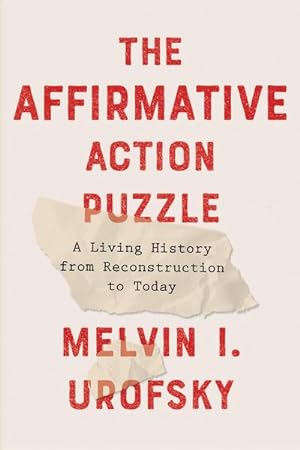
Affirmative Action Puzzle
Melvin I Urofsky
Sold by AHA-BUCH GmbH, Einbeck, Germany
AbeBooks Seller since 14 August 2006
New - Hardcover
Condition: New
Ships from Germany to U.S.A.
Quantity: 1 available
Add to basketSold by AHA-BUCH GmbH, Einbeck, Germany
AbeBooks Seller since 14 August 2006
Condition: New
Quantity: 1 available
Add to basketNeuware - A rich, multifaceted history of affirmative action from the Civil Rights Act of 1866 through today's tumultuous times From acclaimed legal historian, author of a biography of Louis Brandeis ('Remarkable' -Anthony Lewis, The New York Review of Books, 'Definitive'-Jeffrey Rosen, The New Republic) and Dissent and the Supreme Court ('Riveting'-Dahlia Lithwick, The New York Times Book Review), a history of affirmative action from its beginning with the Civil Rights Act of 1866 to the first use of the term in 1935 with the enactment of the National Labor Relations Act (the Wagner Act) to 1961 and John F. Kennedy's Executive Order 10925, mandating that federal contractors take 'affirmative action' to ensure that there be no discrimination by 'race, creed, color, or national origin' down to today's American society. Melvin Urofsky traces the evolution of affirmative action through labor and the struggle for racial equality, writing of World War I and the exodus that began when some six million African Americans moved northward between 1910 and 1960, one of the greatest internal migrations in the country's history. The author also writes of World War II, when women replaced men in factories and the issue of equal pay arose, and of Franklin Delano Roosevelt signing into law his last great New Deal measure for returning veterans-the Servicemen's Readjustment Act (the GI Bill), the most massive affirmative action program in American history. Urofsky tells the story of the struggles of blacks through the 1930s and 1940s, and how the southern states had to live up to the 'equal' parts of the 'separate but equal' formula. He writes as well about Brown v. Board of Education of Topeka, the passage of the 1964 Civil Rights Act, and the 1965 Voting Rights Act. He describes how Harry Truman, after becoming president in 1945, fought for Roosevelt's Fair Employment Practice Act and, surprising everyone, appointed a distinguished panel to serve as the President's Commission on Civil Rights, as well as appointing the first black judge on a federal appeals court in 1948 and, by executive order later that year, ordering full racial integration in the armed forces. We see Dwight Eisenhower sending in one thousand U.S. Army paratroopers and federalizing ten thousand Arkansas national guardsmen to protect black students trying to go to school; John F. Kennedy establishing the President's Committee on Equal Employment Opportunity and naming Lyndon Johnson as its chair, with Kennedy understanding, as did civil rights leaders, that no matter how the government tried to eradicate racial discrimination, the key to progress involved private sector employment with decent paying jobs, which would pull black America out of poverty. Urofsky explores affirmative action in relation to sex, gender, and education and shows that nearly every public university in the country has at one time or another instituted some form of affirmative action plan-some successful, others not. In this important, ambitious, far-reaching book, Urofsky writes about the affirmative action cases decided by the Supreme Court: cases that either upheld or struck down particular plans that affected both governmental and private entities. We come to fully understand the societal impact of affirmative action: how and why it has helped, and inflamed, people of all walks of life; how it has evolved; and how, and why, it is still needed.
Seller Inventory # 9781101870877
A rich, multifaceted history of affirmative action from the Civil Rights Act of 1866 through today’s tumultuous times
From acclaimed legal historian, author of a biography of Louis Brandeis (“Remarkable” —Anthony Lewis, The New York Review of Books, “Definitive”—Jeffrey Rosen, The New Republic) and Dissent and the Supreme Court (“Riveting”—Dahlia Lithwick, The New York Times Book Review), a history of affirmative action from its beginning with the Civil Rights Act of 1866 to the first use of the term in 1935 with the enactment of the National Labor Relations Act (the Wagner Act) to 1961 and John F. Kennedy’s Executive Order 10925, mandating that federal contractors take “affirmative action” to ensure that there be no discrimination by “race, creed, color, or national origin” down to today’s American society.
Melvin Urofsky explores affirmative action in relation to sex, gender, and education and shows that nearly every public university in the country has at one time or another instituted some form of affirmative action plan--some successful, others not.
Urofsky traces the evolution of affirmative action through labor and the struggle for racial equality, writing of World War I and the exodus that began when some six million African Americans moved northward between 1910 and 1960, one of the greatest internal migrations in the country’s history.
He describes how Harry Truman, after becoming president in 1945, fought for Roosevelt’s Fair Employment Practice Act and, surprising everyone, appointed a distinguished panel to serve as the President’s Commission on Civil Rights, as well as appointing the first black judge on a federal appeals court in 1948 and, by executive order later that year, ordering full racial integration in the armed forces.
In this important, ambitious, far-reaching book, Urofsky writes about the affirmative action cases decided by the Supreme Court: cases that either upheld or struck down particular plans that affected both governmental and private entities. We come to fully understand the societal impact of affirmative action: how and why it has helped, and inflamed, people of all walks of life; how it has evolved; and how, and why, it is still needed.
"About this title" may belong to another edition of this title.
General Terms and Conditions and Customer Information / Privacy Policy
I. General Terms and Conditions
§ 1 Basic provisions
(1) The following terms and conditions apply to all contracts that you conclude with us as a provider (AHA-BUCH GmbH) via the Internet platforms AbeBooks and/or ZVAB. Unless otherwise agreed, the inclusion of any of your own terms and conditions used by you will be objected to
(2) A consumer within the meaning of the following regulations is any natural person who concludes...
If you are a consumer you can withdraw from the contract in accordance with the following. Consumer means any natural person who is acting for purposes which are outside his trade, business, craft or profession.
Information regarding the right of withdrawal
Statutory right to withdraw
You have the right to withdraw from this contract within 14 days without giving any reason.
The withdrawal period will expire after 14 days from the day on which you acquire, or a third party other than the carrier and indicated by you acquires, physical possession of the last good or the last lot or piece.
To exercise the right of withdrawal, electronically fill in and submit a clear statement on our website, under "My Purchases" in "My Account". We will communicate to you an acknowledgement of receipt of such a withdrawal on a durable medium (e.g. by e-mail) without delay.
To meet the withdrawal deadline, it is sufficient for you to send your communication concerning your exercise of the right of withdrawal before the withdrawal period has expired.
Effects of withdrawal
If you withdraw from this contract, we will reimburse to you all payments received from you, including the costs of delivery (except for the supplementary costs arising if you chose a type of delivery other than the least expensive type of standard delivery offered by us).
We may make a deduction from the reimbursement for loss in value of any goods supplied, if the loss is the result of unnecessary handling by you.
We will make the reimbursement without undue delay, and not later than 14 days after the day on which we are informed about your decision to withdraw from this contract.
We will make the reimbursement using the same means of payment as you used for the initial transaction, unless you have expressly agreed otherwise; in any event, you will not incur any fees as a result of such reimbursement.
We may withhold reimbursement until we have received the goods back, or you have supplied evidence of having sent back the goods, whichever is the earliest.
You shall send back the goods or hand them over to AHA-BUCH GmbH, Einbeck, Germany, without undue delay and in any event not later than 14 days from the day on which you communicate your withdrawal from this contract to us. The deadline is met if you send back the goods before the period of 14 days has expired. You will have to bear the direct cost of returning the goods. You are only liable for any diminished value of the goods resulting from the handling other than what is necessary to establish the nature, characteristics and functioning of the goods.
Exceptions to the right of withdrawal
The right of withdrawal does not apply to:
We ship your order after we received them
for articles on hand latest 24 hours,
for articles with overnight supply latest 48 hours.
In case we need to order an article from our supplier our dispatch time depends on the reception date of the articles, but the articles will be shipped on the same day.
Our goal is to send the ordered articles in the fastest, but also most efficient and secure way to our customers.
| Order quantity | 7 to 10 business days | 5 to 7 business days |
|---|---|---|
| First item | £ 26.15 | £ 26.15 |
Delivery times are set by sellers and vary by carrier and location. Orders passing through Customs may face delays and buyers are responsible for any associated duties or fees. Sellers may contact you regarding additional charges to cover any increased costs to ship your items.