
Items related to Mechanical Systems, Classical Models: Volume 3: Analytical...
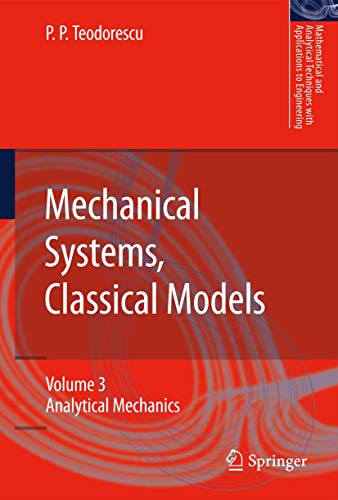
Mechanical Systems, Classical Models: Volume 3: Analytical Mechanics (Mathematical and Analytical Techniques with Applications to Engineering) - Softcover
Synopsis
All phenomena in nature are characterized by motion. Mechanics deals with the objective laws of mechanical motion of bodies, the simplest form of motion. In the study of a science of nature, mathematics plays an important rôle. Mechanics is the first science of nature which has been expressed in terms of mathematics, by considering various mathematical models, associated to phenomena of the surrounding nature. Thus, its development was influenced by the use of a strong mathematical tool. As it was already seen in the first two volumes of the present book, its guideline is precisely the mathematical model of mechanics. The classical models which we refer to are in fact models based on the Newtonian model of mechanics, that is on its five principles, i.e.: the inertia, the forces action, the action and reaction, the independence of the forces action and the initial conditions principle, respectively. Other models, e.g., the model of attraction forces between the particles of a discrete mechanical system, are part of the considered Newtonian model. Kepler’s laws brilliantly verify this model in case of velocities much smaller then the light velocity in vacuum.
"synopsis" may belong to another edition of this title.
About the Author
Prof. Dr. Doc. Petre P. Teodorescu
Born: June 30, 1929, Bucuresti.
M.Sc.: Faculty of Mathematics of the University of Bucharest, 1952; Faculty of Bridges of the Technical University of Civil Engineering, Bucharest, 1953.
Ph.D.: "Calculus of rectangular deep beams in a general case of support and loading", Technical University of Civil Engineering, Bucharest, 1955.
Academic Positions: Consulting Professor.
at the University of Bucharest, Faculty of Mathematics.
Fields of Research: Mechanics of Deformable Solids (especially Elastic Solids), Mathematical Methods of Calculus in Mechanics.
Selected Publications:
1. "Applications of the Theory of Distributions in Mechanics", Editura Academiei-Abacus Press, Bucuresti-Tunbrige Wells, Kent, 1974 (with W. Kecs);
2. "Dynamics of Linear Elastic Bodies", Editura Academiei-Abacus Press, Bucuresti-Tunbrige Wells, Kent, 1975;
3. "Spinor and Non-Euclidean Tensor Calculus with Applications", Editura Tehnicã-Abacus Press, Bucuresti-Tunbrige Wells, Kent, 1983 (with I. Beju and E. Soos);
4. "Mechanical Systems", vol. I, II, Editura Tehnicã, Bucuresti, 1988.
Invited Addresses: The 2nd European Conference of Solid Mechanics, September 1994, Genoa, Italy: Leader of a Section of the Conference and a Communication.
Lectures Given Abroad: Hannover, Dortmund, Paderborn, Germany, 1994; Padova, Pisa, Italy, 1994.
Additional Information: Prize "Gh. Titeica" of the Romanian Academy in 1966; Member in the Advisory Board of Meccanica (Italy), Mechanics Research Communications and Letters in Applied Engineering Sciences (U.S.A.); Member of GAMM (Germany) and AMS (U.S.A.); Reviewer: Mathematical Reviews, Zentralblatt fuer Mathematik und ihre Grenzgebiete, Ph.D. advisor.
From the Back Cover
This third volume completes the Work Mechanical Systems, Classical Models. The first two volumes dealt with particle dynamics and with discrete and continuous mechanical systems. The present volume studies analytical mechanics. Topics like Lagrangian and Hamiltonian mechanics, the Hamilton-Jacobi method, and a study of systems with separate variables are thoroughly discussed. Also included are variational principles and canonical transformations, integral invariants and exterior differential calculus, and particular attention is given to non-holonomic mechanical systems.
The author explains in detail all important aspects of the science of mechanics, regarded as a natural science, and shows how they are useful in understanding important natural phenomena and solving problems of interest in applied and engineering sciences.
Professor Teodorescu has spent more than fifty years as a Professor of Mechanics at the University of Bucharest and this book relies on the extensive literature on the subject as well as the author's original contributions.
Audience: scientists and researchers in applied mathematics, physics and engineering.
"About this title" may belong to another edition of this title.
Search results for Mechanical Systems, Classical Models: Volume 3: Analytical...

Stock Image
Teodorescu:Mechanical Systems, Classica (eng)
Print on DemandSeller: Brook Bookstore On Demand, Napoli, NA, Italy
Seller rating 5 out of 5 stars

Condition: new. Questo è un articolo print on demand. Seller Inventory # d47b38c0006ac162920e7588b8496824
Buy New
£ 144.72
£ 9.29 shipping
Ships from Italy to U.S.A.
Ships from Italy to U.S.A.
Quantity: Over 20 available
Stock Image
Mechanical Systems, Classical Models (Paperback)
Seller: Grand Eagle Retail, Bensenville, IL, U.S.A.
Seller rating 5 out of 5 stars
Paperback. Condition: new. Paperback. All phenomena in nature are characterized by motion. Mechanics deals with the objective laws of mechanical motion of bodies, the simplest form of motion. In the study of a science of nature, mathematics plays an important role. Mechanics is the first science of nature which has been expressed in terms of mathematics, by considering various mathematical models, associated to phenomena of the surrounding nature. Thus, its development was influenced by the use of a strong mathematical tool. As it was already seen in the first two volumes of the present book, its guideline is precisely the mathematical model of mechanics. The classical models which we refer to are in fact models based on the Newtonian model of mechanics, that is on its five principles, i.e.: the inertia, the forces action, the action and reaction, the independence of the forces action and the initial conditions principle, respectively. Other models, e.g., the model of attraction forces between the particles of a discrete mechanical system, are part of the considered Newtonian model. Keplers laws brilliantly verify this model in case of velocities much smaller then the light velocity in vacuum. The classical models which we refer to are in fact models based on the Newtonian model of mechanics, that is on its five principles, i.e.: the inertia, the forces action, the action and reaction, the independence of the forces action and the initial conditions principle, respectively. Shipping may be from multiple locations in the US or from the UK, depending on stock availability. Seller Inventory # 9789400736832
Stock Image
Mechanical Systems, Classical Models : Volume 3: Analytical Mechanics
Seller: GreatBookPricesUK, Woodford Green, United Kingdom
Seller rating 5 out of 5 stars
Condition: New. Seller Inventory # 18263973-n
Buy New
£ 178.08
£ 15 shipping
Ships from United Kingdom to U.S.A.
Ships from United Kingdom to U.S.A.
Quantity: Over 20 available
Seller Image
Mechanical Systems, Classical Models
Seller: moluna, Greven, Germany
Seller rating 5 out of 5 stars
Condition: New. Seller Inventory # 5826705
Buy New
£ 156.70
£ 41.39 shipping
Ships from Germany to U.S.A.
Ships from Germany to U.S.A.
Quantity: Over 20 available
Seller Image
Mechanical Systems, Classical Models : Volume 3: Analytical Mechanics
Seller: GreatBookPrices, Columbia, MD, U.S.A.
Seller rating 5 out of 5 stars
Condition: New. Seller Inventory # 18263973-n
Seller Image
Mechanical Systems, Classical Models
Published by
Springer Netherlands Mrz 2012, 2012
ISBN 10: 9400736835
ISBN 13: 9789400736832
New
Taschenbuch
Seller: BuchWeltWeit Ludwig Meier e.K., Bergisch Gladbach, Germany
Seller rating 5 out of 5 stars
Taschenbuch. Condition: Neu. This item is printed on demand - it takes 3-4 days longer - Neuware -All phenomena in nature are characterized by motion. Mechanics deals with the objective laws of mechanical motion of bodies, the simplest form of motion. In the study of a science of nature, mathematics plays an important rôle. Mechanics is the first science of nature which has been expressed in terms of mathematics, by considering various mathematical models, associated to phenomena of the surrounding nature. Thus, its development was influenced by the use of a strong mathematical tool. As it was already seen in the first two volumes of the present book, its guideline is precisely the mathematical model of mechanics. The classical models which we refer to are in fact models based on the Newtonian model of mechanics, that is on its five principles, i.e.: the inertia, the forces action, the action and reaction, the independence of the forces action and the initial conditions principle, respectively. Other models, e.g., the model of attraction forces between the particles of a discrete mechanical system, are part of the considered Newtonian model. Kepler's laws brilliantly verify this model in case of velocities much smaller then the light velocity in vacuum. 784 pp. Englisch. Seller Inventory # 9789400736832
Stock Image
Mechanical Systems, Classical Models: Volume 3: Analytical Mechanics (Mathematical and Analytical Techniques with Applications to Engineering)
Seller: Ria Christie Collections, Uxbridge, United Kingdom
Seller rating 5 out of 5 stars
Condition: New. In English. Seller Inventory # ria9789400736832_new
Buy New
£ 196.90
£ 14.94 shipping
Ships from United Kingdom to U.S.A.
Ships from United Kingdom to U.S.A.
Quantity: Over 20 available
Seller Image
Mechanical Systems, Classical Models | Volume 3: Analytical Mechanics
Seller: preigu, Osnabrück, Germany
Seller rating 5 out of 5 stars
Taschenbuch. Condition: Neu. Mechanical Systems, Classical Models | Volume 3: Analytical Mechanics | Petre P. Teodorescu | Taschenbuch | Mathematical and Analytical Techniques with Applications to Engineering | x | Englisch | 2012 | Springer | EAN 9789400736832 | Verantwortliche Person für die EU: Springer Verlag GmbH, Tiergartenstr. 17, 69121 Heidelberg, juergen[dot]hartmann[at]springer[dot]com | Anbieter: preigu. Seller Inventory # 106591948
Seller Image
Mechanical Systems, Classical Models
Seller: Rarewaves.com USA, London, LONDO, United Kingdom
Seller rating 5 out of 5 stars
Paperback. Condition: New. All phenomena in nature are characterized by motion. Mechanics deals with the objective laws of mechanical motion of bodies, the simplest form of motion. In the study of a science of nature, mathematics plays an important rôle. Mechanics is the first science of nature which has been expressed in terms of mathematics, by considering various mathematical models, associated to phenomena of the surrounding nature. Thus, its development was influenced by the use of a strong mathematical tool. As it was already seen in the first two volumes of the present book, its guideline is precisely the mathematical model of mechanics. The classical models which we refer to are in fact models based on the Newtonian model of mechanics, that is on its five principles, i.e.: the inertia, the forces action, the action and reaction, the independence of the forces action and the initial conditions principle, respectively. Other models, e.g., the model of attraction forces between the particles of a discrete mechanical system, are part of the considered Newtonian model. Kepler's laws brilliantly verify this model in case of velocities much smaller then the light velocity in vacuum. Seller Inventory # LU-9789400736832
Buy New
£ 229.69
Free Shipping
Ships from United Kingdom to U.S.A.
Ships from United Kingdom to U.S.A.
Quantity: Over 20 available
Seller Image
Mechanical Systems, Classical Models
Published by
Springer Netherlands, Springer Netherlands Mär 2012, 2012
ISBN 10: 9400736835
ISBN 13: 9789400736832
New
Taschenbuch
Seller: buchversandmimpf2000, Emtmannsberg, BAYE, Germany
Seller rating 5 out of 5 stars
Taschenbuch. Condition: Neu. This item is printed on demand - Print on Demand Titel. Neuware -All phenomena in nature are characterized by motion. Mechanics deals with the objective laws of mechanical motion of bodies, the simplest form of motion. In the study of a science of nature, mathematics plays an important rôle. Mechanics is the first science of nature which has been expressed in terms of mathematics, by considering various mathematical models, associated to phenomena of the surrounding nature. Thus, its development was influenced by the use of a strong mathematical tool. As it was already seen in the first two volumes of the present book, its guideline is precisely the mathematical model of mechanics. The classical models which we refer to are in fact models based on the Newtonian model of mechanics, that is on its five principles, i.e.: the inertia, the forces action, the action and reaction, the independence of the forces action and the initial conditions principle, respectively. Other models, e.g., the model of attraction forces between the particles of a discrete mechanical system, are part of the considered Newtonian model. Kepler¿s laws brilliantly verify this model in case of velocities much smaller then the light velocity in vacuum.Springer Verlag GmbH, Tiergartenstr. 17, 69121 Heidelberg 784 pp. Englisch. Seller Inventory # 9789400736832