
Items related to How We Vote : The Factors that Influence Voters
Synopsis
"
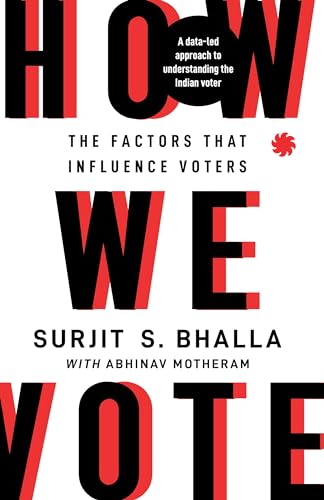
India has transformed and much has happened since the first Lok Sabha elections in 1951–52. Social media, AI and other technologies make it easy to spin narratives and evade accountability, and to glibly manufacture content, data and analysis. These threaten the development of a responsible civil society.
But then what really matters to voters? Times may have changed, but the substantive basis on which people vote – their perception of leadership and the improvement in their well-being – remains constant. Economist Surjit S.
Bhalla integrates politics, economics and psephology to offer insights into how voters think as India heads into its eighteenth general election.
This book examines historical voting patterns and reveals how these correlate to changes in income, employment, welfare schemes, gender equality and much else. It looks at future conundrums like delimitation. It considers how voter attitudes have changed. This deep dive into data comes up with some counter-intuitive conclusions. Whichever way the 2024 elections go, the reader will gain a better understanding of the hows and whys of voter choices.
""synopsis" may belong to another edition of this title.
About the Author
"
Surjit S. Bhalla was executive director for India, Sri Lanka, Bangladesh and Bhutan at the IMF and served on the PM’s Economic Advisory Council. He has also had stints at the World Bank, the Brookings Institution, Deutsche Bank and Goldman Sachs, and was founder-chairman of Oxus Investments. He has been a contributing editor for the Indian Express. He is the author of six books, including Imagine There’s No Country (2002) and The New Wealth of Nations (2017). His last book, Citizen Raj (2019), analysed Indian elections since 1952. He has a PhD in economics from Princeton University.
Abhinav Motheram works as a data science consultant at LEAD, Krea University. His research interests lie at the intersection of data quality, processes of data generation and related fields of survey methods. He holds a masters in economics from BITS Pilani.
""About this title" may belong to another edition of this title.
Search results for How We Vote : The Factors that Influence Voters

Stock Image
How We Vote : The Factors that Influence Voters
Seller: Majestic Books, Hounslow, United Kingdom
Seller rating 4 out of 5 stars

Condition: New. Seller Inventory # 397106809
Buy New
£ 6.92
£ 6.50 shipping
Ships from United Kingdom to U.S.A.
Ships from United Kingdom to U.S.A.
Quantity: 10 available
Stock Image
How We Vote : The Factors That Influence Voters
Seller: GreatBookPrices, Columbia, MD, U.S.A.
Seller rating 5 out of 5 stars

Condition: New. Seller Inventory # 47619365-n
Stock Image
How We Vote : The Factors that Influence Voters
Seller: Books Puddle, New York, NY, U.S.A.
Seller rating 4 out of 5 stars
Condition: New. Seller Inventory # 26400351654
Seller Image
How We Vote
Published by
Juggernaut Publication, IN, 2024
ISBN 10: 9353458439
ISBN 13: 9789353458430
New
Paperback
Seller: Rarewaves.com USA, London, LONDO, United Kingdom
Seller rating 5 out of 5 stars
Paperback. Condition: New. Seller Inventory # LU-9789353458430
Buy New
£ 15.14
Free Shipping
Ships from United Kingdom to U.S.A.
Ships from United Kingdom to U.S.A.
Quantity: 1 available
Stock Image
How We Vote : The Factors That Influence Voters
Seller: GreatBookPrices, Columbia, MD, U.S.A.
Seller rating 5 out of 5 stars
Condition: As New. Unread book in perfect condition. Seller Inventory # 47619365
Stock Image
How We Vote : The Factors that Influence Voters
Seller: Biblios, Frankfurt am main, HESSE, Germany
Seller rating 4 out of 5 stars
Condition: New. Seller Inventory # 18400351660
Stock Image
How We Vote
Seller: PBShop.store UK, Fairford, GLOS, United Kingdom
Seller rating 5 out of 5 stars
PAP. Condition: New. New Book. Shipped from UK. Established seller since 2000. Seller Inventory # GB-9789353458430
Buy New
£ 15.64
£ 4.16 shipping
Ships from United Kingdom to U.S.A.
Ships from United Kingdom to U.S.A.
Quantity: 1 available
Stock Image
How We Vote : The Factors that Influence Voters
Seller: Revaluation Books, Exeter, United Kingdom
Seller rating 5 out of 5 stars
Condition: Brand New. 256 pages. 8.46x5.51x0.63 inches. In Stock. Seller Inventory # __9353458439
Buy New
£ 12.32
£ 10 shipping
Ships from United Kingdom to U.S.A.
Ships from United Kingdom to U.S.A.
Quantity: 1 available
Stock Image
How We Vote (Paperback)
Seller: Grand Eagle Retail, Bensenville, IL, U.S.A.
Seller rating 5 out of 5 stars
Paperback. Condition: new. Paperback. India has transformed and much has happened since the first Lok Sabha elections in 195152. Social media, AI and other technologies make it easy to spin narratives and evade accountability, and to glibly manufacture content, data and analysis. These threaten the development of a responsible civil society. But then what really matters to voters? Times may have changed, but the substantive basis on which people vote their perception of leadership and the improvement in their well-being remains constant. Economist Surjit S. This book examines historical voting patterns and reveals how these correlate to changes in income, employment, welfare schemes, gender equality and much else. It looks at future conundrums like delimitation. It considers how voter attitudes have changed. This deep dive into data comes up with some counter-intuitive conclusions. Whichever way the 2024 elections go, the reader will gain a better understanding of the hows and whys of voter choices. Shipping may be from multiple locations in the US or from the UK, depending on stock availability. Seller Inventory # 9789353458430
Stock Image
How We Vote: The Factors that Influence Voters
Seller: Vedams eBooks (P) Ltd, New Delhi, India
Seller rating 4 out of 5 stars
Soft cover. Condition: New. India has transformed and much has happened since the first Lok Sabha elections in 195152. Social media, AI and other technologies make it easy to spin narratives and evade accountability, and to glibly manufacture content, data and analysis. These threaten the development of a responsible civil society. But then what really matters to voters? Times may have changed, but the substantive basis on which people vote their perception of leadership and the improvement in their well-being remains constant. Economist Surjit S. Bhalla integrates politics, economics and psephology to offer insights into how voters think as India heads into its eighteenth general election. This book examines historical voting patterns and reveals how these correlate to changes in income, employment, welfare schemes, gender equality and much else. It looks at future conundrums like delimitation. It considers how voter attitudes have changed. This deep dive into data comes up with some counter-intuitive conclusions. Whichever way the 2024 elections go, the reader will gain a better understanding of the hows and whys of voter choices. Seller Inventory # 154103