
Items related to Ohne Worte: Vocality and Instrumentality in 19th-Century...
Ohne Worte: Vocality and Instrumentality in 19th-Century Music (Geschriften van het Orpheus Instituut/Collected Writings of the Orpheus Institute, 12) - Softcover
Synopsis
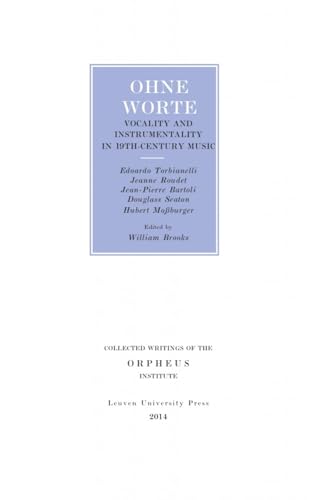
The musical thought and practice of canonical composers. What can music tell us – without words? Can it depict scenes, narrate stories, elucidate beliefs? And can it be an instrument through which we access the inner lives not only of musicians from the past but of ourselves, today? In Ohne Worte five scholars and performers probe these and related questions to illuminate both the experience and performance of nineteenthcentury music. Drawing on a rich range of sources, they reveal the musical thought and practice of canonical composers like Berlioz, Mendelssohn, and Schumann. Their work challenges us to reconsider our musical practices and the voices manifested in them, and it encourages the creation of an art that is both historical and transcendental.
"synopsis" may belong to another edition of this title.
About the Author
William Brooks is professor of music at the University of York, emeritus professor at the University of Illinois, scholar-in-residence at the Newberry Library, and senior research fellow at the Orpheus Institute.
From the Back Cover
The musical thought and practice of canonical composers. What can music tell us - without words? Can it depict scenes, narrate stories, elucidate beliefs? And can it be an instrument through which we access the inner lives not only of musicians from the past but of ourselves, today? In 'Ohne Worte' five scholars and performers probe these and related questions to illuminate both the experience and performance of nineteenthcentury music. Drawing on a rich range of sources, they reveal the musical thought and practice of canonical composers like Berlioz, Mendelssohn, and Schumann. Their work challenges us to reconsider our musical practices and the voices manifested in them, and it encourages the creation of an art that is both historical and transcendental.
"About this title" may belong to another edition of this title.
Search results for Ohne Worte: Vocality and Instrumentality in 19th-Century...

Stock Image
Ohne Worte
Seller: PBShop.store UK, Fairford, GLOS, United Kingdom
Seller rating 5 out of 5 stars

PAP. Condition: New. New Book. Shipped from UK. Established seller since 2000. Seller Inventory # CW-9789058679987
Buy New
£ 29.54
£ 5.02 shipping
Ships from United Kingdom to U.S.A.
Ships from United Kingdom to U.S.A.
Quantity: 1 available
Seller Image
Ohne Worte : Vocality and Instrumentality in 19th-Century Music
Published by
Leuven University Press, 2015
ISBN 10: 9058679985
ISBN 13: 9789058679987
Used
Softcover
Seller: GreatBookPrices, Columbia, MD, U.S.A.
Seller rating 5 out of 5 stars
Condition: As New. Unread book in perfect condition. Seller Inventory # 23160295
Seller Image
Ohne Worte : Vocality and Instrumentality in 19th-Century Music
Seller: GreatBookPrices, Columbia, MD, U.S.A.
Seller rating 5 out of 5 stars
Condition: New. Seller Inventory # 23160295-n
Seller Image
Ohne Worte
Published by
Leuven University Press, BE, 2014
ISBN 10: 9058679985
ISBN 13: 9789058679987
New
Paperback
Seller: Rarewaves.com USA, London, LONDO, United Kingdom
Seller rating 5 out of 5 stars
Paperback. Condition: New. The musical thought and practice of canonical composersWhat can music tell us-without words? Can it depict scenes, narrate stories, elucidate beliefs? And can it be an instrument through which we access the inner lives not only of musicians from the past but of ourselves, today?In Ohne Worte five scholars and performers probe these and related questions to illuminate both the experience and performance of nineteenth-century music. Drawing on a rich range of sources, they reveal the musical thought and practice of canonical composers like Berlioz, Mendelssohn, and Schumann. Their work challenges us to reconsider our musical practices and the voices manifested in them, and it encourages the creation of an art that is both historical and transcendental. This publication is GPRC-labeled (Guaranteed Peer-Reviewed Content).ContributorsJean-Pierre Bartoli (Université Paris-Sorbonne), Hubert Moßburger (Staatlichen Hochschule für Musik und Darstellende Kunst Stuttgart), Jeanne Roudet (Université Paris-Sorbonne), Douglass Seaton (Florida State University School of Music), Edoardo Torbianelli (Hochschule der Künste Bern). Seller Inventory # LU-9789058679987
Buy New
£ 36.36
Free Shipping
Ships from United Kingdom to U.S.A.
Ships from United Kingdom to U.S.A.
Quantity: 2 available
Stock Image
Ohne Worte: Vocality and Instrumentality in 19th-century Music
Seller: Revaluation Books, Exeter, United Kingdom
Seller rating 5 out of 5 stars
Paperback. Condition: Brand New. 1st edition. 100 pages. French language. 9.75x6.00x0.75 inches. In Stock. Seller Inventory # __9058679985
Buy New
£ 28.13
£ 10 shipping
Ships from United Kingdom to U.S.A.
Ships from United Kingdom to U.S.A.
Quantity: 2 available
Seller Image
Ohne Worte : Vocality and Instrumentality in 19th-Century Music
Seller: GreatBookPricesUK, Woodford Green, United Kingdom
Seller rating 5 out of 5 stars
Condition: New. Seller Inventory # 23160295-n
Buy New
£ 29.53
£ 15 shipping
Ships from United Kingdom to U.S.A.
Ships from United Kingdom to U.S.A.
Quantity: 4 available
Seller Image
Ohne Worte : Vocality and Instrumentality in 19th-Century Music
Published by
Leuven University Press, 2015
ISBN 10: 9058679985
ISBN 13: 9789058679987
Used
Softcover
Seller: GreatBookPricesUK, Woodford Green, United Kingdom
Seller rating 5 out of 5 stars
Condition: As New. Unread book in perfect condition. Seller Inventory # 23160295
Buy Used
£ 33.84
£ 15 shipping
Ships from United Kingdom to U.S.A.
Ships from United Kingdom to U.S.A.
Quantity: 4 available
Stock Image
Ohne Worte (Paperback)
Published by
Leuven University Press, Leuven, 2014
ISBN 10: 9058679985
ISBN 13: 9789058679987
New
Paperback
Seller: Grand Eagle Retail, Bensenville, IL, U.S.A.
Seller rating 5 out of 5 stars
Paperback. Condition: new. Paperback. What can music tell us-without words? Can it depict scenes, narrate stories, elucidate beliefs? And can it be an instrument through which we access the inner lives not only of musicians from the past but of ourselves, today? In Ohne Worte five scholars and performers probe these and related questions to illuminate both the experience and performance of nineteenth-century music. Drawing on a rich range of sources, they reveal the musical thought and practice of canonical composers like Berlioz, Mendelssohn, and Schumann. Their work challenges us to reconsider our musical practices and the voices manifested in them, and it encourages the creation of an art that is both historical and transcendental. Contributors: Jean-Pierre Bartoli (Universite Paris-Sorbonne), Hubert Mossburger (Staatlichen Hochschule fur Musik und Darstellende Kunst Stuttgart), Jeanne Roudet (Universite Paris-Sorbonne), Douglass Seaton (Florida State University School of Music), Edoardo Torbianelli (Hochschule der Kunste Bern) What can music tell us-without words? Can it depict scenes, narrate stories, elucidate beliefs? And can it be an instrument through which we access the inner lives not only of musicians from the past but of ourselves, today? Shipping may be from multiple locations in the US or from the UK, depending on stock availability. Seller Inventory # 9789058679987
Stock Image
Ohne Worte: Vocality and Instrumentality in 19th-Century Music (Collected Writings of the Orpheus Institute)
Published by
Leuven University Press, 2015
ISBN 10: 9058679985
ISBN 13: 9789058679987
New
Softcover
First Edition
Seller: Kennys Bookshop and Art Galleries Ltd., Galway, GY, Ireland
Seller rating 5 out of 5 stars
Condition: New. 2015. 1st Edition. Paperback. . . . . . Seller Inventory # V9789058679987
Stock Image
Ohne Worte: Vocality and Instrumentality in 19th-Century Music
Seller: Majestic Books, Hounslow, United Kingdom
Seller rating 4 out of 5 stars

Condition: New. pp. 100. Seller Inventory # 373683166
Buy New
£ 58.92
£ 6.50 shipping
Ships from United Kingdom to U.S.A.
Ships from United Kingdom to U.S.A.
Quantity: 1 available