
Items related to Evolutionary Developmental Biology of Crustacea (Advances...
Evolutionary Developmental Biology of Crustacea (Advances in Crustacean Research) - Hardcover
Book 13 of 16: Advances in Crustacean Research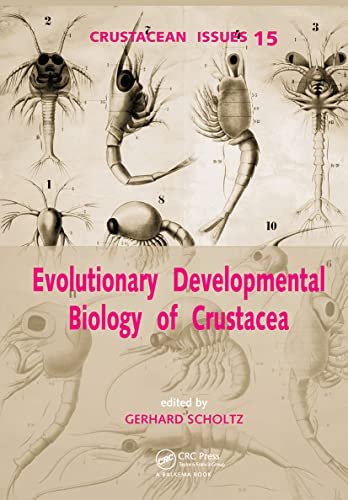
Synopsis
Crustaceans, due to the great diversity of their body organization, segmentation patterns, tagmatization, limb types, larval forms, cleavage, and gastrulation modes, are highly desirable for the study of questions at the interface of evolution and development. Modern interest in evolutionary developmental biology (evo-devo) rests on the molecular genetic approach and a variety of molecular techniques have proven fruitful when performed on crustaceans. Evolutionary Developmental Biology of Crustacea presents a comprehensive treatment of all aspects of the field, beginning with a discussion of the implications of the typological Bauplan and phylum concepts versus historical concepts such as ground pattern and monophylum for the formulation of conceptual questions in evo-devo. Following this, the authors present the results of Hox gene expression in various crustacean taxa, aspects of segment formation at the cellular and genetic levels, the formation of segmental structures such as neurons, ganglia, and limbs, and the role of morphological ontogenetic characters in resolving phylogenetic relationships. By covering so many general aspects of crustacean development, morphology, and evolution, Evolutionary Developmental Biology of Crustacea serves as an indispensable reference for developmental and evolutionary biologists investigating the role of genetics in evolution and development.
"synopsis" may belong to another edition of this title.
About the Author
Gerhard Scholtz
From the Back Cover
Evolutionary Developmental Biology of Crustacea presents a comprehensive treatment of all aspects of the field, beginning with a discussion of the implications of the typological Bauplan and phylum concepts versus historical concepts such as ground pattern and monophylum for the formulation of conceptual questions in evo-devo. Following this, the authors present the results of Hox gene expression in various crustacean taxa, aspects of segment formation at the cellular and genetic levels, the formation of segmental structures such as neurons, ganglia, and limbs, and the role of morphological ontogenetic characters in resolving phylogenetic relationships.
"About this title" may belong to another edition of this title.
Search results for Evolutionary Developmental Biology of Crustacea (Advances...

Stock Image
Evolutionary Developmental Biology of Crustacea. (=Crustacean Issues, 15)
Published by
Lisse, Abingdon, Tokyo : A A Balkema Publishers, 2004
ISBN 10: 9058096378
ISBN 13: 9789058096371
Used
Hardcover
Seller: Antiquariat Thomas Haker GmbH & Co. KG, Berlin, Germany
Seller rating 5 out of 5 stars

Hardcover. Condition: Gut. 285 p., ill. Good. Ex-library with usual markings. Clean pages. Sprache: Englisch Gewicht in Gramm: 850. Seller Inventory # 871819
Stock Image
Evolutionary Developmental Biology of Crustacea.; (Crustacean Issues, Book 15
Seller: J. HOOD, BOOKSELLERS, ABAA/ILAB, Baldwin City, KS, U.S.A.
Seller rating 5 out of 5 stars
Hardcover. 300pp. As new, clean, tight and bright condition without a dust jacket as published. Seller Inventory # 212297
Stock Image
Evolutionary Developmental Biology of Crustacea
Print on DemandSeller: Majestic Books, Hounslow, United Kingdom
Seller rating 4 out of 5 stars

Condition: New. pp. 220 This item is printed on demand. Seller Inventory # 6876387
Buy New
£ 96.36
£ 6.50 shipping
Ships from United Kingdom to U.S.A.
Ships from United Kingdom to U.S.A.
Quantity: 3 available
Stock Image
Evolutionary Developmental Biology of Crustacea
Seller: GreatBookPrices, Columbia, MD, U.S.A.
Seller rating 5 out of 5 stars
Condition: New. Seller Inventory # 2064066-n
Stock Image
Evolutionary Developmental Biology of Crustacea
Seller: Books Puddle, Woodside, NY, U.S.A.
Seller rating 4 out of 5 stars
Condition: New. pp. 220. Seller Inventory # 262052924
Stock Image
Evolutionary Developmental Biology of Crustacea (Advances in Crustacean Research)
Seller: California Books, Miami, FL, U.S.A.
Seller rating 5 out of 5 stars
Condition: New. Seller Inventory # I-9789058096371
Stock Image
Evolutionary Developmental Biology of Crustacea
Seller: GreatBookPricesUK, Woodford Green, United Kingdom
Seller rating 5 out of 5 stars
Condition: New. Seller Inventory # 2064066-n
Buy New
£ 99.21
£ 15 shipping
Ships from United Kingdom to U.S.A.
Ships from United Kingdom to U.S.A.
Quantity: Over 20 available
Stock Image
Evolutionary Developmental Biology of Crustacea
Print on DemandSeller: Biblios, Frankfurt am main, HESSE, Germany
Seller rating 4 out of 5 stars
Condition: New. PRINT ON DEMAND pp. 220. Seller Inventory # 182052918
Stock Image
Evolutionary Developmental Biology of Crustacea (Advances in Crustacean Research)
Seller: Ria Christie Collections, Uxbridge, United Kingdom
Seller rating 5 out of 5 stars
Condition: New. In English. Seller Inventory # ria9789058096371_new
Buy New
£ 111.73
£ 11.29 shipping
Ships from United Kingdom to U.S.A.
Ships from United Kingdom to U.S.A.
Quantity: Over 20 available
Stock Image
Evolutionary Developmental Biology of Crustacea
Seller: Revaluation Books, Exeter, United Kingdom
Seller rating 5 out of 5 stars
Hardcover. Condition: Brand New. 1st edition. 220 pages. 9.50x6.75x0.75 inches. In Stock. Seller Inventory # x-9058096378
Buy New
£ 133.87
£ 12.50 shipping
Ships from United Kingdom to U.S.A.
Ships from United Kingdom to U.S.A.
Quantity: 2 available