
Items related to One Parent – One Language: An interactional...
Synopsis
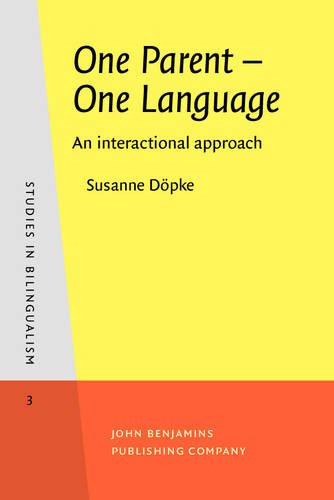
This volume examines the relationship between young children's degrees of bilingualism and features of the verbal input which these children receive from their parents. In particular, it seeks to explore the following question: to what extent are families who follow the 'one parent-one language' principle and whose children become active bilinguals this way, different from families who take the same approach but whose children never develop an active command of the minority language? Case studies of six first-born children growing up with German and English were done during the children's third year of life. The input the children received was examined for parents' consistency of language choice, parents' insistence that the children use the appropriate language, parents' sensitivity towards the children's interactional and attentional needs, and parents' orientation towards the teaching of formal aspects of the linguistic system. The findings support the notion that raising one's children bilingually according to the 'one parent-one language' principle involves great efforts on the side of the minority language-speaking parent. Importantly, they indicate that these efforts must be invested in the child's education turn-by-turn.
"synopsis" may belong to another edition of this title.
Synopsis
The divergence in attitudes to the degree of bilingualism that can be achieved through the "one parent-one language" approach is striking. On the one hand, it is claimed that children can acquire two languages simultaneously as a matter of course of being exposed to them and, on the other hand, there are parents who report that their children never progressed past a limited amount of actively used words and a set number of rehearsed phrases in the minority language. The aim of this study is to analyze this discrepancy more closely. In the first chapter, the theoretical framework and the hypotheses underlying the study are presented. The book then offers an account of an empirical investigation of the degree of bilingualism in six German-English families who employ the "one parent-one language" principle. It describes the collection and processing of the data and analyzes the children's proficiency in German. The parents are compared with respect to the linguistic input they provided, which is discussed in relation to the children's proficiency in German; the language environment is examined on a macrolevel (parents' attitude to bilingualism, extent of contact with German).
The main body of the study consists of an analysis of the discourse structures each parent is engaged in, with special emphasis on the teaching methods the parents employed. The concluding chapter also presents a follow-up of the children's further development in German."About this title" may belong to another edition of this title.
Search results for One Parent – One Language: An interactional...

Stock Image
One Parent One Language. An interactional approach.
Seller: Revaluation Books, Exeter, United Kingdom
Seller rating 5 out of 5 stars

Paperback. Condition: Brand New. 231 pages. 8.27x5.91x0.47 inches. In Stock. Seller Inventory # __9027241074
Stock Image
One Parent One Language an Interactional Approach
Published by
John Benjamin's Publishing Company, Amsterdam and Philadelphia, 1992
ISBN 10: 9027241074
ISBN 13: 9789027241078
Used
Hardcover
First Edition
Seller: Webbooks, Wigtown, Wigtown, United Kingdom
Seller rating 5 out of 5 stars
Hard Cover. Condition: Good. No Jacket. First Edition. From an academic library with the usual stamps and labels. Apart from the library evidence a decent copy. A00018346. Seller Inventory # A00018346
Stock Image
One Parent One Language an Interactional Approach
Published by
John Benjamin's Publishing Company, Amsterdam and Philadelphia, 1992
ISBN 10: 9027241074
ISBN 13: 9789027241078
Used
Hardcover
First Edition
Seller: Webbooks, Wigtown, Wigtown, United Kingdom
Seller rating 5 out of 5 stars
Hard Cover. Condition: Good. No Jacket. First Edition. From an academic library with the usual stamps and labels. Apart from the library evidence a decent copy. A00018345. Seller Inventory # A00018345
Stock Image
One Parent One Language an Interactional Approach
Published by
John Benjamin's Publishing Company, Amsterdam and Philadelphia, 1992
ISBN 10: 9027241074
ISBN 13: 9789027241078
Used
Hardcover
First Edition
Seller: Webbooks, Wigtown, Wigtown, United Kingdom
Seller rating 5 out of 5 stars
Hard Cover. Condition: Good. No Jacket. First Edition. From an academic library with the usual stamps and labels. Apart from the library evidence a decent copy. A00018347. Seller Inventory # A00018347