
Synopsis
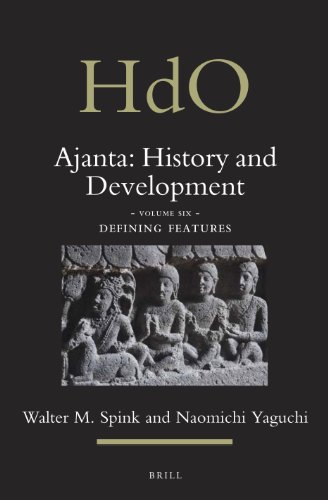
Volume 6, in Walter Spink's detailed analysis of the creation and development of the Ajanta caves, during the reign of the emperor Harisena (c.460-c.477) has had a profound and often upsetting impact on the understanding of Indian history in the so-called Golden Age. The author contends that through the discipline of Art History one can in fact change the established view of cultural developments in the crucial "Classic Age" (5th Century CE). One of his major aims is to prove that it was the Vakatakas, under the emperor Harisena, and not the Guptas, that brought Indian culture to its apogee in the late 470s and to show that by analyzing and organizing Ajanta's "defining feature" in revealing developmental sequences, one can support, with specifics, the revolutionary (but now increasingly accepted) "short chronology" for which the author is well known. These "defining features" range from the changing types of Buddha images and living arrangements for the monks, to the precise analysis of the evolution of pillars, doorways, and excavation techniques. The volume also includes, at the start, a discussion of the transforming effect of competition, and finally war, as a key to Ajanta's highly driven development, its florescence, and finally its sad demise.
"synopsis" may belong to another edition of this title.
About the Author
Walter M. Spink, Professor Emeritus of Indian Art at the University of Michigan received his PhD from Harvard University in 1954. His chief interest has entered upon the Ajanta caves in India, where he had spent many years, with support from Bollingen, Guggenheim, Fulbright Foundations, NEH, and AIIS for his Ajanta: History and Development (Brill).
Naomichi Yaguchi, Associate Professor, Kanazawa University, Japan, has taken all of the photographs for, and has been actively involved in discussions about the volume.
"About this title" may belong to another edition of this title.
Search results for Ajanta: History and Development, Volume 6 Defining...

Stock Image
Defining Features
Seller: Rain Dog Books, Bloomington, IL, U.S.A.
Seller rating 4 out of 5 stars

Hardcover. Condition: Fine. 8vo. 464 pages. Ajanta: History And Development, 18/6. We specialize in fine books in collectible condition. Orders are professionaly packaged and shipped promptly. Seller Inventory # 88514
Stock Image
Ajanta History and Development Volume 6 Defining Features
Print on DemandSeller: Brook Bookstore On Demand, Napoli, NA, Italy
Seller rating 5 out of 5 stars

Condition: new. Questo è un articolo print on demand. Seller Inventory # ea8aa759172a23d54366120db37a4935
Buy New
£ 158.89
£ 6.84 shipping
Ships from Italy to U.S.A.
Ships from Italy to U.S.A.
Quantity: Over 20 available
Stock Image
Ajanta: History and Development : : Defining Features Volume 6 (Ajanta: History and Development S., No. 18\6)
Seller: Asano Bookshop, Nagoya, AICHI, Japan
Seller rating 5 out of 5 stars
Hardcover. Condition: New. Volume 6 of Walter Spink's monumental and continuing study of the Ajanta caves, with over 350 illustrations, explains the gradual evolution of the site's architectural and sculptural features during Ajanta's remarkably brief development (462-480 CE). Seller Inventory # a28322
Stock Image
Defining Features (Ajanta: History and Development, 18/6)
Seller: Mispah books, Redhill, SURRE, United Kingdom
Seller rating 4 out of 5 stars
hardcover. Condition: New. NEW. SHIPS FROM MULTIPLE LOCATIONS. book. Seller Inventory # ERICA829900418015X5
Stock Image
Ajanta: History and Development, Volume 6 Defining Features
Seller: PBShop.store UK, Fairford, GLOS, United Kingdom
Seller rating 5 out of 5 stars
HRD. Condition: New. New Book. Shipped from UK. Established seller since 2000. Seller Inventory # L2-9789004180154
Buy New
£ 213.37
£ 6.76 shipping
Ships from United Kingdom to U.S.A.
Ships from United Kingdom to U.S.A.
Quantity: Over 20 available
Stock Image
Ajanta: History and Development, Defining Features: Vol 6
Print on DemandSeller: Revaluation Books, Exeter, United Kingdom
Seller rating 5 out of 5 stars
Hardcover. Condition: Brand New. 525 pages. 9.50x6.25x1.00 inches. In Stock. This item is printed on demand. Seller Inventory # __900418015X
Buy New
£ 232.49
£ 12.50 shipping
Ships from United Kingdom to U.S.A.
Ships from United Kingdom to U.S.A.
Quantity: 1 available
Seller Image
Ajanta: History and Development, Volume 6 Defining Features
Seller: moluna, Greven, Germany
Seller rating 5 out of 5 stars
Hardcover. Condition: New. Über den AutorWalter M. Spink, Professor Emeritus of Indian Art at the University of Michigan received his PhD from Harvard University in 1954. His chief interest has entered upon the Ajanta caves in India, where he had spent many y. Seller Inventory # 909456807
Buy New
£ 239.06
£ 41.87 shipping
Ships from Germany to U.S.A.
Ships from Germany to U.S.A.
Quantity: Over 20 available
Seller Image
Ajanta : History and Development, Volume 6 Defining Features
Published by
Koninklijke Brill BV Mär 2014, 2014
ISBN 10: 900418015X
ISBN 13: 9789004180154
New
Hardcover
Seller: AHA-BUCH GmbH, Einbeck, Germany
Seller rating 5 out of 5 stars
Buch. Condition: Neu. Neuware - Volume 6, in Walter Spink's detailed analysis of the creation and development of the Ajanta caves, during the reign of the emperor Harisena (c.460-c.477) has had a profound and often upsetting impact on the understanding of Indian history in the so-called Golden Age. The author contends that through the discipline of Art History one can in fact change the established view of cultural developments in the crucial 'Classic Age' (5th Century CE). One of his major aims is to prove that it was the Vakatakas, under the emperor Harisena, and not the Guptas, that brought Indian culture to its apogee in the late 470s and to show that by analyzing and organizing Ajanta's 'defining feature' in revealing developmental sequences, one can support, with specifics, the revolutionary (but now increasingly accepted) 'short chronology' for which the author is well known. These 'defining features' range from the changing types of Buddha images and living arrangements for the monks, to the precise analysis of the evolution of pillars, doorways, and excavation techniques. The volume also includes, at the start, a discussion of the transforming effect of competition, and finally war, as a key to Ajanta's highly driven development, its florescence, and finally its sad demise. Seller Inventory # 9789004180154