
Items related to Frontiers in European Radiology: 4
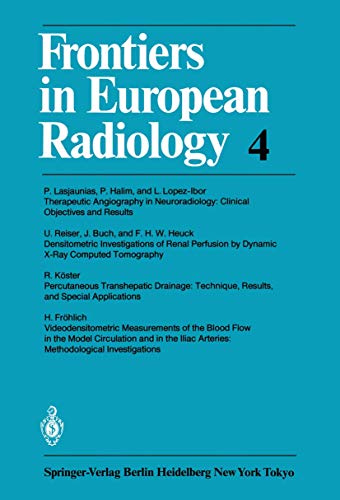
Synopsis
The quantitative analysis of blood flow within central and peripheral blood vessels has attracted more and more interest, for with the rapid developments in vascular surgery and the introduction of percutaneous transluminal angioplasty, it is becom ing increasingly important to be able to measure regional blood flow in man. In clinical radiology, angiography has been used predominantly from the point of view of its morphological applications. However, theoretically angiography may also be regarded as a specific application of indicator-dilution measurements of blood flow. The indicator is contrast medium (CM), the changing concentration of which is re corded by cinematography or video-electronic systems at sites downstream from the point of injection. The curves of density thus obtained correspond to indicator-di lution curves. The blood flow can be calculated from the concentration-time curves ofCM in much the same way as it is estimated from other indicator-dilution curves. In our early work with clinical application of videodensitometric measurement of blood flow in the iliac artery, we found that this method did not offer as high a degree of accuracy as one would have expected from investigations by other authors. We saw that we needed to examine the following problems: 1. We had to investigate whether our conventional X-ray equipment and video densitometer could be viewed as a linear measuring system. To what extent do unavoidable nonlinear changes in the measuring signals influence the blood flow values? 2.
"synopsis" may belong to another edition of this title.
Search results for Frontiers in European Radiology: 4

Stock Image
Frontiers in European Radiology (eng)
Print on DemandSeller: Brook Bookstore On Demand, Napoli, NA, Italy
Seller rating 5 out of 5 stars

Condition: new. Questo è un articolo print on demand. Seller Inventory # ZDWZTWYHDE
Buy New
£ 74.12
£ 4.59 shipping
Ships from Italy to U.S.A.
Ships from Italy to U.S.A.
Quantity: Over 20 available
Stock Image
Frontiers in European Radiology
Seller: California Books, Miami, FL, U.S.A.
Seller rating 5 out of 5 stars
Condition: New. Seller Inventory # I-9783642697197
Seller Image
Frontiers in European Radiology
Seller: GreatBookPrices, Columbia, MD, U.S.A.
Seller rating 5 out of 5 stars
Condition: New. Seller Inventory # 18758160-n
Seller Image
Frontiers in European Radiology
Published by
Springer, J.B. Metzler Nov 2011, 2011
ISBN 10: 3642697194
ISBN 13: 9783642697197
New
Taschenbuch
Seller: BuchWeltWeit Ludwig Meier e.K., Bergisch Gladbach, Germany
Seller rating 5 out of 5 stars
Taschenbuch. Condition: Neu. This item is printed on demand - it takes 3-4 days longer - Neuware -The quantitative analysis of blood flow within central and peripheral blood vessels has attracted more and more interest, for with the rapid developments in vascular surgery and the introduction of percutaneous transluminal angioplasty, it is becom ing increasingly important to be able to measure regional blood flow in man. In clinical radiology, angiography has been used predominantly from the point of view of its morphological applications. However, theoretically angiography may also be regarded as a specific application of indicator-dilution measurements of blood flow. The indicator is contrast medium (CM), the changing concentration of which is re corded by cinematography or video-electronic systems at sites downstream from the point of injection. The curves of density thus obtained correspond to indicator-di lution curves. The blood flow can be calculated from the concentration-time curves ofCM in much the same way as it is estimated from other indicator-dilution curves. In our early work with clinical application of videodensitometric measurement of blood flow in the iliac artery, we found that this method did not offer as high a degree of accuracy as one would have expected from investigations by other authors. We saw that we needed to examine the following problems: 1. We had to investigate whether our conventional X-ray equipment and video densitometer could be viewed as a linear measuring system. To what extent do unavoidable nonlinear changes in the measuring signals influence the blood flow values 2. 168 pp. Englisch. Seller Inventory # 9783642697197
Seller Image
Frontiers in European Radiology
Seller: GreatBookPricesUK, Woodford Green, United Kingdom
Seller rating 5 out of 5 stars
Condition: New. Seller Inventory # 18758160-n
Buy New
£ 100.14
£ 15 shipping
Ships from United Kingdom to U.S.A.
Ships from United Kingdom to U.S.A.
Quantity: Over 20 available
Seller Image
Frontiers in European Radiology
Published by
Springer Berlin Heidelberg, 2011
ISBN 10: 3642697194
ISBN 13: 9783642697197
New
Softcover
Seller: moluna, Greven, Germany
Seller rating 5 out of 5 stars
Condition: New. Seller Inventory # 5068359
Buy New
£ 79.30
£ 40.88 shipping
Ships from Germany to U.S.A.
Ships from Germany to U.S.A.
Quantity: Over 20 available
Seller Image
Frontiers in European Radiology
Seller: AHA-BUCH GmbH, Einbeck, Germany
Seller rating 5 out of 5 stars
Taschenbuch. Condition: Neu. Druck auf Anfrage Neuware - Printed after ordering - The quantitative analysis of blood flow within central and peripheral blood vessels has attracted more and more interest, for with the rapid developments in vascular surgery and the introduction of percutaneous transluminal angioplasty, it is becom ing increasingly important to be able to measure regional blood flow in man. In clinical radiology, angiography has been used predominantly from the point of view of its morphological applications. However, theoretically angiography may also be regarded as a specific application of indicator-dilution measurements of blood flow. The indicator is contrast medium (CM), the changing concentration of which is re corded by cinematography or video-electronic systems at sites downstream from the point of injection. The curves of density thus obtained correspond to indicator-di lution curves. The blood flow can be calculated from the concentration-time curves ofCM in much the same way as it is estimated from other indicator-dilution curves. In our early work with clinical application of videodensitometric measurement of blood flow in the iliac artery, we found that this method did not offer as high a degree of accuracy as one would have expected from investigations by other authors. We saw that we needed to examine the following problems: 1. We had to investigate whether our conventional X-ray equipment and video densitometer could be viewed as a linear measuring system. To what extent do unavoidable nonlinear changes in the measuring signals influence the blood flow values 2. Seller Inventory # 9783642697197
Stock Image
Frontiers in European Radiology
Seller: Revaluation Books, Exeter, United Kingdom
Seller rating 5 out of 5 stars
Paperback. Condition: Brand New. reprint edition. 168 pages. 9.60x6.60x0.50 inches. In Stock. Seller Inventory # x-3642697194
Buy New
£ 127.26
£ 10 shipping
Ships from United Kingdom to U.S.A.
Ships from United Kingdom to U.S.A.
Quantity: 2 available
Stock Image
Frontiers in European Radiology
Seller: Books Puddle, Woodside, NY, U.S.A.
Seller rating 4 out of 5 stars

Condition: New. pp. 170. Seller Inventory # 2658586407
Seller Image
Frontiers in European Radiology
Published by
Springer, J.B. Metzler Nov 2011, 2011
ISBN 10: 3642697194
ISBN 13: 9783642697197
New
Taschenbuch
Seller: buchversandmimpf2000, Emtmannsberg, BAYE, Germany
Seller rating 5 out of 5 stars
Taschenbuch. Condition: Neu. This item is printed on demand - Print on Demand Titel. Neuware -The quantitative analysis of blood flow within central and peripheral blood vessels has attracted more and more interest, for with the rapid developments in vascular surgery and the introduction of percutaneous transluminal angioplasty, it is becom ing increasingly important to be able to measure regional blood flow in man. In clinical radiology, angiography has been used predominantly from the point of view of its morphological applications. However, theoretically angiography may also be regarded as a specific application of indicator-dilution measurements of blood flow. The indicator is contrast medium (CM), the changing concentration of which is re corded by cinematography or video-electronic systems at sites downstream from the point of injection. The curves of density thus obtained correspond to indicator-di lution curves. The blood flow can be calculated from the concentration-time curves ofCM in much the same way as it is estimated from other indicator-dilution curves. In our early work with clinical application of videodensitometric measurement of blood flow in the iliac artery, we found that this method did not offer as high a degree of accuracy as one would have expected from investigations by other authors. We saw that we needed to examine the following problems: 1. We had to investigate whether our conventional X-ray equipment and video densitometer could be viewed as a linear measuring system. To what extent do unavoidable nonlinear changes in the measuring signals influence the blood flow values 2.Springer-Verlag KG, Sachsenplatz 4-6, 1201 Wien 168 pp. Englisch. Seller Inventory # 9783642697197