
Items related to Logic and Games on Automatic Structures: Playing with...
Logic and Games on Automatic Structures: Playing with Quantifiers and Decompositions: 6810 (Lecture Notes in Computer Science, 6810) - Softcover
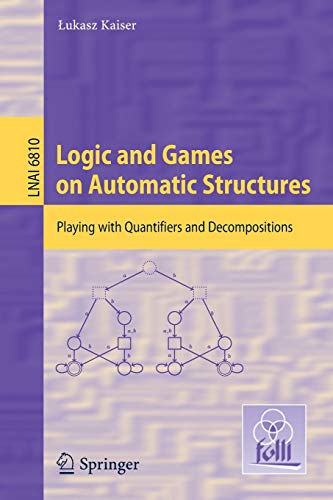
Synopsis
This book presents an innovative study in algorithmic model theory, demonstrating the deep interplay between logic and computability in automatic structures. It is based on the PhD thesis of Lukasz Kaiser, which was awarded the E.W. Beth award.
"synopsis" may belong to another edition of this title.
From the Back Cover
The evaluation of a logical formula can be viewed as a game played by two opponents, one trying to show that the formula is true and the other trying to prove it is false. This correspondence has been known for a very long time and has inspired numerous research directions. In this book, the author extends this connection between logic and games to the class of automatic structures, where relations are recognized by synchronous finite automata.
In model-checking games for automatic structures, two coalitions play against each other with a particular kind of hierarchical imperfect information. The investigation of such games leads to the introduction of a game quantifier on automatic structures, which connects alternating automata with the classical model-theoretic notion of a game quantifier. This study is then extended, determining the memory needed for strategies in infinitary games on the one hand, and characterizing regularity-preserving Lindström quantifiers on the other. Counting quantifiers are investigated in depth: it is shown that all countable omega-automatic structures are in fact finite-word automatic and that the infinity and uncountability set quantifiers are definable in MSO over countable linear orders and over labeled binary trees.
This book is based on the PhD thesis of Lukasz Kaiser, which was awarded with the E.W. Beth award for outstanding dissertations in the fields of logic, language, and information in 2009. The work constitutes an innovative study in the area of algorithmic model theory, demonstrating the deep interplay between logic and computability in automatic structures. It displays very high technical and presentational quality and originality, advances significantly the field of algorithmic model theory and raises interesting new questions, thus emerging as a fruitful and inspiring source for future research.
"About this title" may belong to another edition of this title.
Search results for Logic and Games on Automatic Structures: Playing with...

Stock Image
Kaiser:Logic and Games on Automatic Str (eng)
Print on DemandSeller: Brook Bookstore On Demand, Napoli, NA, Italy
Seller rating 5 out of 5 stars

Condition: new. Questo è un articolo print on demand. Seller Inventory # fe759c403c525a0cec6cf0ee20e55760
Buy New
£ 40.46
£ 3.40 shipping
Ships from Italy to U.S.A.
Ships from Italy to U.S.A.
Quantity: Over 20 available
Seller Image
Logic and Games on Automatic Structures : Playing with Quantifiers and Decompositions
Seller: GreatBookPrices, Columbia, MD, U.S.A.
Seller rating 5 out of 5 stars
Condition: New. Seller Inventory # 12935710-n
Seller Image
Logic and Games on Automatic Structures
Published by
Springer-Verlag Berlin and Heidelberg GmbH and Co. KG, DE, 2011
ISBN 10: 3642228062
ISBN 13: 9783642228063
New
Paperback
Seller: Rarewaves.com USA, London, LONDO, United Kingdom
Seller rating 5 out of 5 stars
Paperback. Condition: New. 2011 ed. The evaluation of a logical formula can be viewed as a game played by two opponents, one trying to show that the formula is true and the other trying to prove it is false. This correspondence has been known for a very long time and has inspired numerous research directions. In this book, the author extends this connection between logic and games to the class of automatic structures, where relations are recognized by synchronous finite automata.In model-checking games for automatic structures, two coalitions play against each other with a particular kind of hierarchical imperfect information. The investigation of such games leads to the introduction of a game quantifier on automatic structures, which connects alternating automata with the classical model-theoretic notion of a game quantifier. This study is then extended, determining the memory needed for strategies in infinitary games on the one hand, and characterizing regularity-preserving Lindström quantifiers on the other. Counting quantifiers are investigated in depth: it is shown that all countable omega-automatic structures are in fact finite-word automatic and that the infinity and uncountability set quantifiers are definable in MSO over countable linear orders and over labeled binary trees.This book is based on the PhD thesis of Lukasz Kaiser, which was awarded with the E.W. Beth award for outstanding dissertations in the fields of logic, language, and information in 2009. The work constitutes an innovative study in the area of algorithmic model theory, demonstrating the deep interplay between logic and computability in automatic structures. It displays very high technical and presentational quality and originality, advances significantly the field of algorithmic model theory and raises interesting new questions, thus emerging as a fruitful and inspiring source for future research. Seller Inventory # LU-9783642228063
Buy New
£ 55.57
Free Shipping
Ships from United Kingdom to U.S.A.
Ships from United Kingdom to U.S.A.
Quantity: Over 20 available
Stock Image
Logic and Games on Automatic Structures : Playing with Quantifiers and Decompositions
Seller: GreatBookPrices, Columbia, MD, U.S.A.
Seller rating 5 out of 5 stars
Condition: As New. Unread book in perfect condition. Seller Inventory # 12935710
Stock Image
Logic and Games on Automatic Structures : Playing with Quantifiers and Decompositions
Seller: Chiron Media, Wallingford, United Kingdom
Seller rating 5 out of 5 stars
PF. Condition: New. Seller Inventory # 6666-IUK-9783642228063
Buy New
£ 47.39
£ 15.49 shipping
Ships from United Kingdom to U.S.A.
Ships from United Kingdom to U.S.A.
Quantity: 10 available
Stock Image
Logic and Games on Automatic Structures: Playing with Quantifiers and Decompositions (Lecture Notes in Computer Science, 6810)
Seller: Ria Christie Collections, Uxbridge, United Kingdom
Seller rating 5 out of 5 stars
Condition: New. In English. Seller Inventory # ria9783642228063_new
Buy New
£ 54.35
£ 9.37 shipping
Ships from United Kingdom to U.S.A.
Ships from United Kingdom to U.S.A.
Quantity: Over 20 available
Stock Image
Logic and Games on Automatic Structures: Playing With Quantifiers and Decompositions
Published by
Springer-Verlag New York Inc, 2011
ISBN 10: 3642228062
ISBN 13: 9783642228063
New
Paperback
Seller: Revaluation Books, Exeter, United Kingdom
Seller rating 5 out of 5 stars
Paperback. Condition: Brand New. 130 pages. 9.10x6.10x0.30 inches. In Stock. Seller Inventory # x-3642228062
Buy New
£ 65.18
£ 10 shipping
Ships from United Kingdom to U.S.A.
Ships from United Kingdom to U.S.A.
Quantity: 2 available
Seller Image
Logic and Games on Automatic Structures
Published by
Springer Berlin Heidelberg, 2011
ISBN 10: 3642228062
ISBN 13: 9783642228063
New
Kartoniert / Broschiert
Seller: moluna, Greven, Germany
Seller rating 5 out of 5 stars
Kartoniert / Broschiert. Condition: New. Seller Inventory # 5053008
Buy New
£ 42.66
£ 41.63 shipping
Ships from Germany to U.S.A.
Ships from Germany to U.S.A.
Quantity: Over 20 available
Seller Image
Logic and Games on Automatic Structures
Published by
Springer-Verlag Berlin and Heidelberg GmbH and Co. KG, DE, 2011
ISBN 10: 3642228062
ISBN 13: 9783642228063
New
Paperback
Seller: Rarewaves.com UK, London, United Kingdom
Seller rating 5 out of 5 stars
Paperback. Condition: New. 2011 ed. The evaluation of a logical formula can be viewed as a game played by two opponents, one trying to show that the formula is true and the other trying to prove it is false. This correspondence has been known for a very long time and has inspired numerous research directions. In this book, the author extends this connection between logic and games to the class of automatic structures, where relations are recognized by synchronous finite automata.In model-checking games for automatic structures, two coalitions play against each other with a particular kind of hierarchical imperfect information. The investigation of such games leads to the introduction of a game quantifier on automatic structures, which connects alternating automata with the classical model-theoretic notion of a game quantifier. This study is then extended, determining the memory needed for strategies in infinitary games on the one hand, and characterizing regularity-preserving Lindström quantifiers on the other. Counting quantifiers are investigated in depth: it is shown that all countable omega-automatic structures are in fact finite-word automatic and that the infinity and uncountability set quantifiers are definable in MSO over countable linear orders and over labeled binary trees.This book is based on the PhD thesis of Lukasz Kaiser, which was awarded with the E.W. Beth award for outstanding dissertations in the fields of logic, language, and information in 2009. The work constitutes an innovative study in the area of algorithmic model theory, demonstrating the deep interplay between logic and computability in automatic structures. It displays very high technical and presentational quality and originality, advances significantly the field of algorithmic model theory and raises interesting new questions, thus emerging as a fruitful and inspiring source for future research. Seller Inventory # LU-9783642228063
Buy New
£ 51.87
£ 65 shipping
Ships from United Kingdom to U.S.A.
Ships from United Kingdom to U.S.A.
Quantity: Over 20 available
Stock Image
Logic and Games on Automatic Structures : Playing with Quantifiers and Decompositions
Seller: Buchpark, Trebbin, Germany
Seller rating 5 out of 5 stars
Condition: Sehr gut. Zustand: Sehr gut | Sprache: Englisch | Produktart: Bücher | Keine Beschreibung verfügbar. Seller Inventory # 10937175/12