
Items related to Theoretical Chemical Engineering: Modeling and Simulation
Synopsis
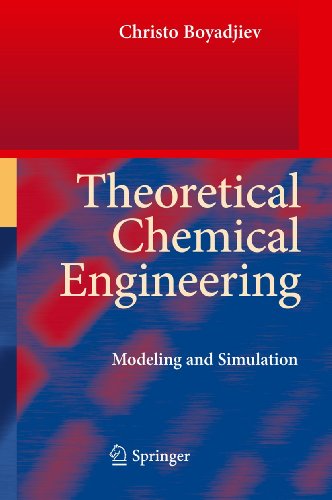
The role of theory in science was formulated very brilliantly by Max Planck: Experimenters are the striking force of science. The experiment is a question which science puts to nature. The measurement is the registration of nature’s answer. But before the question is put to nature,it must be formulated. Before the measurement result is used,itmust be explained, i.e., the answer must be understood correctly. These two problems are obligations of the theoreticians. Chemical engineering is an experimental science, but theory permits us to formulate correct experimental conditions and to understand correctly the exp- imental results. The theoretical methods of chemical engineering for modeling and simulation of industrial processes are surveyed in this book. Theoretical chemical engineering solves the problems that spring up from the necessity for a quantitative description of the processes in the chemical industry. They are quite different at the different stages of the quantitative description, i.e., a wide circle of theoretical methods are required for their solutions. Modeling and simulation are a united approach to obtain a quantitative description of the processes and systems in chemical engineering and chemical technology, which is necessary to clarify the process mechanism or for optimal process design, process control, and plant renovation. Modeling is the creation of the mathematical model, i.e., construction of the mathematical description (on the basis of the process mechanism), calculation of the model parameters (using experimental data), and statistical analysis of the model adequacy.
"synopsis" may belong to another edition of this title.
From the Back Cover
This survey presents the theoretical methods of chemical engineering for modeling and simulation of industrial processes. On this base it is possible to formulate correct experimental conditions and to understand rightly the experimental results. The book uses the mechanics of continuous media approach for modeling of the simple processes as hydrodynamic processes, mass and heat transfer processes. The theory of the scalar, vector and tensor fields permit to create the basic equations and boundary conditions. The problems of rheology, turbulence, turbulent diffusion and turbulent mass transfer are examined too.
The book incorporates a lot of fundamental knowledge, but it is assumed that the readers are familiar with the mathematics at engineering level and that they thought some special topics in usual university courses. It includes examples at the end of all chapters using the author’s investigations. Therefore, it is highly valuable for scientists as well as graduate and PhDstudents.
"About this title" may belong to another edition of this title.
Search results for Theoretical Chemical Engineering: Modeling and Simulation

Stock Image
Theoretical Chemical Engineering: Modeling and Simulation
Seller: Phatpocket Limited, Waltham Abbey, HERTS, United Kingdom
Seller rating 5 out of 5 stars

Condition: Good. Your purchase helps support Sri Lankan Children's Charity 'The Rainbow Centre'. Ex-library, so some stamps and wear, but in good overall condition. Our donations to The Rainbow Centre have helped provide an education and a safe haven to hundreds of children who live in appalling conditions. Seller Inventory # Z1-Q-024-03352
Buy Used
£ 144.21
£ 10.64 shipping
Ships from United Kingdom to U.S.A.
Ships from United Kingdom to U.S.A.
Quantity: 1 available
Stock Image
Boyadjiev,C.:Theoretical Chemical Eng. (eng)
Print on DemandSeller: Brook Bookstore On Demand, Napoli, NA, Italy
Seller rating 5 out of 5 stars
Condition: new. Questo è un articolo print on demand. Seller Inventory # 8f0fa0141f2aee674b5961c971f73934
Buy New
£ 146.57
£ 9.41 shipping
Ships from Italy to U.S.A.
Ships from Italy to U.S.A.
Quantity: Over 20 available
Stock Image
Theoretical Chemical Engineering: Modeling and Simulation
Seller: Ria Christie Collections, Uxbridge, United Kingdom
Seller rating 5 out of 5 stars
Condition: New. In. Seller Inventory # ria9783642107771_new
Buy New
£ 189.04
£ 11.98 shipping
Ships from United Kingdom to U.S.A.
Ships from United Kingdom to U.S.A.
Quantity: Over 20 available
Seller Image
Theoretical Chemical Engineering
Published by
Springer Berlin Heidelberg, 2010
ISBN 10: 364210777X
ISBN 13: 9783642107771
New
Hardcover
Seller: moluna, Greven, Germany
Seller rating 5 out of 5 stars
Condition: New. Dieser Artikel ist ein Print on Demand Artikel und wird nach Ihrer Bestellung fuer Sie gedruckt. Presents the theoretical methods of chemical engineering for modeling and simulation of industrial processesEnable the reader to formulate correct experimental conditions and to understand rightly the experimental resultsIncorporates a lot . Seller Inventory # 5049344
Buy New
£ 160.01
£ 41.92 shipping
Ships from Germany to U.S.A.
Ships from Germany to U.S.A.
Quantity: Over 20 available
Seller Image
Theoretical Chemical Engineering
Published by
Berlin Springer Berlin Heidelberg Springer Okt 2010, 2010
ISBN 10: 364210777X
ISBN 13: 9783642107771
New
Hardcover
Seller: BuchWeltWeit Ludwig Meier e.K., Bergisch Gladbach, Germany
Seller rating 5 out of 5 stars
Buch. Condition: Neu. This item is printed on demand - it takes 3-4 days longer - Neuware -The role of theory in science was formulated very brilliantly by Max Planck: Experimenters are the striking force of science. The experiment is a question which science puts to nature. The measurement is the registration of nature's answer. But before the question is put to nature,it must be formulated. Before the measurement result is used,itmust be explained, i.e., the answer must be understood correctly. These two problems are obligations of the theoreticians. Chemical engineering is an experimental science, but theory permits us to formulate correct experimental conditions and to understand correctly the exp- imental results. The theoretical methods of chemical engineering for modeling and simulation of industrial processes are surveyed in this book. Theoretical chemical engineering solves the problems that spring up from the necessity for a quantitative description of the processes in the chemical industry. They are quite different at the different stages of the quantitative description, i.e., a wide circle of theoretical methods are required for their solutions. Modeling and simulation are a united approach to obtain a quantitative description of the processes and systems in chemical engineering and chemical technology, which is necessary to clarify the process mechanism or for optimal process design, process control, and plant renovation. Modeling is the creation of the mathematical model, i.e., construction of the mathematical description (on the basis of the process mechanism), calculation of the model parameters (using experimental data), and statistical analysis of the model adequacy. 594 pp. Englisch. Seller Inventory # 9783642107771
Seller Image
Theoretical Chemical Engineering : Modeling and Simulation
Published by
Springer, Berlin, Springer, 2010
ISBN 10: 364210777X
ISBN 13: 9783642107771
New
Hardcover
Seller: AHA-BUCH GmbH, Einbeck, Germany
Seller rating 5 out of 5 stars
Buch. Condition: Neu. Druck auf Anfrage Neuware - Printed after ordering - The role of theory in science was formulated very brilliantly by Max Planck: Experimenters are the striking force of science. The experiment is a question which science puts to nature. The measurement is the registration of nature's answer. But before the question is put to nature,it must be formulated. Before the measurement result is used,itmust be explained, i.e., the answer must be understood correctly. These two problems are obligations of the theoreticians. Chemical engineering is an experimental science, but theory permits us to formulate correct experimental conditions and to understand correctly the exp- imental results. The theoretical methods of chemical engineering for modeling and simulation of industrial processes are surveyed in this book. Theoretical chemical engineering solves the problems that spring up from the necessity for a quantitative description of the processes in the chemical industry. They are quite different at the different stages of the quantitative description, i.e., a wide circle of theoretical methods are required for their solutions. Modeling and simulation are a united approach to obtain a quantitative description of the processes and systems in chemical engineering and chemical technology, which is necessary to clarify the process mechanism or for optimal process design, process control, and plant renovation. Modeling is the creation of the mathematical model, i.e., construction of the mathematical description (on the basis of the process mechanism), calculation of the model parameters (using experimental data), and statistical analysis of the model adequacy. Seller Inventory # 9783642107771