
Items related to Mathematical Modelling for Sustainable Development...
Mathematical Modelling for Sustainable Development (Environmental Science and Engineering) - Softcover
Book 1 of 127: Environmental Science and Engineering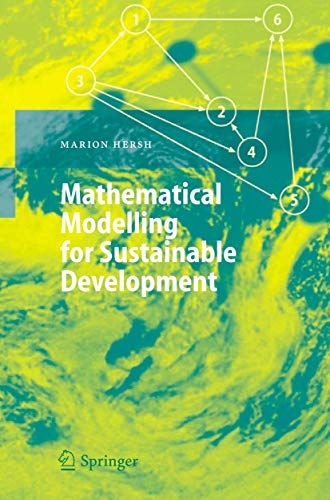
Synopsis
Many people are convinced that Sustainable Development and Mathematics are completely unrelated. Sustainable Development, in its role of a value laden imperative for polluting and over-consuming societies, seems to be totally unconnected to mathematical reasoning and ignorant of the values behind its symbols. Still, they are not only connected: they need each other. Mathematics needs Sustainable Development. When science was gradually reinvented in European medieval societies, it was legitimised as contributing to the disclosure of God’s divine creation. The conflicts that emerged became well known as a result of the clash between Galileo and the Church. Science found a new legitimacy through recognition that it was a powerful force against superstition. In the Enlightenment the argument was pushed forward by attributing Progress to the advancement of science: science could produce a better world by promoting rationality. In our modern society, science has become intimately linked to technology. Science for its own sake unfortunately rarely has positive outcomes in terms of research grant applications. Meanwhile, science and technology, and the progress they are supposed to produce, meet with wide scale scepticism. We all know of the current global problems: climate change, resource depletion, a thinning ozone layer, space debris, declining biodiversity, malnutrition, dying ecosystems, global inequity, and the risk of unprecedented nuclear wars. Science has to engage with these problems or lose its legitimacy.
"synopsis" may belong to another edition of this title.
Review
Aus den Rezensionen:
"Marion Herschs Lehrbuch über mathematische Methoden dient der formalen Begründung von Entscheidungen zur nachhaltigen Entwicklung. Zum Einstieg diskutiert die Autorin den Nachhaltigkeitsbegriff, der in ihrem Verständnis auch Gender- und Menschenrechtsaspekte berücksichtigt. Damit verdeutlicht sie die Schwierigkeiten, die sich bei einer formalen Analyse der Nachhaltigkeit stellen ..."
(in: Ökologisches Wirtschaften, 2007, Issue 1, S. 56)
"About this title" may belong to another edition of this title.
Search results for Mathematical Modelling for Sustainable Development...

Seller Image
Mathematical Modelling for Sustainable Development
Published by
Springer Berlin Heidelberg, 2010
ISBN 10: 3642063411
ISBN 13: 9783642063411
New
Softcover
Seller: moluna, Greven, Germany
Seller rating 5 out of 5 stars

Condition: New. Dieser Artikel ist ein Print on Demand Artikel und wird nach Ihrer Bestellung fuer Sie gedruckt. The book is mathematically sound and it is written in a way that makes the material accessible for practical researchers without a very strong mathematical backgroundThis reference offers both a basic introduction and advanced technical details of av. Seller Inventory # 5045452
Buy New
£ 215.92
£ 41.03 shipping
Ships from Germany to U.S.A.
Ships from Germany to U.S.A.
Quantity: Over 20 available
Seller Image
Mathematical Modelling for Sustainable Development
Published by
Springer Berlin Heidelberg Feb 2010, 2010
ISBN 10: 3642063411
ISBN 13: 9783642063411
New
Taschenbuch
Seller: BuchWeltWeit Ludwig Meier e.K., Bergisch Gladbach, Germany
Seller rating 5 out of 5 stars
Taschenbuch. Condition: Neu. This item is printed on demand - it takes 3-4 days longer - Neuware -This reference offers both a basic introduction and advanced technical details of available mathematical and computing methods for modeling sustainable development, closing an exisiting gap in this field, as well as illustrating their use through case studies and examples. The methods and case studies presented here are targetted at sustainable development, although they have a wide range of other applications, including economics, medicine and control systems. 588 pp. Englisch. Seller Inventory # 9783642063411
Stock Image
Mathematical Modelling for Sustainable Development
Seller: GreatBookPrices, Columbia, MD, U.S.A.
Seller rating 5 out of 5 stars
Condition: New. Seller Inventory # 12688294-n
Seller Image
Mathematical Modelling for Sustainable Development
Seller: preigu, Osnabrück, Germany
Seller rating 5 out of 5 stars
Taschenbuch. Condition: Neu. Mathematical Modelling for Sustainable Development | Marion Hersh | Taschenbuch | xxx | Englisch | 2010 | Springer | EAN 9783642063411 | Verantwortliche Person für die EU: Springer Verlag GmbH, Tiergartenstr. 17, 69121 Heidelberg, juergen[dot]hartmann[at]springer[dot]com | Anbieter: preigu. Seller Inventory # 107175586
Seller Image
Mathematical Modelling for Sustainable Development
Seller: GreatBookPrices, Columbia, MD, U.S.A.
Seller rating 5 out of 5 stars
Condition: As New. Unread book in perfect condition. Seller Inventory # 12688294
Stock Image
Mathematical Modelling for Sustainable Development (Environmental Science and Engineering)
Seller: Ria Christie Collections, Uxbridge, United Kingdom
Seller rating 5 out of 5 stars
Condition: New. In English. Seller Inventory # ria9783642063411_new
Buy New
£ 275.36
£ 11.29 shipping
Ships from United Kingdom to U.S.A.
Ships from United Kingdom to U.S.A.
Quantity: Over 20 available
Seller Image
Mathematical Modelling for Sustainable Development
Published by
Springer, Springer Feb 2010, 2010
ISBN 10: 3642063411
ISBN 13: 9783642063411
New
Taschenbuch
Seller: buchversandmimpf2000, Emtmannsberg, BAYE, Germany
Seller rating 5 out of 5 stars
Taschenbuch. Condition: Neu. This item is printed on demand - Print on Demand Titel. Neuware -Many people are convinced that Sustainable Development and Mathematics are completely unrelated. Sustainable Development, in its role of a value laden imperative for polluting and over-consuming societies, seems to be totally unconnected to mathematical reasoning and ignorant of the values behind its symbols. Still, they are not only connected: they need each other. Mathematics needs Sustainable Development. When science was gradually reinvented in European medieval societies, it was legitimised as contributing to the disclosure of God¿s divine creation. The conflicts that emerged became well known as a result of the clash between Galileo and the Church. Science found a new legitimacy through recognition that it was a powerful force against superstition. In the Enlightenment the argument was pushed forward by attributing Progress to the advancement of science: science could produce a better world by promoting rationality. In our modern society, science has become intimately linked to technology. Science for its own sake unfortunately rarely has positive outcomes in terms of research grant applications. Meanwhile, science and technology, and the progress they are supposed to produce, meet with wide scale scepticism. We all know of the current global problems: climate change, resource depletion, a thinning ozone layer, space debris, declining biodiversity, malnutrition, dying ecosystems, global inequity, and the risk of unprecedented nuclear wars. Science has to engage with these problems or lose its legitimacy.Springer-Verlag KG, Sachsenplatz 4-6, 1201 Wien 588 pp. Englisch. Seller Inventory # 9783642063411
Seller Image
Mathematical Modelling for Sustainable Development
Seller: AHA-BUCH GmbH, Einbeck, Germany
Seller rating 5 out of 5 stars
Taschenbuch. Condition: Neu. Druck auf Anfrage Neuware - Printed after ordering - Many people are convinced that Sustainable Development and Mathematics are completely unrelated. Sustainable Development, in its role of a value laden imperative for polluting and over-consuming societies, seems to be totally unconnected to mathematical reasoning and ignorant of the values behind its symbols. Still, they are not only connected: they need each other. Mathematics needs Sustainable Development. When science was gradually reinvented in European medieval societies, it was legitimised as contributing to the disclosure of God's divine creation. The conflicts that emerged became well known as a result of the clash between Galileo and the Church. Science found a new legitimacy through recognition that it was a powerful force against superstition. In the Enlightenment the argument was pushed forward by attributing Progress to the advancement of science: science could produce a better world by promoting rationality. In our modern society, science has become intimately linked to technology. Science for its own sake unfortunately rarely has positive outcomes in terms of research grant applications. Meanwhile, science and technology, and the progress they are supposed to produce, meet with wide scale scepticism. We all know of the current global problems: climate change, resource depletion, a thinning ozone layer, space debris, declining biodiversity, malnutrition, dying ecosystems, global inequity, and the risk of unprecedented nuclear wars. Science has to engage with these problems or lose its legitimacy. Seller Inventory # 9783642063411
Stock Image
Mathematical Modelling for Sustainable Development (Environmental Science and Engineering / Environmental Engineering)
Seller: Revaluation Books, Exeter, United Kingdom
Seller rating 5 out of 5 stars
Paperback. Condition: Brand New. 588 pages. 9.20x6.00x1.60 inches. In Stock. Seller Inventory # x-3642063411
Buy New
£ 346.91
£ 12.50 shipping
Ships from United Kingdom to U.S.A.
Ships from United Kingdom to U.S.A.
Quantity: 2 available