
Items related to Datatype-Generic Programming: International Spring...
Datatype-Generic Programming: International Spring School, SSDGP 2006, Nottingham, UK, April 24-27, 2006, Revised Lectures: 4719 (Lecture Notes in Computer Science, 4719) - Softcover
Synopsis
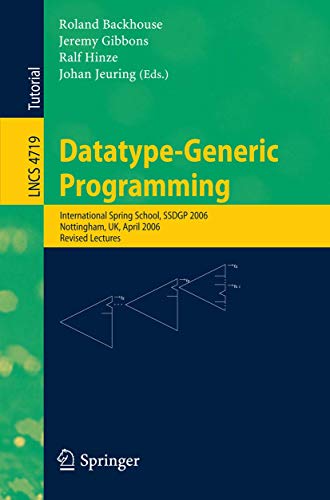
This tutorial book presents six carefully revised lectures given at the Spring School on Datatype-Generic Programming, SSDGP 2006. This was held in Nottingham, UK, in April 2006. It was colocated with the Symposium on Trends in Functional Programming (TFP 2006), and the Conference of the Types Project (TYPES 2006). All the lectures have been subjected to thorough internal review by the editors and contributors, supported by independent external reviews.
"synopsis" may belong to another edition of this title.
From the Back Cover
A leitmotif in the evolution of programming paradigms has been the level and extent of parametrisation that is facilitated ¿ the so-called genericity of the paradigm. The sorts of parameters that can be envisaged in a programming language range from simple values, like integers and ?oating-point numbers, through structured values, types and classes, to kinds (the type of types and/or classes).Datatype-generic programming is about parametrising programsby the structure of the data that they manipulate. Toappreciatethe importanceofdatatypegenericity,oneneedlooknofurther than the internet. The internet is a massive repository of structured data, but the structure is rarely exploited. For example, compression of data can be much more e?ective if its structure is known, but most compression algorithms regard the input data as simply a string of bits, and take no account of its internal organisation. Datatype-genericprogrammingisaboutexploitingthestructureofdatawhen it is relevant and ignoring it when it is not. Programming languages most c- monly used at the present time do not provide e?ective mechanisms for do- menting and implementing datatype genericity. This volume is a contribution towards improving the state of the art. The emergence of datatype genericity can be traced back to the late 1980s.
"About this title" may belong to another edition of this title.
Search results for Datatype-Generic Programming: International Spring...

Seller Image
Datatype-Generic Programming. International Spring School, SSDGP 2006, Nottingham, UK, April 2006. Revised Lectures. [Lecture Notes in Computer Science, Vol. 4719].
Seller: Antiquariat Thomas Haker GmbH & Co. KG, Berlin, Germany
Seller rating 5 out of 5 stars

Softcover/Paperback. Condition: Sehr gut. 384 p. Very good. Shrink wrapped. / Sehr guter Zustand. In Folie verschweißt. Sprache: Englisch Gewicht in Gramm: 676. Seller Inventory # 817860
Stock Image
Datatype-Generic Programming
Seller: Majestic Books, Hounslow, United Kingdom
Seller rating 4 out of 5 stars

Condition: New. pp. 386 49:B&W 6.14 x 9.21 in or 234 x 156 mm (Royal 8vo) Perfect Bound on White w/Gloss Lam. Seller Inventory # 7543009
Buy New
£ 30.46
£ 6.50 shipping
Ships from United Kingdom to U.S.A.
Ships from United Kingdom to U.S.A.
Quantity: 4 available
Stock Image
Datatype-Generic Programming
Seller: Books Puddle, Woodside, NY, U.S.A.
Seller rating 4 out of 5 stars
Condition: New. pp. 386. Seller Inventory # 26304958
Stock Image
Datatype-Generic Programming
Seller: Biblios, Frankfurt am main, HESSE, Germany
Seller rating 4 out of 5 stars
Condition: New. pp. 386. Seller Inventory # 18304948
Stock Image
Datatype- Generic Programming (Pb)
Seller: Basi6 International, Irving, TX, U.S.A.
Seller rating 5 out of 5 stars
Condition: Brand New. New. US edition. Expediting shipping for all USA and Europe orders excluding PO Box. Excellent Customer Service. Seller Inventory # ABEOCT25-244111
Stock Image
Datatype- Generic Programming (Pb)
Seller: Romtrade Corp., STERLING HEIGHTS, MI, U.S.A.
Seller rating 5 out of 5 stars
Condition: New. This is a Brand-new US Edition. This Item may be shipped from US or any other country as we have multiple locations worldwide. Seller Inventory # ABBB-74206
Stock Image
Datatype-Generic Programming : International Spring School, SSDGP 2006, Nottingham, UK, April 24-27, 2006, Revised Lectures
Print on DemandSeller: Chiron Media, Wallingford, United Kingdom
Seller rating 5 out of 5 stars
PF. Condition: New. This item is printed on demand. Brand new book, sourced directly from publisher. Dispatch time is 6-7 days from our warehouse. Book will be sent in robust, secure packaging to ensure it reaches you securely. Seller Inventory # 6666-IUK-9783540767855
Buy New
£ 47.80
£ 6.49 shipping
Ships from United Kingdom to U.S.A.
Ships from United Kingdom to U.S.A.
Quantity: 20 available
Seller Image
Datatype-Generic Programming : International Spring School, SSDGP 2006, Nottingham, Uk, April 24-27, 2006, Revised Lectures
Seller: GreatBookPrices, Columbia, MD, U.S.A.
Seller rating 5 out of 5 stars
Condition: As New. Unread book in perfect condition. Seller Inventory # 5496859
Seller Image
Datatype-Generic Programming : International Spring School, SSDGP 2006, Nottingham, Uk, April 24-27, 2006, Revised Lectures
Seller: GreatBookPrices, Columbia, MD, U.S.A.
Seller rating 5 out of 5 stars
Condition: New. Seller Inventory # 5496859-n

International Edition
DATATYPE GENERIC PROGRAMMING (PB 2007)
International EditionSeller: UK BOOKS STORE, London, LONDO, United Kingdom
Seller rating 5 out of 5 stars
Condition: New. Brand New! Fast Delivery This is an International Edition and ship within 24-48 hours. Deliver by FedEx and Dhl, & Aramex, UPS, & USPS and we do accept APO and PO BOX Addresses. Order can be delivered worldwide within 6-10 days and we do have flat rate for up to 2LB. Extra shipping charges will be requested if the Book weight is more than 5 LB. This Item May be shipped from India, United states & United Kingdom. Depending on your location and availability. Seller Inventory # CvS 9783540767855
Buy New
£ 55.46
£ 3.99 shipping
Ships from United Kingdom to U.S.A.
Ships from United Kingdom to U.S.A.
Quantity: 6 available