
Items related to Game Equilibrium Models I: Evolution and Game Dynamics
Synopsis
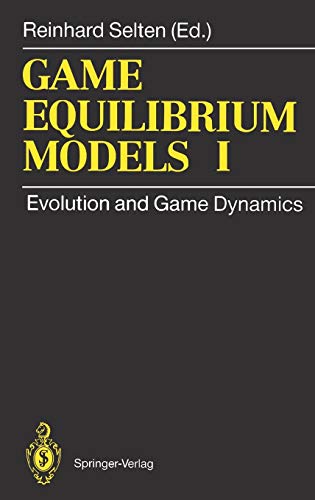
There are two main approaches towards the phenotypic analysis of frequency dependent natural selection. First, there is the approach of evolutionary game theory, which was introduced in 1973 by John Maynard Smith and George R. Price. In this theory, the dynamical process of natural selection is not modeled explicitly. Instead, the selective forces acting within a population are represented by a fitness function, which is then analysed according to the concept of an evolutionarily stable strategy or ESS. Later on, the static approach of evolutionary game theory has been complemented by a dynamic stability analysis of the replicator equations. Introduced by Peter D. Taylor and Leo B. Jonker in 1978, these equations specify a class of dynamical systems, which provide a simple dynamic description of a selection process. Usually, the investigation of the replicator dynamics centers around a stability analysis of their stationary solutions. Although evolutionary stability and dynamic stability both intend to characterize the long-term outcome of frequency dependent selection, these concepts differ considerably in the 'philosophies' on which they are based. It is therefore not too surprising that they often lead to quite different evolutionary predictions (see, e. g. , Weissing 1983). The present paper intends to illustrate the incongruities between the two approaches towards a phenotypic theory of natural selection. A detailed game theoretical and dynamical analysis is given for a generic class of evolutionary normal form games.
"synopsis" may belong to another edition of this title.
Search results for Game Equilibrium Models I: Evolution and Game Dynamics

Stock Image
Game Equilibrium Models I: Evolution and Game Dynamics
Seller: Munster & Company LLC, ABAA/ILAB, Corvallis, OR, U.S.A.
Seller rating 5 out of 5 stars

Condition: Good. Springer Verlag, 1991. Volume I only; cover very rubbed/lightly soiled, board edges bumped, significant bump/tear in top edge of rear board, corners very rubbed/bumped, spine ends very rubbed/bumped; edges soiled/foxed; ffep has erasures; some foxing to first five and last five pages; binding tight; cover, edges, and interior intact and clean except as noted. hardcover. Good. Seller Inventory # 610577
Stock Image
Game Equilibrium Models I: Evolution and Game Dynamics
Seller: Ria Christie Collections, Uxbridge, United Kingdom
Seller rating 5 out of 5 stars
Condition: New. In English. Seller Inventory # ria9783540542254_new
Buy New
£ 55.95
£ 11.29 shipping
Ships from United Kingdom to U.S.A.
Ships from United Kingdom to U.S.A.
Quantity: Over 20 available
Stock Image
Game Equilibrium Models I : Evolution and Game Dynamics
Seller: GreatBookPrices, Columbia, MD, U.S.A.
Seller rating 5 out of 5 stars
Condition: New. Seller Inventory # 5053837-n
Stock Image
Game Equilibrium Models I
Seller: Books Puddle, Woodside, NY, U.S.A.
Seller rating 4 out of 5 stars

Condition: New. pp. 344. Seller Inventory # 26348869
Stock Image
Game Equilibrium Models I
Print on DemandSeller: Majestic Books, Hounslow, United Kingdom
Seller rating 4 out of 5 stars
Condition: New. Print on Demand pp. 344 52:B&W 6.14 x 9.21in or 234 x 156mm (Royal 8vo) Case Laminate on White w/Gloss Lam. Seller Inventory # 7531802
Buy New
£ 76.48
£ 6.50 shipping
Ships from United Kingdom to U.S.A.
Ships from United Kingdom to U.S.A.
Quantity: 4 available
Stock Image
Game Equilibrium Models I
Print on DemandSeller: Biblios, Frankfurt am main, HESSE, Germany
Seller rating 4 out of 5 stars
Condition: New. PRINT ON DEMAND pp. 344. Seller Inventory # 18348879
Seller Image
Game Equilibrium Models I
Published by
Springer Berlin Heidelberg, 1991
ISBN 10: 3540542256
ISBN 13: 9783540542254
New
Hardcover
Seller: moluna, Greven, Germany
Seller rating 5 out of 5 stars
Condition: New. There are two main approaches towards the phenotypic analysis of frequency dependent natural selection. First, there is the approach of evolutionary game theory, which was introduced in 1973 by John Maynard Smith and George R. Price. In this theory, the dyn. Seller Inventory # 18965904
Stock Image
Game Equilibrium Models I : Evolution and Game Dynamics
Seller: Buchpark, Trebbin, Germany
Seller rating 5 out of 5 stars
Condition: Sehr gut. Zustand: Sehr gut | Seiten: 330 | Sprache: Englisch | Produktart: Bücher | Keine Beschreibung verfügbar. Seller Inventory # 10397528/2
Stock Image
Game Equilibrium Models I : Evolution and Game Dynamics
Seller: Buchpark, Trebbin, Germany
Seller rating 5 out of 5 stars
Condition: Sehr gut. Zustand: Sehr gut | Seiten: 330 | Sprache: Englisch | Produktart: Bücher | Keine Beschreibung verfügbar. Seller Inventory # 10397528/202
Stock Image
Game Equilibrium Models I : Evolution and Game Dynamics
Seller: Buchpark, Trebbin, Germany
Seller rating 5 out of 5 stars
Condition: Hervorragend. Zustand: Hervorragend | Seiten: 330 | Sprache: Englisch | Produktart: Bücher | Keine Beschreibung verfügbar. Seller Inventory # 10397528/1