
Items related to Automatic Parallelization: New Approaches to Code Generation...
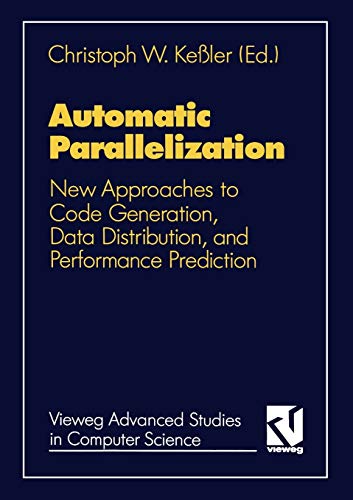
Automatic Parallelization: New Approaches to Code Generation, Data Distribution, and Performance Prediction (Vieweg Advanced Studies in Computer Science) - Softcover
Synopsis
Distributed-memory multiprocessing systems (DMS), such as Intel's hypercubes, the Paragon, Thinking Machine's CM-5, and the Meiko Computing Surface, have rapidly gained user acceptance and promise to deliver the computing power required to solve the grand challenge problems of Science and Engineering. These machines are relatively inexpensive to build, and are potentially scalable to large numbers of processors. However, they are difficult to program: the non-uniformity of the memory which makes local accesses much faster than the transfer of non-local data via message-passing operations implies that the locality of algorithms must be exploited in order to achieve acceptable performance. The management of data, with the twin goals of both spreading the computational workload and minimizing the delays caused when a processor has to wait for non-local data, becomes of paramount importance. When a code is parallelized by hand, the programmer must distribute the program's work and data to the processors which will execute it. One of the common approaches to do so makes use of the regularity of most numerical computations. This is the so-called Single Program Multiple Data (SPMD) or data parallel model of computation. With this method, the data arrays in the original program are each distributed to the processors, establishing an ownership relation, and computations defining a data item are performed by the processors owning the data.
"synopsis" may belong to another edition of this title.
Synopsis
This work contains 11 contributions which deal with true automatic parallelization, and the focus is on automatic methods. Some of the questions under discussion are: up to which degree is automatic parallelization for DMS possible today? What are currently the most important problems for automatic parallelization and which new ideas are there? In which cases can knowledge-based methods help? Are there promising methods for automatic data distribution and redistribution? Why is performance prediction problematic?
"About this title" may belong to another edition of this title.
Other Popular Editions of the Same Title

Search results for Automatic Parallelization: New Approaches to Code Generation...

Stock Image
Automatic Parallelization
Seller: Basi6 International, Irving, TX, U.S.A.
Seller rating 5 out of 5 stars

Condition: Brand New. New. Delivery takes 25-30 days. Excellent Customer Service. Seller Inventory # POD-66583
Seller Image
Automatic Parallelization
Published by
Vieweg+Teubner, Vieweg+Teubner Verlag Jan 1994, 1994
ISBN 10: 3528054018
ISBN 13: 9783528054014
New
Taschenbuch
Seller: BuchWeltWeit Ludwig Meier e.K., Bergisch Gladbach, Germany
Seller rating 5 out of 5 stars
Taschenbuch. Condition: Neu. This item is printed on demand - it takes 3-4 days longer - Neuware -Distributed-memory multiprocessing systems (DMS), such as Intel's hypercubes, the Paragon, Thinking Machine's CM-5, and the Meiko Computing Surface, have rapidly gained user acceptance and promise to deliver the computing power required to solve the grand challenge problems of Science and Engineering. These machines are relatively inexpensive to build, and are potentially scalable to large numbers of processors. However, they are difficult to program: the non-uniformity of the memory which makes local accesses much faster than the transfer of non-local data via message-passing operations implies that the locality of algorithms must be exploited in order to achieve acceptable performance. The management of data, with the twin goals of both spreading the computational workload and minimizing the delays caused when a processor has to wait for non-local data, becomes of paramount importance. When a code is parallelized by hand, the programmer must distribute the program's work and data to the processors which will execute it. One of the common approaches to do so makes use of the regularity of most numerical computations. This is the so-called Single Program Multiple Data (SPMD) or data parallel model of computation. With this method, the data arrays in the original program are each distributed to the processors, establishing an ownership relation, and computations defining a data item are performed by the processors owning the data. 224 pp. Englisch. Seller Inventory # 9783528054014
Stock Image
Automatic Parallelization: New Approaches to Code Generation, Data Distribution, and Performance Prediction (Vieweg Advanced Studies of Computer Science)
Seller: Ria Christie Collections, Uxbridge, United Kingdom
Seller rating 5 out of 5 stars
Condition: New. In. Seller Inventory # ria9783528054014_new
Buy New
£ 96.88
£ 11.98 shipping
Ships from United Kingdom to U.S.A.
Ships from United Kingdom to U.S.A.
Quantity: Over 20 available
Stock Image
Automatic Parallelization
Published by
Friedrich Vieweg & Sohn Verlagsgesellschaft mbH, 1994
ISBN 10: 3528054018
ISBN 13: 9783528054014
New
Softcover
Seller: Kennys Bookshop and Art Galleries Ltd., Galway, GY, Ireland
Seller rating 5 out of 5 stars
Condition: New. Contains 11 contributions which deal with true automatic parallelization, and the focus is on automatic methods. Some of the questions under discussion are: up to which degree is automatic parallelization for DMS possible today? In which cases can knowledge-based methods help? Editor(s): Kessler, Christoph W. Series: Vieweg Advanced Studies in Computer Science. Num Pages: 224 pages, biography. BIC Classification: UYFP. Category: (P) Professional & Vocational; (UP) Postgraduate, Research & Scholarly; (UU) Undergraduate. Dimension: 210 x 148 x 12. Weight in Grams: 318. . 1994. Paperback. . . . . Seller Inventory # V9783528054014
Seller Image
Automatic Parallelization
Print on DemandSeller: moluna, Greven, Germany
Seller rating 5 out of 5 stars
Condition: New. Dieser Artikel ist ein Print on Demand Artikel und wird nach Ihrer Bestellung fuer Sie gedruckt. Distributed-memory multiprocessing systems (DMS), such as Intel s hypercubes, the Paragon, Thinking Machine s CM-5, and the Meiko Computing Surface, have rapidly gained user acceptance and promise to deliver the computing power required to solve the grand c. Seller Inventory # 4866723
Buy New
£ 81.22
£ 41.87 shipping
Ships from Germany to U.S.A.
Ships from Germany to U.S.A.
Quantity: Over 20 available
Stock Image
Automatic Parallelization
Published by
Vieweg Verlag, Friedr, & Sohn Verlagsgesellschaft mbH, 1994
ISBN 10: 3528054018
ISBN 13: 9783528054014
New
Softcover
Seller: Books Puddle, New York, NY, U.S.A.
Seller rating 4 out of 5 stars

Condition: New. pp. 242. Seller Inventory # 2648025922
Stock Image
Automatic Parallelization
Published by
Vieweg Verlag, Friedr, & Sohn Verlagsgesellschaft mbH, 1994
ISBN 10: 3528054018
ISBN 13: 9783528054014
New
Softcover
Seller: Majestic Books, Hounslow, United Kingdom
Seller rating 4 out of 5 stars
Condition: New. Print on Demand pp. 242 25:B&W 5.83 x 8.27 in or 210 x 148 mm (A5) Perfect Bound on White w/Gloss Lam. Seller Inventory # 44789405
Buy New
£ 126.75
£ 6.50 shipping
Ships from United Kingdom to U.S.A.
Ships from United Kingdom to U.S.A.
Quantity: 4 available
Stock Image
Automatic Parallelization
Published by
Vieweg Verlag, Friedr, & Sohn Verlagsgesellschaft mbH, 1994
ISBN 10: 3528054018
ISBN 13: 9783528054014
New
Softcover
Seller: Biblios, Frankfurt am main, HESSE, Germany
Seller rating 4 out of 5 stars
Condition: New. PRINT ON DEMAND pp. 242. Seller Inventory # 1848025928
Seller Image
Automatic Parallelization | New Approaches to Code Generation, Data Distribution, and Performance Prediction
Print on DemandSeller: preigu, Osnabrück, Germany
Seller rating 5 out of 5 stars
Taschenbuch. Condition: Neu. Automatic Parallelization | New Approaches to Code Generation, Data Distribution, and Performance Prediction | Christoph W. Kessler | Taschenbuch | xi | Englisch | 1994 | Vieweg & Teubner | EAN 9783528054014 | Verantwortliche Person für die EU: Springer Vieweg in Springer Science + Business Media, Abraham-Lincoln-Str. 46, 65189 Wiesbaden, juergen[dot]hartmann[at]springer[dot]com | Anbieter: preigu Print on Demand. Seller Inventory # 102072671
Seller Image
Automatic Parallelization
Published by
Vieweg+Teubner Verlag, Vieweg+Teubner Verlag Jan 1994, 1994
ISBN 10: 3528054018
ISBN 13: 9783528054014
New
Taschenbuch
Seller: buchversandmimpf2000, Emtmannsberg, BAYE, Germany
Seller rating 5 out of 5 stars
Taschenbuch. Condition: Neu. This item is printed on demand - Print on Demand Titel. Neuware -Distributed-memory multiprocessing systems (DMS), such as Intel's hypercubes, the Paragon, Thinking Machine's CM-5, and the Meiko Computing Surface, have rapidly gained user acceptance and promise to deliver the computing power required to solve the grand challenge problems of Science and Engineering. These machines are relatively inexpensive to build, and are potentially scalable to large numbers of processors. However, they are difficult to program: the non-uniformity of the memory which makes local accesses much faster than the transfer of non-local data via message-passing operations implies that the locality of algorithms must be exploited in order to achieve acceptable performance. The management of data, with the twin goals of both spreading the computational workload and minimizing the delays caused when a processor has to wait for non-local data, becomes of paramount importance. When a code is parallelized by hand, the programmer must distribute the program's work and data to the processors which will execute it. One of the common approaches to do so makes use of the regularity of most numerical computations. This is the so-called Single Program Multiple Data (SPMD) or data parallel model of computation. With this method, the data arrays in the original program are each distributed to the processors, establishing an ownership relation, and computations defining a data item are performed by the processors owning the data.Springer Vieweg in Springer Science + Business Media, Abraham-Lincoln-Straße 46, 65189 Wiesbaden 240 pp. Englisch. Seller Inventory # 9783528054014