
Items related to Information Science for Materials Discovery and Design:...
Information Science for Materials Discovery and Design: 225 (Springer Series in Materials Science, 225) - Hardcover
Book 135 of 233: Springer Series in Materials Science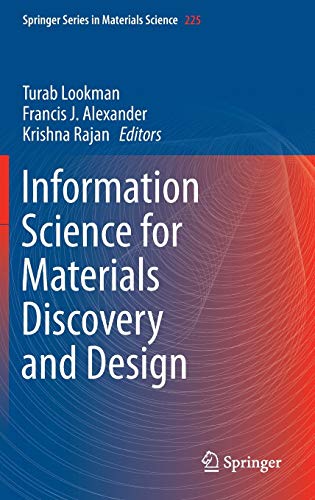
Synopsis
This book deals with an information-driven approach to plan materials discovery and design, iterative learning. The authors present contrasting but complementary approaches, such as those based on high throughput calculations, combinatorial experiments or data driven discovery, together with machine-learning methods. Similarly, statistical methods successfully applied in other fields, such as biosciences, are presented. The content spans from materials science to information science to reflect the cross-disciplinary nature of the field. A perspective is presented that offers a paradigm (codesign loop for materials design) to involve iteratively learning from experiments and calculations to develop materials with optimum properties. Such a loop requires the elements of incorporating domain materials knowledge, a database of descriptors (the genes), a surrogate or statistical model developed to predict a given property with uncertainties, performing adaptive experimental design to guide the next experiment or calculation and aspects of high throughput calculations as well as experiments. The book is about manufacturing with the aim to halving the time to discover and design new materials. Accelerating discovery relies on using large databases, computation, and mathematics in the material sciences in a manner similar to the way used to in the Human Genome Initiative. Novel approaches are therefore called to explore the enormous phase space presented by complex materials and processes. To achieve the desired performance gains, a predictive capability is needed to guide experiments and computations in the most fruitful directions by reducing not successful trials. Despite advances in computation and experimental techniques, generating vast arrays of data; without a clear way of linkage to models, the full value of data driven discovery cannot be realized. Hence, along with experimental, theoretical and computational materials science, we need to add a “fourth leg’’ toour toolkit to make the “Materials Genome'' a reality, the science of Materials Informatics.
"synopsis" may belong to another edition of this title.
From the Back Cover
This book deals with an information-driven approach to plan materials discovery and design, iterative learning. The authors present contrasting but complementary approaches, such as those based on high throughput calculations, combinatorial experiments or data driven discovery, together with machine-learning methods. Similarly, statistical methods successfully applied in other fields, such as biosciences, are presented. The content spans from materials science to information science to reflect the cross-disciplinary nature of the field. A perspective is presented that offers a paradigm (codesign loop for materials design) to involve iteratively learning from experiments and calculations to develop materials with optimum properties. Such a loop requires the elements of incorporating domain materials knowledge, a database of descriptors (the genes), a surrogate or statistical model developed to predict a given property with uncertainties, performing adaptive experimental design to guide the next experiment or calculation and aspects of high throughput calculations as well as experiments. The book is about manufacturing with the aim to halving the time to discover and design new materials. Accelerating discovery relies on using large databases, computation, and mathematics in the material sciences in a manner similar to the way used to in the Human Genome Initiative. Novel approaches are therefore called to explore the enormous phase space presented by complex materials and processes. To achieve the desired performance gains, a predictive capability is needed to guide experiments and computations in the most fruitful directions by reducing not successful trials. Despite advances in computation and experimental techniques, generating vast arrays of data; without a clear way of linkage to models, the full value of data driven discovery cannot be realized. Hence, along with experimental, theoretical and computational materials science, we need to add a “fourth leg’’ toour toolkit to make the “Materials Genome'' a reality, the science of Materials Informatics.
"About this title" may belong to another edition of this title.
Search results for Information Science for Materials Discovery and Design:...

Stock Image
Information Science for Materials Discovery and Design (Springer Series in Materials Science, 225)
Seller: thebookforest.com, San Rafael, CA, U.S.A.
Seller rating 4 out of 5 stars

Condition: Very Good. Text block firm and clean, binding unblemished, boards straight, no highlights or underlining. Well packaged and promptly shipped from California. Partnered with Friends of the Library since 2010. Seller Inventory # BAY_14_SH_070476
Stock Image
Information Science for Materials Discovery and Design (Springer Series in Materials Science, 225)
Seller: Ria Christie Collections, Uxbridge, United Kingdom
Seller rating 5 out of 5 stars

Condition: New. In English. Seller Inventory # ria9783319238708_new
Buy New
£ 106.71
£ 11.29 shipping
Ships from United Kingdom to U.S.A.
Ships from United Kingdom to U.S.A.
Quantity: Over 20 available
Seller Image
Information Science for Materials Discovery and Design
Published by
Springer International Publishing AG, CH, 2015
ISBN 10: 3319238701
ISBN 13: 9783319238708
New
Hardcover
Seller: Rarewaves.com USA, London, LONDO, United Kingdom
Seller rating 5 out of 5 stars
Hardback. Condition: New. 1st ed. 2016. This book deals with an information-driven approach to plan materials discovery and design, iterative learning. The authors present contrasting but complementary approaches, such as those based on high throughput calculations, combinatorial experiments or data driven discovery, together with machine-learning methods. Similarly, statistical methods successfully applied in other fields, such as biosciences, are presented. The content spans from materials science to information science to reflect the cross-disciplinary nature of the field. A perspective is presented that offers a paradigm (codesign loop for materials design) to involve iteratively learning from experiments and calculations to develop materials with optimum properties. Such a loop requires the elements of incorporating domain materials knowledge, a database of descriptors (the genes), a surrogate or statistical model developed to predict a given property with uncertainties, performing adaptive experimental design to guide the next experiment or calculation and aspects of high throughput calculations as well as experiments. The book is about manufacturing with the aim to halving the time to discover and design new materials. Accelerating discovery relies on using large databases, computation, and mathematics in the material sciences in a manner similar to the way used to in the Human Genome Initiative. Novel approaches are therefore called to explore the enormous phase space presented by complex materials and processes. To achieve the desired performance gains, a predictive capability is needed to guide experiments and computations in the most fruitful directions by reducing not successful trials. Despite advances in computation and experimental techniques, generating vast arrays of data; without a clear way of linkage to models, the full value of data driven discovery cannot be realized. Hence, along with experimental, theoretical and computational materials science, we need to add a "fourth leg'' toour toolkit to make the "Materials Genome'' a reality, the science of Materials Informatics. Seller Inventory # LU-9783319238708
Buy New
£ 130.26
Free Shipping
Ships from United Kingdom to U.S.A.
Ships from United Kingdom to U.S.A.
Quantity: Over 20 available
Stock Image
Information Science for Materials Discovery and Design (eng)
Print on DemandSeller: Brook Bookstore On Demand, Napoli, NA, Italy
Seller rating 5 out of 5 stars
Condition: new. Questo è un articolo print on demand. Seller Inventory # 7704d4c68aac86f456edbd5ca59f67f4
Buy New
£ 168.59
£ 6.88 shipping
Ships from Italy to U.S.A.
Ships from Italy to U.S.A.
Quantity: Over 20 available
Seller Image
Information Science for Materials Discovery and Design
Published by
Springer International Publishing AG, CH, 2015
ISBN 10: 3319238701
ISBN 13: 9783319238708
New
Hardcover
Seller: Rarewaves.com UK, London, United Kingdom
Seller rating 5 out of 5 stars
Hardback. Condition: New. 1st ed. 2016. This book deals with an information-driven approach to plan materials discovery and design, iterative learning. The authors present contrasting but complementary approaches, such as those based on high throughput calculations, combinatorial experiments or data driven discovery, together with machine-learning methods. Similarly, statistical methods successfully applied in other fields, such as biosciences, are presented. The content spans from materials science to information science to reflect the cross-disciplinary nature of the field. A perspective is presented that offers a paradigm (codesign loop for materials design) to involve iteratively learning from experiments and calculations to develop materials with optimum properties. Such a loop requires the elements of incorporating domain materials knowledge, a database of descriptors (the genes), a surrogate or statistical model developed to predict a given property with uncertainties, performing adaptive experimental design to guide the next experiment or calculation and aspects of high throughput calculations as well as experiments. The book is about manufacturing with the aim to halving the time to discover and design new materials. Accelerating discovery relies on using large databases, computation, and mathematics in the material sciences in a manner similar to the way used to in the Human Genome Initiative. Novel approaches are therefore called to explore the enormous phase space presented by complex materials and processes. To achieve the desired performance gains, a predictive capability is needed to guide experiments and computations in the most fruitful directions by reducing not successful trials. Despite advances in computation and experimental techniques, generating vast arrays of data; without a clear way of linkage to models, the full value of data driven discovery cannot be realized. Hence, along with experimental, theoretical and computational materials science, we need to add a "fourth leg'' toour toolkit to make the "Materials Genome'' a reality, the science of Materials Informatics. Seller Inventory # LU-9783319238708
Buy New
£ 120.73
£ 65 shipping
Ships from United Kingdom to U.S.A.
Ships from United Kingdom to U.S.A.
Quantity: Over 20 available
Seller Image
Information Science for Materials Discovery and Design
Published by
Springer International Publishing, 2015
ISBN 10: 3319238701
ISBN 13: 9783319238708
New
Hardcover
Seller: moluna, Greven, Germany
Seller rating 5 out of 5 stars
Gebunden. Condition: New. Dieser Artikel ist ein Print on Demand Artikel und wird nach Ihrer Bestellung fuer Sie gedruckt. One of the first books on materials discovery strategyEmphasizes the paradigm of codesignBrings together diverse expertise to improve the model for materials discoveryThis book deals with an information-driven approach to plan ma. Seller Inventory # 43799490
Buy New
£ 182.85
£ 42.14 shipping
Ships from Germany to U.S.A.
Ships from Germany to U.S.A.
Quantity: Over 20 available
Seller Image
Information Science for Materials Discovery and Design
Published by
Springer International Publishing, Springer Nature Switzerland Dez 2015, 2015
ISBN 10: 3319238701
ISBN 13: 9783319238708
New
Hardcover
Seller: BuchWeltWeit Ludwig Meier e.K., Bergisch Gladbach, Germany
Seller rating 5 out of 5 stars
Buch. Condition: Neu. This item is printed on demand - it takes 3-4 days longer - Neuware -This book deals with an information-driven approach to plan materials discovery and design, iterative learning. The authors present contrasting but complementary approaches, such as those based on high throughput calculations, combinatorial experiments or data driven discovery, together with machine-learning methods. Similarly, statistical methods successfully applied in other fields, such as biosciences, are presented. The content spans from materials science to information science to reflect the cross-disciplinary nature of the field. A perspective is presented that offers a paradigm (codesign loop for materials design) to involve iteratively learning from experiments and calculations to develop materials with optimum properties. Such a loop requires the elements of incorporating domain materials knowledge, a database of descriptors (the genes), a surrogate or statistical model developed to predict a given property with uncertainties, performing adaptive experimental design to guide the next experiment or calculation and aspects of high throughput calculations as well as experiments. The book is about manufacturing with the aim to halving the time to discover and design new materials. Accelerating discovery relies on using large databases, computation, and mathematics in the material sciences in a manner similar to the way used to in the Human Genome Initiative. Novel approaches are therefore called to explore the enormous phase space presented by complex materials and processes. To achieve the desired performance gains, a predictive capability is needed to guide experiments and computations in the most fruitful directions by reducing not successful trials. Despite advances in computation and experimental techniques, generating vast arrays of data; without a clear way of linkage to models, the full value of data driven discovery cannot be realized. Hence, along with experimental, theoretical and computational materials science, we need to add a 'fourth leg'' toour toolkit to make the 'Materials Genome'' a reality, the science of Materials Informatics. 328 pp. Englisch. Seller Inventory # 9783319238708
Stock Image
Information Science for Materials Discovery and Design (Springer Series in Materials Science)
Seller: Books Puddle, Woodside, NY, U.S.A.
Seller rating 4 out of 5 stars
Condition: New. pp. 340. Seller Inventory # 26372723081
Stock Image
Information Science for Materials Discovery and Design (Springer Series in Materials Science)
Print on DemandSeller: Majestic Books, Hounslow, United Kingdom
Seller rating 4 out of 5 stars
Condition: New. Print on Demand pp. 340. Seller Inventory # 373355094
Buy New
£ 256.62
£ 6.50 shipping
Ships from United Kingdom to U.S.A.
Ships from United Kingdom to U.S.A.
Quantity: 4 available
Seller Image
Information Science for Materials Discovery and Design
Print on DemandSeller: AHA-BUCH GmbH, Einbeck, Germany
Seller rating 5 out of 5 stars
Buch. Condition: Neu. nach der Bestellung gedruckt Neuware - Printed after ordering - This book deals with an information-driven approach to plan materials discovery and design, iterative learning. The authors present contrasting but complementary approaches, such as those based on high throughput calculations, combinatorial experiments or data driven discovery, together with machine-learning methods. Similarly, statistical methods successfully applied in other fields, such as biosciences, are presented. The content spans from materials science to information science to reflect the cross-disciplinary nature of the field. A perspective is presented that offers a paradigm (codesign loop for materials design) to involve iteratively learning from experiments and calculations to develop materials with optimum properties. Such a loop requires the elements of incorporating domain materials knowledge, a database of descriptors (the genes), a surrogate or statistical model developed to predict a given property with uncertainties, performing adaptive experimental design to guide the next experiment or calculation and aspects of high throughput calculations as well as experiments. The book is about manufacturing with the aim to halving the time to discover and design new materials. Accelerating discovery relies on using large databases, computation, and mathematics in the material sciences in a manner similar to the way used to in the Human Genome Initiative. Novel approaches are therefore called to explore the enormous phase space presented by complex materials and processes. To achieve the desired performance gains, a predictive capability is needed to guide experiments and computations in the most fruitful directions by reducing not successful trials. Despite advances in computation and experimental techniques, generating vast arrays of data; without a clear way of linkage to models, the full value of data driven discovery cannot be realized. Hence, along with experimental, theoretical and computational materials science, we need to add a 'fourth leg'' toour toolkit to make the 'Materials Genome'' a reality, the science of Materials Informatics. Seller Inventory # 9783319238708