
Items related to A Chronicle of Permutation Statistical Methods: 1920–...
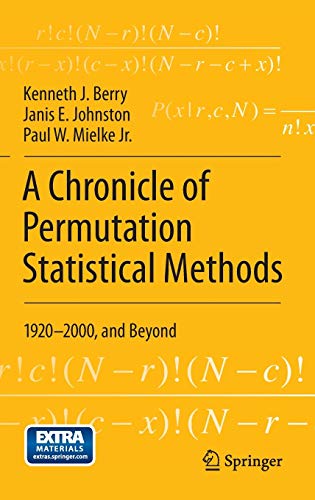
Synopsis
The focus of this book is on the birth and historical development of permutation statistical methods from the early 1920s to the near present. Beginning with the seminal contributions of R.A. Fisher, E.J.G. Pitman, and others in the 1920s and 1930s, permutation statistical methods were initially introduced to validate the assumptions of classical statistical methods.
Permutation methods have advantages over classical methods in that they are optimal for small data sets and non-random samples, are data-dependent, and are free of distributional assumptions. Permutation probability values may be exact, or estimated via moment- or resampling-approximation procedures. Because permutation methods are inherently computationally-intensive, the evolution of computers and computing technology that made modern permutation methods possible accompanies the historical narrative.
Permutation analogs of many well-known statistical tests are presented in a historical context, includingmultiple correlation and regression, analysis of variance, contingency table analysis, and measures of association and agreement. A non-mathematical approach makes the text accessible to readers of all levels.
"synopsis" may belong to another edition of this title.
About the Author
Kenneth J. Berry is Professor of Sociology at Colorado State University.
Janis E. Johnston is a Social Science Policy Analyst with the United States government in Washington, D.C.
Paul W. Mielke, Jr. is Professor Emeritus of Statistics at Colorado State University and Fellow of the American Statistical Association.
From the Back Cover
The focus of this book is on the birth and historical development of permutation statistical methods from the early 1920s to the near present. Beginning with the seminal contributions of R.A. Fisher, E.J.G. Pitman, and others in the 1920s and 1930s, permutation statistical methods were initially introduced to validate the assumptions of classical statistical methods.
Permutation methods have advantages over classical methods in that they are optimal for small data sets and non-random samples, are data-dependent, and are free of distributional assumptions. Permutation probability values may be exact, or estimated via moment- or resampling-approximation procedures. Because permutation methods are inherently computationally-intensive, the evolution of computers and computing technology that made modern permutation methods possible accompanies the historical narrative.
Permutation analogs of many well-known statistical tests are presented in a historical context, includingmultiple correlation and regression, analysis of variance, contingency table analysis, and measures of association and agreement. A non-mathematical approach makes the text accessible to readers of all levels.
"About this title" may belong to another edition of this title.
Search results for A Chronicle of Permutation Statistical Methods: 1920–...

Stock Image
Berry:A Chronicle of Permutation Statis (eng)
Print on DemandSeller: Brook Bookstore On Demand, Napoli, NA, Italy
Seller rating 5 out of 5 stars

Condition: new. Questo è un articolo print on demand. Seller Inventory # 202339e58773dbe12a20d819f56eaf97
Buy New
£ 75.05
£ 6.76 shipping
Ships from Italy to U.S.A.
Ships from Italy to U.S.A.
Quantity: Over 20 available
Seller Image
A Chronicle of Permutation Statistical Methods
Published by
Springer International Publishing Apr 2014, 2014
ISBN 10: 3319027433
ISBN 13: 9783319027432
New
Hardcover
Seller: BuchWeltWeit Ludwig Meier e.K., Bergisch Gladbach, Germany
Seller rating 5 out of 5 stars
Buch. Condition: Neu. This item is printed on demand - it takes 3-4 days longer - Neuware -The focus of this book is on the birth and historical development of permutation statistical methods from the early 1920s to the near present. Beginning with the seminal contributions of R.A. Fisher, E.J.G. Pitman, and others in the 1920s and 1930s, permutation statistical methods were initially introduced to validate the assumptions of classical statistical methods. Permutation methods have advantages over classical methods in that they are optimal for small data sets and non-random samples, are data-dependent, and are free of distributional assumptions. Permutation probability values may be exact, or estimated via moment- or resampling-approximation procedures. Because permutation methods are inherently computationally-intensive, the evolution of computers and computing technology that made modern permutation methods possible accompanies the historical narrative. Permutation analogs of many well-known statistical tests are presented in a historical context, including multiple correlation and regression, analysis of variance, contingency table analysis, and measures of association and agreement. A non-mathematical approach makes the text accessible to readers of all levels. 540 pp. Englisch. Seller Inventory # 9783319027432
Stock Image
Chronicle of Permutation Statistical Methods : 1920?2000, and Beyond
Seller: GreatBookPrices, Columbia, MD, U.S.A.
Seller rating 5 out of 5 stars
Condition: New. Seller Inventory # 20921749-n
Stock Image
A Chronicle of Permutation Statistical Methods: 1920-2000, and Beyond
Seller: Ria Christie Collections, Uxbridge, United Kingdom
Seller rating 5 out of 5 stars
Condition: New. In English. Seller Inventory # ria9783319027432_new
Buy New
£ 106.71
£ 14.94 shipping
Ships from United Kingdom to U.S.A.
Ships from United Kingdom to U.S.A.
Quantity: Over 20 available
Seller Image
A Chronicle of Permutation Statistical Methods
Published by
Springer International Publishing, 2014
ISBN 10: 3319027433
ISBN 13: 9783319027432
New
Hardcover
Seller: moluna, Greven, Germany
Seller rating 5 out of 5 stars
Gebunden. Condition: New. Dieser Artikel ist ein Print on Demand Artikel und wird nach Ihrer Bestellung fuer Sie gedruckt. A unique approach to explaining statistics by developing the history and establishing the rigor of a topicThe first historical approach to this field and its developmentAn extensive historical bibliography is providedKenneth J. B. Seller Inventory # 4496526
Buy New
£ 80.30
£ 41.39 shipping
Ships from Germany to U.S.A.
Ships from Germany to U.S.A.
Quantity: Over 20 available
Stock Image
A Chronicle of Permutation Statistical Methods
Seller: Books Puddle, Woodside, NY, U.S.A.
Seller rating 4 out of 5 stars

Condition: New. pp. 540 Index. Seller Inventory # 2698176481
Seller Image
A Chronicle of Permutation Statistical Methods
Published by
Springer, Palgrave Macmillan Apr 2014, 2014
ISBN 10: 3319027433
ISBN 13: 9783319027432
New
Hardcover
Seller: buchversandmimpf2000, Emtmannsberg, BAYE, Germany
Seller rating 5 out of 5 stars
Buch. Condition: Neu. This item is printed on demand - Print on Demand Titel. Neuware -The focus of this book is on the birth and historical development of permutation statistical methods from the early 1920s to the near present. Beginning with the seminal contributions of R.A. Fisher, E.J.G. Pitman, and others in the 1920s and 1930s, permutation statistical methods were initially introduced to validate the assumptions of classical statistical methods.Permutation methods have advantages over classical methods in that they are optimal for small data sets and non-random samples, are data-dependent, and are free of distributional assumptions. Permutation probability values may be exact, or estimated via moment- or resampling-approximation procedures. Because permutation methods are inherently computationally-intensive, the evolution of computers and computing technology that made modern permutation methods possible accompanies the historical narrative.Permutation analogs of many well-known statistical tests are presented in a historical context, includingmultiple correlation and regression, analysis of variance, contingency table analysis, and measures of association and agreement. A non-mathematical approach makes the text accessible to readers of all levels.Springer-Verlag KG, Sachsenplatz 4-6, 1201 Wien 540 pp. Englisch. Seller Inventory # 9783319027432
Stock Image
A Chronicle of Permutation Statistical Methods: 1920-2000, and Beyond
Seller: Revaluation Books, Exeter, United Kingdom
Seller rating 5 out of 5 stars
Hardcover. Condition: Brand New. 580 pages. 9.25x6.25x1.25 inches. In Stock. Seller Inventory # x-3319027433
Buy New
£ 134.62
£ 12.50 shipping
Ships from United Kingdom to U.S.A.
Ships from United Kingdom to U.S.A.
Quantity: 2 available
Stock Image
A Chronicle of Permutation Statistical Methods
Print on DemandSeller: Majestic Books, Hounslow, United Kingdom
Seller rating 4 out of 5 stars
Condition: New. Print on Demand pp. 540 51 Illus. Seller Inventory # 95269438
Buy New
£ 145.84
£ 6.50 shipping
Ships from United Kingdom to U.S.A.
Ships from United Kingdom to U.S.A.
Quantity: 4 available
Stock Image
A Chronicle of Permutation Statistical Methods
Print on DemandSeller: Biblios, Frankfurt am main, HESSE, Germany
Seller rating 4 out of 5 stars
Condition: New. PRINT ON DEMAND pp. 540 Epilogue. Seller Inventory # 1898176491