
Items related to Interests and Control in Community Decision-Making:...
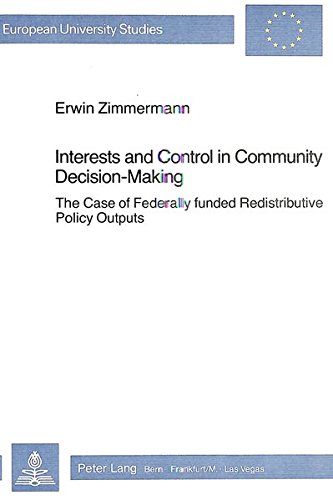
Interests and Control in Community Decision-Making: The Case of Federally Funded Redistributive Policy Outputs: v. 64 (European University Studies) - Softcover
Synopsis
The research presented in this book is a comparative study of collective community decision-making regarding federally funded redistributive policy outputs. The study covers federal allocations by the Office of Economic Opportunity (OEO) to thirty middle-sized American cities from 1968 to 1970. At a theoretical level, three but interdependent community subsystems are distinguished: citizens, organizations, and political entrepreneurs. The propositions that are formulated and tested relate to the role of subsystem preferences in determining redistributive policy outputs and to the processes through which these preferences are translated into collective community decisions. The key analytic concepts are purposive actors, assets and liabilities, influence resources, and collective action. The major methodological innovation of this study is it's use of Coleman's Mathematical Model of Collective Action (1973) in comparative urban research. In a sample, twenty to thirty-five political entrepreneurs were questioned in each city considering their interests and influence in two kinds of anti-poverty policies: economic development providing jobs to the poor, and redistributive welfare spending. The use of the model is empirically successful. Collective elite action explains indeed a substantial proportion of the variance in federal OEO allocations to cities.
"synopsis" may belong to another edition of this title.
Search results for Interests and Control in Community Decision-Making:...

Seller Image
Interests and control in community decision-making : the case of federally funded redistributive policy outputs.
Published by
Peter Lang International Academic Publishers, 1981
ISBN 10: 3261049693
ISBN 13: 9783261049698
Used
Softcover
Seller: Kloof Booksellers & Scientia Verlag, Amsterdam, Netherlands
Seller rating 4 out of 5 stars

Condition: very good. Frankfurt am Main : Peter Lang, 1981. Paperback. 236 pp. (Europäische Hochschulschriften. Reihe XXII, Soziologie ; Bd. 64.) The research presented in this book is a comparative study of collective community decision-making regarding federally funded redistributive policy outputs. The study covers federal allocations by the Office of Economic Opportunity (OEO) to thirty middle-sized American cities from 1968 to 1970. At a theoretical level, three but interdependent community subsystems are distinguished: citizens, organizations, and political entrepreneurs. The propositions that are formulated and tested relate to the role of subsystem preferences in determining redistributive policy outputs and to the processes through which these preferences are translated into collective community decisions. The key analytic concepts are purposive actors, assets and liabilities, influence resources, and collective action. The major methodological innovation of this study is it's use of Coleman's Mathematical Model of Collective Action (1973) in comparative urban research. In a sample, twenty to thirty-five political entrepreneurs were questioned in each city considering their interests and influence in two kinds of anti-poverty policies: economic development providing jobs to the poor, and redistributive welfare spending. The use of the model is empirically successful. Collective elite action explains indeed a substantial proportion of the variance in federal OEO allocations to cities. Condition : very good copy. ISBN 9783261049698. Keywords : SOCIOLOGY, Seller Inventory # 301164
Buy Used
£ 25.20
£ 25.35 shipping
Ships from Netherlands to U.S.A.
Ships from Netherlands to U.S.A.
Quantity: 1 available