
Items related to Christian Identity in Corinth: A Comparative Study...
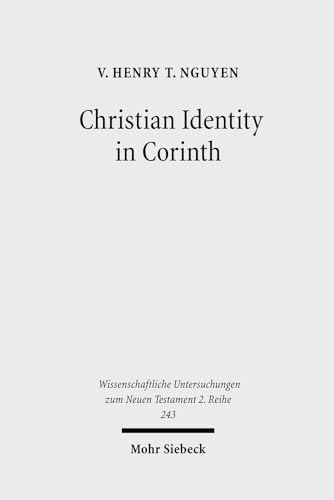
Christian Identity in Corinth: A Comparative Study of 2 Corinthians, Epictetus and Valerius Maximus (Wissenschaftliche Untersuchungen zum Neuen Testament 2/243) - Softcover
Synopsis
V. Henry T. Nguyen explores the social dynamics of Christian identity in the apostle Paul's second letter to the Corinthians. In order to grasp how aspects of identity affected social relations in the world of the New Testament, the author examines the significance of the ancient concept of persona for denoting a person's social identity in the Graeco-Roman social world. In addition to describing this social concept, which has been largely ignored by New Testament scholars and classicists, he considers two figures - Epictetus and Valerius Maximus - for their perceptions of social identity and persona in the Graeco-Roman world. By exploring this ancient concept and contributing new insights into Epictetus and Valerius, the author demonstrates the existence of a large preoccupation with the superficial features that expressed identity and persona (e.g. rank, status, and eloquence). He then investigates 2 Corinthians and argues that some of the conflicts in the Corinthian church resulted from the Corinthian Christians' adoption of the conventional values of identity and persona that were prevalent in Corinth. Paul's conflict with the Corinthians is clearly seen in their superficial assessment of his persona as lacking the appropriate credentials for an apostle. The author shows that in order to combat this misconception of Christian identity in the Corinthian church, Paul reacted to the Corinthians' conventional values of identity by promoting and projecting a subversive Christ-like identity, which is a visible embodiment of the dying and life of Jesus Christ.
"synopsis" may belong to another edition of this title.
About the Author
V. Henry T. Nguyen, Born 1977; B.A. Life Pacific College (USA); M.A. Talbot School of Theology, Biola University (USA); PhD University of Aberdeen (UK); currently teaching at Loyola Marymount University and Biola University in Los Angeles, USA.
"About this title" may belong to another edition of this title.
Search results for Christian Identity in Corinth: A Comparative Study...

Seller Image
Christian Identity in Corinth: A Comparative Study of 2 Corinthians, Epictetus and Valerius Maximus (Wissenschaftliche Untersuchungen zum Neuen Testament 2/243)
Seller: -OnTimeBooks-, Phoenix, AZ, U.S.A.
Seller rating 5 out of 5 stars

Condition: good. A copy that has been read, remains in good condition. All pages are intact, and the cover is intact. The spine and cover show signs of wear. Pages can include notes and highlighting and show signs of wear, and the copy can include "From the library of" labels or previous owner inscriptions. 100% GUARANTEE! Shipped with delivery confirmation, if you're not satisfied with purchase please return item! Ships via media mail. Seller Inventory # OTV.3161496663.G
Stock Image
Christian Identity in Corinth
Published by
Mohr Siebeck, 2008
ISBN 10: 3161496663
ISBN 13: 9783161496660
New
paperback
First Edition
Seller: ISD LLC, Bristol, CT, U.S.A.
Seller rating 5 out of 5 stars
paperback. Condition: New. 1st. Seller Inventory # 305081
Stock Image
Christian Identity in Corinth: A Comparative Study of 2 Corinthians, Epictetus and Valerius Maximus
Seller: Revaluation Books, Exeter, United Kingdom
Seller rating 5 out of 5 stars
Paperback. Condition: Brand New. 272 pages. 9.00x6.00x0.75 inches. In Stock. Seller Inventory # __3161496663
Buy New
£ 87.80
£ 10 shipping
Ships from United Kingdom to U.S.A.
Ships from United Kingdom to U.S.A.
Quantity: 1 available
Stock Image
Christian Identity in Corinth: A Comparative Study of 2 Corinthians, Epictetus and Valerius Maximus (Wissenschaftliche Untersuchungen zum Neuen Testament 2/243)
Seller: Ria Christie Collections, Uxbridge, United Kingdom
Seller rating 5 out of 5 stars
Condition: New. In English. Seller Inventory # ria9783161496660_new
Buy New
£ 100.45
£ 11.29 shipping
Ships from United Kingdom to U.S.A.
Ships from United Kingdom to U.S.A.
Quantity: 1 available
Stock Image
Christian Identity in Corinth: A Comparative Study of 2 Corinthians, Epictetus and Valerius Maximus
Published by
Mohr Siebeck, 2008
ISBN 10: 3161496663
ISBN 13: 9783161496660
New
Softcover
First Edition
Seller: Kennys Bookshop and Art Galleries Ltd., Galway, GY, Ireland
Seller rating 5 out of 5 stars
Condition: New. 2008. 1st Edition. paperback. . . . . . Seller Inventory # V9783161496660
Stock Image
Christian Identity in Corinth: A Comparative Study of 2 Corinthians, Epictetus and Valerius Maximus
Seller: Kennys Bookstore, Olney, MD, U.S.A.
Seller rating 5 out of 5 stars
Condition: New. 2008. 1st Edition. paperback. . . . . . Books ship from the US and Ireland. Seller Inventory # V9783161496660