
Synopsis
Johann Georg Hamann (1730–88) remains one of the most influential and yet least understood figures in the history of German thought and literature. Throughout his life, he had major influence on figures as diverse as Goethe, Schiller, Kant, Hegel, Hölderlin, Kierkegaard, and a host of others. Hamann is also one of the most difficult-to-read authors in the German language, writing in an ultracondensed, hyperallusive language for which he became infamous―and which his detractors constantly used to dismiss him. Today, Hamann has been picked up by literary theorists as a precursor of the linguistic turn.
The Last Mask focuses on Hamann’s final work, Entkleidung und Verklärung (1786), which was consciously conceived of as an “Abschluss” of his “kleine Autorschaft” and a final defense against his critics. Equally philological and theoretical, it identifies a number of previously unnoticed manuscript alterations that help answer some long-standing questions in Hamann scholarship as well as open new doors for inquiry.
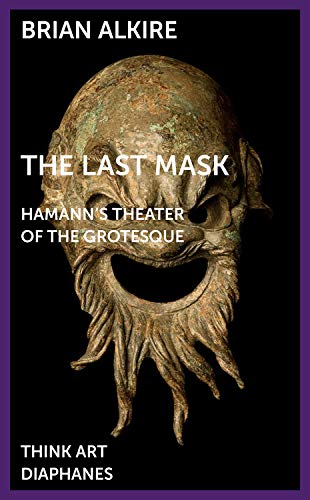
Importantly, the manuscripts show that Hamann is one of the earliest theorists of the virtual in our sense of the word today, using the word “virtualiter” to describe his own theory. He links this theory with the concept of the mask or disguise, and conceives of texts as fabrics or textiles composed of threads and strings. The philological focus is on Hamann’s understanding of intertextuality, and on the basis of his dominant string images his notion of virtuality is brought into conversation with Deleuze’s idea of a plane of immanence through the image of a skein of immanence, a knotted bundle of thread which solidifies into a three-dimensional virtual space―a new perspective in contemporary discussions surrounding the nature of virtuality.
"synopsis" may belong to another edition of this title.
About the Author
Brian Alkire is a research fellow in the Department of Comparative Literature at the University of Zürich, working on a project entitled “Voices of Exhaustion: Form and Physiology in Kafka, Beckett, and Bernhard.” In the spring of 2021, he will be joining the Department of German at New York University.
"About this title" may belong to another edition of this title.
Search results for The Last Mask – Hamann`s Theater of the Grotesque...

Stock Image
The Last Mask: Hamann's Theater of the Grotesque (Think Art)
Seller: Silent Way Books, Glenside, PA, U.S.A.
Seller rating 4 out of 5 stars

Paperback. Condition: As New. Seller Inventory # 029629
Stock Image
Last Mask : Hamann's Theater of the Grotesque
Seller: GreatBookPrices, Columbia, MD, U.S.A.
Seller rating 5 out of 5 stars

Condition: As New. Unread book in perfect condition. Seller Inventory # 42431771
Stock Image
Last Mask : Hamann's Theater of the Grotesque
Seller: GreatBookPrices, Columbia, MD, U.S.A.
Seller rating 5 out of 5 stars
Condition: New. Seller Inventory # 42431771-n
Stock Image
The Last Mask Hamann`s Theater of the Grotesque (Paperback)
Seller: Grand Eagle Retail, Bensenville, IL, U.S.A.
Seller rating 5 out of 5 stars
Paperback. Condition: new. Paperback. Johann Georg Hamann (173088) remains one of the most influential and yet least understood figures in the history of German thought and literature. Throughout his life, he had major influence on figures as diverse as Goethe, Schiller, Kant, Hegel, Hoelderlin, Kierkegaard, and a host of others. Hamann is also one of the most difficult-to-read authors in the German language, writing in an ultracondensed, hyperallusive language for which he became infamousand which his detractors constantly used to dismiss him. Today, Hamann has been picked up by literary theorists as a precursor of the linguistic turn. The Last Mask focuses on Hamanns final work, Entkleidung und Verklaerung (1786), which was consciously conceived of as an Abschluss of his kleine Autorschaft and a final defense against his critics. Equally philological and theoretical, it identifies a number of previously unnoticed manuscript alterations that help answer some long-standing questions in Hamann scholarship as well as open new doors for inquiry. Importantly, the manuscripts show that Hamann is one of the earliest theorists of the virtual in our sense of the word today, using the word virtualiter to describe his own theory. He links this theory with the concept of the mask or disguise, and conceives of texts as fabrics or textiles composed of threads and strings. The philological focus is on Hamanns understanding of intertextuality, and on the basis of his dominant string images his notion of virtuality is brought into conversation with Deleuzes idea of a plane of immanence through the image of a skein of immanence, a knotted bundle of thread which solidifies into a three-dimensional virtual spacea new perspective in contemporary discussions surrounding the nature of virtuality. Hamanns Theater of the Grotesque. An examination of the final work of a key, yet little understood, German thinker Shipping may be from multiple locations in the US or from the UK, depending on stock availability. Seller Inventory # 9783035803709
Stock Image
TheLastMask Format: Paperback
Seller: INDOO, Avenel, NJ, U.S.A.
Seller rating 5 out of 5 stars
Condition: New. Brand New. Seller Inventory # 9783035803709
Seller Image
The Last Mask - Hamann`s Theater of the Grotesque
Seller: Rarewaves.com USA, London, LONDO, United Kingdom
Seller rating 5 out of 5 stars
Paperback. Condition: New. Johann Georg Hamann (1730-88) remains one of the most influential and yet least understood figures in the history of German thought and literature. Throughout his life, he had major influence on figures as diverse as Goethe, Schiller, Kant, Hegel, Hölderlin, Kierkegaard, and a host of others. Hamann is also one of the most difficult-to-read authors in the German language, writing in an ultracondensed, hyperallusive language for which he became infamous-and which his detractors constantly used to dismiss him. Today, Hamann has been picked up by literary theorists as a precursor of the linguistic turn. The Last Mask focuses on Hamann's final work, Entkleidung und Verklärung (1786), which was consciously conceived of as an "Abschluss" of his "kleine Autorschaft" and a final defense against his critics. Equally philological and theoretical, it identifies a number of previously unnoticed manuscript alterations that help answer some long-standing questions in Hamann scholarship as well as open new doors for inquiry. Importantly, the manuscripts show that Hamann is one of the earliest theorists of the virtual in our sense of the word today, using the word "virtualiter" to describe his own theory. He links this theory with the concept of the mask or disguise, and conceives of texts as fabrics or textiles composed of threads and strings. The philological focus is on Hamann's understanding of intertextuality, and on the basis of his dominant string images his notion of virtuality is brought into conversation with Deleuze's idea of a plane of immanence through the image of a skein of immanence, a knotted bundle of thread which solidifies into a three-dimensional virtual space-a new perspective in contemporary discussions surrounding the nature of virtuality. Seller Inventory # LU-9783035803709
Buy New
£ 20.99
Free Shipping
Ships from United Kingdom to U.S.A.
Ships from United Kingdom to U.S.A.
Quantity: 4 available
Stock Image
The Last Mask Hamann`s Theater of the Grotesque
Seller: PBShop.store US, Wood Dale, IL, U.S.A.
Seller rating 5 out of 5 stars
PAP. Condition: New. New Book. Shipped from UK. Established seller since 2000. Seller Inventory # FW-9783035803709
Stock Image
The Last Mask ? Hamann`s Theater of the Grotesque (eng)
Seller: Brook Bookstore On Demand, Napoli, NA, Italy
Seller rating 5 out of 5 stars
Condition: new. Seller Inventory # THCPKKCF70
Stock Image
The Last Mask Hamann`s Theater of the Grotesque
Seller: PBShop.store UK, Fairford, GLOS, United Kingdom
Seller rating 5 out of 5 stars
PAP. Condition: New. New Book. Shipped from UK. Established seller since 2000. Seller Inventory # FW-9783035803709
Buy New
£ 20.42
£ 3.29 shipping
Ships from United Kingdom to U.S.A.
Ships from United Kingdom to U.S.A.
Quantity: 8 available
Stock Image
The Last Mask Hamann`s Theater of the Grotesque
Seller: Revaluation Books, Exeter, United Kingdom
Seller rating 5 out of 5 stars
Paperback. Condition: Brand New. 128 pages. 7.50x4.75x0.75 inches. In Stock. Seller Inventory # __3035803706
Buy New
£ 17.82
£ 10 shipping
Ships from United Kingdom to U.S.A.
Ships from United Kingdom to U.S.A.
Quantity: 2 available