
Items related to Designing Engineering and Technology Curricula: Embedding...
Designing Engineering and Technology Curricula: Embedding Educational Philosophy (Synthesis Lectures on Engineering, Science, and Technology) - Softcover
Book 30 of 110: Synthesis Lectures on Engineering, Science, and Technology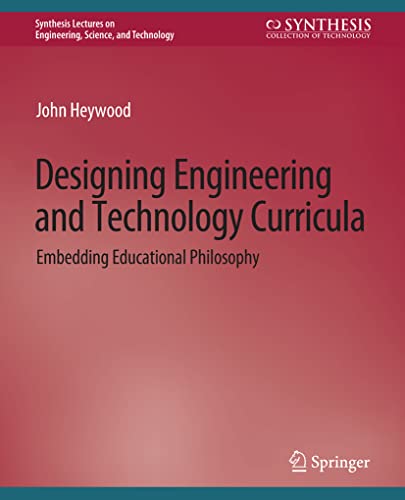
Synopsis
The intention of this book is to demonstrate that curriculum design is a profoundly philosophical exercise that stems from perceptions of the mission of higher education. Since the curriculum is the formal mechanism through which intended aims are achieved, philosophy has a profound role to play in the determination of aims. It is argued that the curriculum is far more than a list of subjects and syllabi, or that it is the addition, and subtraction, of items from a syllabus, or whether this subject should be added and that subject taken away. This book explores how curricular aims and objectives are developed by re-examining the curriculum of higher education and how it is structured in the light of its increasing costs, rapidly changing technology, and the utilitarian philosophy that currently governs the direction of higher education. It is concluded that higher education should be a preparation for and continuing support for life and work, a consequence of which is that it has to equip graduates with skill in independent learning (and its planning), and reflective practice. A transdisciplinary curriculum with technology at its core is deduced that serves the four realities of the person, the job, technology, and society.
"synopsis" may belong to another edition of this title.
About the Author
John Heywood is a Professorial Fellow Emeritus of Trinity College Dublin. His primary interest is in education for the professions, especially engineering, management and teacher education. He was awarded the best research publication award of the division for the professions of the American Educational Research Association in 2006 for his book “Engineering Education: Research and Development in Curriculum and Instruction” published by IEEE/Wiley. His other publications include “Learning, Adaptability and Change: The challenge for education and Industry”, “The Human Side of Engineering”, “Empowering Professional teaching in Engineering; Sustaining the Scholarship of Teaching”. He was a co-author of “Analysing Jobs”.
"About this title" may belong to another edition of this title.
Search results for Designing Engineering and Technology Curricula: Embedding...

Stock Image
Designing Engineering and Technology Curricula (eng)
Print on DemandSeller: Brook Bookstore On Demand, Napoli, NA, Italy
Seller rating 5 out of 5 stars

Condition: new. Questo è un articolo print on demand. Seller Inventory # 8G0LFQ9VZI
Buy New
£ 44.18
£ 4.70 shipping
Ships from Italy to U.S.A.
Ships from Italy to U.S.A.
Quantity: Over 20 available
Stock Image
Designing Engineering and Technology Curricula: Embedding Educational Philosophy (Synthesis Lectures on Engineering, Science, and Technology)
Seller: Chiron Media, Wallingford, United Kingdom
Seller rating 5 out of 5 stars
Paperback. Condition: New. Brand new book, sourced directly from publisher. Dispatch time is 6-7 days from our warehouse. Book will be sent in robust, secure packaging to ensure it reaches you securely. Seller Inventory # 6666-IUK-9783031037528
Buy New
£ 51.93
£ 4.99 shipping
Ships from United Kingdom to U.S.A.
Ships from United Kingdom to U.S.A.
Quantity: Over 20 available
Stock Image
Designing Engineering and Technology Curricula: Embedding Educational Philosophy
Seller: California Books, Miami, FL, U.S.A.
Seller rating 5 out of 5 stars
Condition: New. Seller Inventory # I-9783031037528
Stock Image
Designing Engineering and Technology Curricula: Embedding Educational Philosophy
Seller: Ria Christie Collections, Uxbridge, United Kingdom
Seller rating 5 out of 5 stars
Condition: New. In English. Seller Inventory # ria9783031037528_new
Buy New
£ 60.46
£ 9.37 shipping
Ships from United Kingdom to U.S.A.
Ships from United Kingdom to U.S.A.
Quantity: Over 20 available
Seller Image
Designing Engineering and Technology Curricula
Published by
Springer International Publishing Jan 2022, 2022
ISBN 10: 3031037529
ISBN 13: 9783031037528
New
Taschenbuch
Seller: BuchWeltWeit Ludwig Meier e.K., Bergisch Gladbach, Germany
Seller rating 5 out of 5 stars
Taschenbuch. Condition: Neu. This item is printed on demand - it takes 3-4 days longer - Neuware -The intention of this book is to demonstrate that curriculum design is a profoundly philosophical exercise that stems from perceptions of the mission of higher education. Since the curriculum is the formal mechanism through which intended aims are achieved, philosophy has a profound role to play in the determination of aims. It is argued that the curriculum is far more than a list of subjects and syllabi, or that it is the addition, and subtraction, of items from a syllabus, or whether this subject should be added and that subject taken away. This book explores how curricular aims and objectives are developed by re-examining the curriculum of higher education and how it is structured in the light of its increasing costs, rapidly changing technology, and the utilitarian philosophy that currently governs the direction of higher education. It is concluded that higher education should be a preparation for and continuing support for life and work, a consequence of which is that it has to equip graduates with skill in independent learning (and its planning), and reflective practice. A transdisciplinary curriculum with technology at its core is deduced that serves the four realities of the person, the job, technology, and society. 164 pp. Englisch. Seller Inventory # 9783031037528
Stock Image
Designing Engineering And Technology Cur
Seller: Kennys Bookshop and Art Galleries Ltd., Galway, GY, Ireland
Seller rating 5 out of 5 stars
Condition: New. Seller Inventory # V9783031037528
Stock Image
Designing Engineering and Technology Curricula: Embedding Educational Philosophy (Synthesis Lectures on Engineering, Science, and Technology)
Seller: Books Puddle, Woodside, NY, U.S.A.
Seller rating 4 out of 5 stars

Condition: New. 1st edition NO-PA16APR2015-KAP. Seller Inventory # 26394683449
Stock Image
Designing Engineering and Technology Curricula: Embedding Educational Philosophy (Synthesis Lectures on Engineering, Science, and Technology)
Print on DemandSeller: Majestic Books, Hounslow, United Kingdom
Seller rating 4 out of 5 stars
Condition: New. Print on Demand. Seller Inventory # 401726438
Buy New
£ 77.47
£ 6.50 shipping
Ships from United Kingdom to U.S.A.
Ships from United Kingdom to U.S.A.
Quantity: 4 available
Seller Image
Designing Engineering and Technology Curricula
ISBN 10: 3031037529
ISBN 13: 9783031037528
New
Kartoniert / Broschiert
Seller: moluna, Greven, Germany
Seller rating 5 out of 5 stars
Kartoniert / Broschiert. Condition: New. Dieser Artikel ist ein Print on Demand Artikel und wird nach Ihrer Bestellung fuer Sie gedruckt. The intention of this book is to demonstrate that curriculum design is a profoundly philosophical exercise that stems from perceptions of the mission of higher education. Since the curriculum is the formal mechanism through which intended aims are achieved,. Seller Inventory # 608129661
Buy New
£ 45.31
£ 41.83 shipping
Ships from Germany to U.S.A.
Ships from Germany to U.S.A.
Quantity: Over 20 available
Seller Image
Designing Engineering and Technology Curricula : Embedding Educational Philosophy
Seller: AHA-BUCH GmbH, Einbeck, Germany
Seller rating 5 out of 5 stars
Taschenbuch. Condition: Neu. Druck auf Anfrage Neuware - Printed after ordering - The intention of this book is to demonstrate that curriculum design is a profoundly philosophical exercise that stems from perceptions of the mission of higher education. Since the curriculum is the formal mechanism through which intended aims are achieved, philosophy has a profound role to play in the determination of aims. It is argued that the curriculum is far more than a list of subjects and syllabi, or that it is the addition, and subtraction, of items from a syllabus, or whether this subject should be added and that subject taken away. This book explores how curricular aims and objectives are developed by re-examining the curriculum of higher education and how it is structured in the light of its increasing costs, rapidly changing technology, and the utilitarian philosophy that currently governs the direction of higher education. It is concluded that higher education should be a preparation for and continuing support for life and work, a consequence of which is that it has to equip graduates with skill in independent learning (and its planning), and reflective practice. A transdisciplinary curriculum with technology at its core is deduced that serves the four realities of the person, the job, technology, and society. Seller Inventory # 9783031037528