
Items related to Revising Cognitive and Evolutionary Science of Religion:...
Revising Cognitive and Evolutionary Science of Religion: Religion as an Adaptation: 8 (New Approaches to the Scientific Study of Religion, 8) - Softcover
Book 8 of 10: New Approaches to the Scientific Study of Religion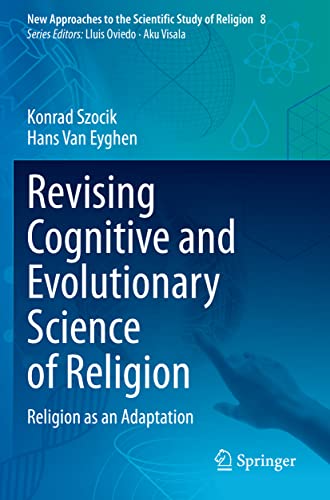
Synopsis
This unique and pioneering book critically appraises current work from both the cognitive science of religion and the evolutionary study of religion. It addresses the question: Why does the believer possess supernatural or religious beliefs in the combined context of his cognitive biases, their adaptive usefulness measured in terms of survival and reproduction, and the impact of social learning and cultural traits? The authors outlines a pluralistic approach to the study of religion that does not treat religion as an accidental by-product but an adaptation selected by natural selection.
Chapters discuss the role of religious components for the evolution of cooperation and altruism, and explore the development of atheism and secular ideas, in cognitive and evolutionary terms. Topics such as the usefulness of religion, the transmission of religious beliefs, and a Darwinian approach to religion are among those addressed. Contrary to standard views, religious biases are regarded as shaped by cultural influences and not merely by natural dispositions.
This monograph will particularly appeal to researchers who are looking for a scientific explanation of religion and religious beliefs but who do not stop at the level of narrow cognitive and evolutionary accounts. The work will also be of interest to students of philosophy, sociology, religious studies, theology, or anthropology who seek to explain such fascinating, complex, and unequivocal phenomena as religion and religious components.
"synopsis" may belong to another edition of this title.
About the Author
Konrad Szocik is a doctor of philosophy and assistant professor in Department of Social Sciences at University of Information Technology and Management in Rzeszów, Poland. His research interests include cognitive and evolutionary science of religion, evolution of cooperation, space ethics and bioethics, space philosophy and space policy, and the ethics of human enhancement.
Hans Van Eyghen is assistant professor of Philosophy at Tilburg University the Netherlands. His research interests include religious epistemology, philosophy of religion and cognitive and evolutionary science of religion.
From the Back Cover
This unique and pioneering book critically appraises current work from both the cognitive science of religion and the evolutionary study of religion. It addresses the question: Why does the believer possess supernatural or religious beliefs in the combined context of his cognitive biases, their adaptive usefulness measured in terms of survival and reproduction, and the impact of social learning and cultural traits? The authors outlines a pluralistic approach to the study of religion that does not treat religion as an accidental by-product but an adaptation selected by natural selection.
Chapters discuss the role of religious components for the evolution of cooperation and altruism, and explore the development of atheism and secular ideas, in cognitive and evolutionary terms. Topics such as the usefulness of religion, the transmission of religious beliefs, and a Darwinian approach to religion are among those addressed. Contrary to standard views, religious biases are regardedas shaped by cultural influences and not merely by natural dispositions.
This monograph will particularly appeal to researchers who are looking for a scientific explanation of religion and religious beliefs but who do not stop at the level of narrow cognitive and evolutionary accounts. The work will also be of interest to students of philosophy, sociology, religious studies, theology, or anthropology who seek to explain such fascinating, complex, and unequivocal phenomena as religion and religious components.
"About this title" may belong to another edition of this title.
Search results for Revising Cognitive and Evolutionary Science of Religion:...

Stock Image
Revising Cognitive and Evolutionary Science of Religion (eng)
Print on DemandSeller: Brook Bookstore On Demand, Napoli, NA, Italy
Seller rating 5 out of 5 stars

Condition: new. Questo è un articolo print on demand. Seller Inventory # e84119c1244c929bfbc36efd7c4f408a
Buy New
£ 40.38
£ 4.67 shipping
Ships from Italy to U.S.A.
Ships from Italy to U.S.A.
Quantity: Over 20 available
Stock Image
Revising Cognitive and Evolutionary Science of Religion : Religion As an Adaptation
Seller: GreatBookPrices, Columbia, MD, U.S.A.
Seller rating 5 out of 5 stars
Condition: As New. Unread book in perfect condition. Seller Inventory # 44172327
Stock Image
Revising Cognitive and Evolutionary Science of Religion: Religion as an Adaptation (New Approaches to the Scientific Study of Religion, 8)
Seller: Ria Christie Collections, Uxbridge, United Kingdom
Seller rating 5 out of 5 stars
Condition: New. In English. Seller Inventory # ria9783030635183_new
Buy New
£ 54.35
£ 9.37 shipping
Ships from United Kingdom to U.S.A.
Ships from United Kingdom to U.S.A.
Quantity: Over 20 available
Seller Image
Revising Cognitive and Evolutionary Science of Religion
Published by
Springer International Publishing Jan 2022, 2022
ISBN 10: 303063518X
ISBN 13: 9783030635183
New
Taschenbuch
Seller: BuchWeltWeit Ludwig Meier e.K., Bergisch Gladbach, Germany
Seller rating 5 out of 5 stars
Taschenbuch. Condition: Neu. This item is printed on demand - it takes 3-4 days longer - Neuware -This unique and pioneering book critically appraises current work from both the cognitive science of religion and the evolutionary study of religion. It addresses the question: Why does the believer possess supernatural or religious beliefs in the combined context of his cognitive biases, their adaptive usefulness measured in terms of survival and reproduction, and the impact of social learning and cultural traits The authors outlines a pluralistic approach to the study of religion that does not treat religion as an accidental by-product but an adaptation selected by natural selection. Chapters discuss the role of religious components for the evolution of cooperation and altruism, and explore the development of atheism and secular ideas, in cognitive and evolutionary terms. Topics such as the usefulness of religion, the transmission of religious beliefs, and a Darwinian approach to religion are among those addressed. Contrary to standard views, religious biases are regarded as shaped by cultural influences and not merely by natural dispositions. This monograph will particularly appeal to researchers who are looking for a scientific explanation of religion and religious beliefs but who do not stop at the level of narrow cognitive and evolutionary accounts. The work will also be of interest to students of philosophy, sociology, religious studies, theology, or anthropology who seek to explain such fascinating, complex, and unequivocal phenomena as religion and religious components. 132 pp. Englisch. Seller Inventory # 9783030635183
Stock Image
Revising Cognitive And Evolutionary Scie
Seller: Kennys Bookshop and Art Galleries Ltd., Galway, GY, Ireland
Seller rating 5 out of 5 stars
Condition: New. Seller Inventory # V9783030635183
Stock Image
Revising Cognitive and Evolutionary Science of Religion : Religion As an Adaptation
Seller: GreatBookPrices, Columbia, MD, U.S.A.
Seller rating 5 out of 5 stars
Condition: New. Seller Inventory # 44172327-n
Stock Image
Revising Cognitive and Evolutionary Science of Religion: Religion as an Adaptation (New Approaches to the Scientific Study of Religion, 8)
Seller: Books Puddle, Woodside, NY, U.S.A.
Seller rating 4 out of 5 stars

Condition: New. 1st ed. 2021 edition NO-PA16APR2015-KAP. Seller Inventory # 26394680827
Stock Image
Revising Cognitive and Evolutionary Science of Religion: Religion as an Adaptation (New Approaches to the Scientific Study of Religion, 8)
Print on DemandSeller: Majestic Books, Hounslow, United Kingdom
Seller rating 4 out of 5 stars
Condition: New. Print on Demand. Seller Inventory # 401729060
Buy New
£ 69.65
£ 6.50 shipping
Ships from United Kingdom to U.S.A.
Ships from United Kingdom to U.S.A.
Quantity: 4 available
Stock Image
Revising Cognitive and Evolutionary Science of Religion: Religion as an Adaptation (New Approaches to the Scientific Study of Religion, 8)
Print on DemandSeller: Biblios, Frankfurt am main, HESSE, Germany
Seller rating 4 out of 5 stars
Condition: New. PRINT ON DEMAND. Seller Inventory # 18394680817
Seller Image
Revising Cognitive and Evolutionary Science of Religion : Religion as an Adaptation
Seller: AHA-BUCH GmbH, Einbeck, Germany
Seller rating 5 out of 5 stars
Taschenbuch. Condition: Neu. Druck auf Anfrage Neuware - Printed after ordering - This unique and pioneering book critically appraises current work from both the cognitive science of religion and the evolutionary study of religion. It addresses the question: Why does the believer possess supernatural or religious beliefs in the combined context of his cognitive biases, their adaptive usefulness measured in terms of survival and reproduction, and the impact of social learning and cultural traits The authors outlines a pluralistic approach to the study of religion that does not treat religion as an accidental by-product but an adaptation selected by natural selection. Chapters discuss the role of religious components for the evolution of cooperation and altruism, and explore the development of atheism and secular ideas, in cognitive and evolutionary terms. Topics such as the usefulness of religion, the transmission of religious beliefs, and a Darwinian approach to religion are among those addressed. Contrary to standard views, religious biases are regarded as shaped by cultural influences and not merely by natural dispositions. This monograph will particularly appeal to researchers who are looking for a scientific explanation of religion and religious beliefs but who do not stop at the level of narrow cognitive and evolutionary accounts. The work will also be of interest to students of philosophy, sociology, religious studies, theology, or anthropology who seek to explain such fascinating, complex, and unequivocal phenomena as religion and religious components. Seller Inventory # 9783030635183