
Items related to MEMS: Field Models and Optimal Design: 573 (Lecture...
MEMS: Field Models and Optimal Design: 573 (Lecture Notes in Electrical Engineering, 573) - Softcover
Book 367 of 548: Lecture Notes in Electrical Engineering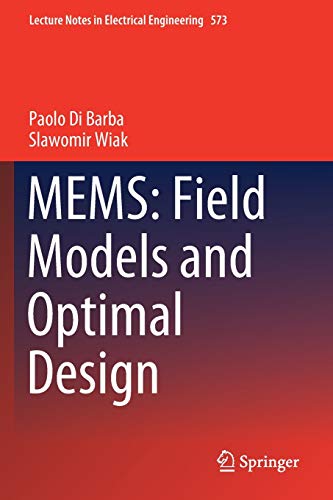
Synopsis
This book highlights numerical models as powerful tools for the optimal design of Micro-Electro-Mechanical Systems (MEMS). Most MEMS experts have a background in electronics, where circuit models or behavioral models (i.e. lumped-parameter models) of devices are preferred to field models. This is certainly convenient in terms of preliminary design, e.g. in the prototyping stage. However, design optimization should also take into account fine-sizing effects on device behavior and therefore be based on distributed-parameter models, such as finite-element models. The book shows how the combination of automated optimal design and field-based models can produce powerful design toolboxes for MEMS. It especially focuses on illustrating theoretical concepts with practical examples, fostering comprehension through a problem-solving approach. By comparing the results obtained using different methods, readers will learn to identify their respective strengths and weaknesses. In addition, special emphasis is given to evolutionary computing and nature-inspired optimization strategies, the effectiveness of which has already been amply demonstrated. Given its scope, the book provides PhD students, researchers and professionals in the area of computer-aided analysis with a comprehensive, yet concise and practice-oriented guide to MEMS design and optimization. To benefit most from the book, readers should have a basic grasp of electromagnetism, vector analysis and numerical methods.
"synopsis" may belong to another edition of this title.
From the Back Cover
This book highlights numerical models as powerful tools for the optimal design of Micro-Electro-Mechanical Systems (MEMS). Most MEMS experts have a background in electronics, where circuit models or behavioral models (i.e. lumped-parameter models) of devices are preferred to field models. This is certainly convenient in terms of preliminary design, e.g. in the prototyping stage. However, design optimization should also take into account fine-sizing effects on device behavior and therefore be based on distributed-parameter models, such as finite-element models. The book shows how the combination of automated optimal design and field-based models can produce powerful design toolboxes for MEMS. It especially focuses on illustrating theoretical concepts with practical examples, fostering comprehension through a problem-solving approach. By comparing the results obtained using different methods, readers will learn to identify their respective strengths and weaknesses.In addition, special emphasis is given to evolutionary computing and nature-inspired optimization strategies, the effectiveness of which has already been amply demonstrated. Given its scope, the book provides PhD students, researchers and professionals in the area of computer-aided analysis with a comprehensive, yet concise and practice-oriented guide to MEMS design and optimization. To benefit most from the book, readers should have a basic grasp of electromagnetism, vector analysis and numerical methods.
"About this title" may belong to another edition of this title.
Search results for MEMS: Field Models and Optimal Design: 573 (Lecture...

Stock Image
MEMS: Field Models and Optimal Design (Lecture Notes in Electrical Engineering, 573)
Seller: Ria Christie Collections, Uxbridge, United Kingdom
Seller rating 5 out of 5 stars

Condition: New. In. Seller Inventory # ria9783030214982_new
Buy New
£ 81.52
£ 11.29 shipping
Ships from United Kingdom to U.S.A.
Ships from United Kingdom to U.S.A.
Quantity: Over 20 available
Stock Image
MEMS: Field Models and Optimal Design
Seller: Chiron Media, Wallingford, United Kingdom
Seller rating 5 out of 5 stars
PF. Condition: New. Seller Inventory # 6666-IUK-9783030214982
Buy New
£ 79.09
£ 15.49 shipping
Ships from United Kingdom to U.S.A.
Ships from United Kingdom to U.S.A.
Quantity: 10 available
Stock Image
MEMS: Field Models and Optimal Design (eng)
Print on DemandSeller: Brook Bookstore On Demand, Napoli, NA, Italy
Seller rating 5 out of 5 stars
Condition: new. Questo è un articolo print on demand. Seller Inventory # 9e4d7988bd86e08b2f09d19a1a869b07
Buy New
£ 97.39
£ 4.72 shipping
Ships from Italy to U.S.A.
Ships from Italy to U.S.A.
Quantity: Over 20 available
Seller Image
MEMS: Field Models and Optimal Design
Published by
Springer International Publishing Aug 2020, 2020
ISBN 10: 3030214982
ISBN 13: 9783030214982
New
Taschenbuch
Seller: BuchWeltWeit Ludwig Meier e.K., Bergisch Gladbach, Germany
Seller rating 5 out of 5 stars
Taschenbuch. Condition: Neu. This item is printed on demand - it takes 3-4 days longer - Neuware -This book highlights numerical models as powerful tools for the optimal design of Micro-Electro-Mechanical Systems (MEMS). Most MEMS experts have a background in electronics, where circuit models or behavioral models (i.e. lumped-parameter models) of devices are preferred to field models. This is certainly convenient in terms of preliminary design, e.g. in the prototyping stage. However, design optimization should also take into account fine-sizing effects on device behavior and therefore be based on distributed-parameter models, such as finite-element models. The book shows how the combination of automated optimal design and field-based models can produce powerful design toolboxes for MEMS. It especially focuses on illustrating theoretical concepts with practical examples, fostering comprehension through a problem-solving approach. By comparing the results obtained using different methods, readers will learn to identify their respective strengths and weaknesses. In addition, special emphasis is given to evolutionary computing and nature-inspired optimization strategies, the effectiveness of which has already been amply demonstrated. Given its scope, the book provides PhD students, researchers and professionals in the area of computer-aided analysis with a comprehensive, yet concise and practice-oriented guide to MEMS design and optimization. To benefit most from the book, readers should have a basic grasp of electromagnetism, vector analysis and numerical methods. 200 pp. Englisch. Seller Inventory # 9783030214982
Seller Image
MEMS: Field Models and Optimal Design
Published by
Springer International Publishing, 2020
ISBN 10: 3030214982
ISBN 13: 9783030214982
New
Softcover
Seller: moluna, Greven, Germany
Seller rating 5 out of 5 stars
Condition: New. Dieser Artikel ist ein Print on Demand Artikel und wird nach Ihrer Bestellung fuer Sie gedruckt. Describes modern numerical methods for MEMS analysis and designReports on automated optimal design and field-based models of MEMS Shows applications to NEMS devices as wellThis book highlights numer. Seller Inventory # 448675485
Buy New
£ 104.77
£ 42.01 shipping
Ships from Germany to U.S.A.
Ships from Germany to U.S.A.
Quantity: Over 20 available
Stock Image
MEMS: Field Models and Optimal Design: 573 (Lecture Notes in Electrical Engineering)
Seller: Books Puddle, New York, NY, U.S.A.
Seller rating 4 out of 5 stars

Condition: New. pp. 190 1st ed. 2020 edition NO-PA16APR2015-KAP. Seller Inventory # 26380342890
Stock Image
MEMS: Field Models and Optimal Design: 573 (Lecture Notes in Electrical Engineering)
Print on DemandSeller: Majestic Books, Hounslow, United Kingdom
Seller rating 4 out of 5 stars
Condition: New. Print on Demand pp. 190. Seller Inventory # 383528373
Buy New
£ 154.42
£ 6.50 shipping
Ships from United Kingdom to U.S.A.
Ships from United Kingdom to U.S.A.
Quantity: 4 available
Seller Image
MEMS: Field Models and Optimal Design
Seller: preigu, Osnabrück, Germany
Seller rating 5 out of 5 stars
Taschenbuch. Condition: Neu. MEMS: Field Models and Optimal Design | Paolo Di Barba (u. a.) | Taschenbuch | Lecture Notes in Electrical Engineering | ix | Englisch | 2020 | Springer | EAN 9783030214982 | Verantwortliche Person für die EU: Springer Verlag GmbH, Tiergartenstr. 17, 69121 Heidelberg, juergen[dot]hartmann[at]springer[dot]com | Anbieter: preigu. Seller Inventory # 118834227
Stock Image
Mems: Field Models and Optimal Design
Seller: Revaluation Books, Exeter, United Kingdom
Seller rating 5 out of 5 stars
Paperback. Condition: Brand New. 200 pages. 9.25x6.10x0.46 inches. In Stock. Seller Inventory # x-3030214982
Buy New
£ 159.28
£ 10 shipping
Ships from United Kingdom to U.S.A.
Ships from United Kingdom to U.S.A.
Quantity: 2 available
Stock Image
MEMS: Field Models and Optimal Design: 573 (Lecture Notes in Electrical Engineering)
Print on DemandSeller: Biblios, Frankfurt am main, HESSE, Germany
Seller rating 4 out of 5 stars
Condition: New. PRINT ON DEMAND pp. 190. Seller Inventory # 18380342880