
Items related to Flemish Tapestry in European: Studies in Honour of...
Flemish Tapestry in European: Studies in Honour of Guy Delmarcel: 1 (Studies in Western Tapestry) - Hardcover
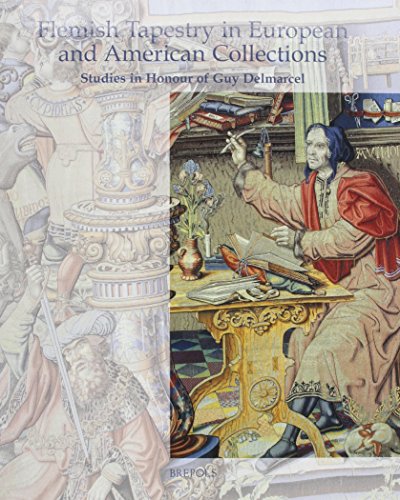
Synopsis
Professor Dr Guy Delmarcel was Curator of Textiles at the Brussels Koninklijke Musea voor Kunst en Geschiedenis (1975-1990) and Professor of History of Art at the Catholic University of Leuven (1981-2002). He passionately devoted his career to the study of Flemish tapestry. His intensive research on the 'Mobile Frescoes of the North' resulted in numerous articles, books, lectures, and exhibitions, thereby unlocking tapestry to both scholars and the general public. Guy Delmarcel has now been given emeritus status. The Department of Archaeology, History of Art and Musicology decided to honour its former chairman by offering him a Festschrift entirely dedicated to his beloved field of research. Fourteen renowned tapestry scholars from all over the world willingly accepted the invitation to celebrate their esteemed colleague. Throughout the centuries Flemish tapestry has eagerly been collected. In the Middle Ages and Early Modern Times the European elite spent fortunes on these lavish works of art. A number of essays compiled in the present volume focus on the patronage and collections of European kings and noblemen. In the nineteenth and twentieth centuries European and American museums became important collectors of Flemish tapestry, as is demonstrated by some museological studies presented in Studies in Honour of Guy Delmarcel. This penetration by Flemish tapestry of the public realm has obviously necessitated iconographic and stylistic studies. A number of new analyses are gathered in the Festschrift.
"synopsis" may belong to another edition of this title.
Synopsis
Presented as a festschrift on the occasion of Delmarcel's retirement from Leuven U., Belgium, where he taught art history, this slightly oversize (10x12<">) volume contains 13 articles on tapestries in collections in the US and Europe. Individual topics include Flemish tapestries recorded in drawings by the 17th- century collector Roger de Gaignie
"About this title" may belong to another edition of this title.
Search results for Flemish Tapestry in European: Studies in Honour of...

Stock Image
Flemish Tapestry in European and American Collections
Published by
Brepols Publishers, 2003
ISBN 10: 2503521746
ISBN 13: 9782503521749
New
Hardcover
First Edition
Seller: ISD LLC, Bristol, CT, U.S.A.
Seller rating 5 out of 5 stars

hardcover. Condition: New. 1st. Seller Inventory # 86401
Stock Image
FLEMISH TAPESTRY IN EUROPEAN AND AMERICAN COLLECTIONS. Studies in Honour of Guy Delmarcel.
Seller: EDITORIALE UMBRA SAS, Foligno, PG, Italy
Seller rating 5 out of 5 stars
Condition: UsatoBuono. Ril. carton., cm 30x25, pp 213, 15 tavv con numer. ill. a colori, numer. ill. b/n. - ISBN: 9782503521749. Seller Inventory # 54021
Stock Image
Flemish Tapestry in European and American Collections: Studies in Honour of Guy Delmarcel
Published by
Brepols Publishers, Turnhout, 2003
ISBN 10: 2503521746
ISBN 13: 9782503521749
Used
Hardcover
Seller: Luigi De Bei, PREGANZIOL, TV, Italy
Seller rating 2 out of 5 stars

Cloth. Condition: As New. Dust Jacket Condition: As New. Flemish Tapestry in European and American Collections : Studiesin Honour of Guy Delmarcel editée par Konrad Brosens.Turnhout 2003 Brepols publishers Pages 231 ills.30 pages in color and b& w Quarto cloth Euro 90,00.- Size: Quarto. Seller Inventory # 001886
Stock Image
Les Tapisseries Des Barberini et La Décoration D'interieur Dans La Rome Baroque
Published by
Brepols Publishers, Turnhout, 2005
ISBN 10: 2503521746
ISBN 13: 9782503521749
Used
Hardcover
First Edition
Seller: Luigi De Bei, PREGANZIOL, TV, Italy
Seller rating 2 out of 5 stars
Rilegato. Condition: As New. Dust Jacket Condition: As New. prima edizione. Studies in Western Tapestry (SWT 2) P.-F. Bertrand Les tapisseries des Barberini et la décoration d'intérieur dans la Rome baroque 343 p., 153 b/w ill. + 16 colour ill., 245 x 297 mm, 2005 ISBN: 978-2-503-51668-4 Languages: French Hardback The publication is available. Retail price: EUR 135,00 The subject of this book is tapestry, with a particular focus on the function and use of hangings, and on the eventuality or necessity of owning them in the modern world. It is thus viewed from an angle warranted by an inquiry into the determination of the object. The relationship of that object to the place for which it was intended or in which it is used is a crucial point, for, by its very nature, tapestry can be easily moved and can take on a new meaning in a different setting. This apparent truism is rendered complex by the specific characteristics of tapestry, which places any analysis in the dual perspective of furnishings on the one hand and of large-scale architectural decor on the other and touches at the same time on the sociology of art and its reception. The point of departure for this study is the celebrated Barberini family, which assumed a prominent position within Roman nobility by virtue of the authority of Urban VIII, who was elected Pope in 1623. Patrons of the Arts and Letters, the Pope and his nephews, Cardinals Francesco and Antonio Barberini, as well as Prince Taddeo, brought together more than nine hundred tapestries to adorn their sumptuous palaces and to decorate churches for ceremonial occasions. The sources drawn on consist of a vast ensemble of archival documents (inventories, records of payments and correspondence) from the Vatican Library. The first two parts deal with the problem of individual taste for a given type of object, tapestry in the present case. They pay particular attention to the manifestations of the Barberini¿s interest in it, to their admiration for such and such a hanging, and to their private commissions. They inquire into the significance of the foundation of the family tapestry works by Cardinal Francesco Barberini. The third part is based on a discussion of the daily use of the tapestries in palaces, but also of occasional use for events on festive or ceremonial occasions outside, in the streets of the city, or in churches. This part in fact attempts to answer the question as to the way in which, in a hierarchical and codified society, an interest in a given art form can be expressed in interior decoration in a way that allows awareness of its specific characteristics. The fourth part is concerned with the notion of patrician collection and the dispersion of the latter. Nearly two-thirds of the extant tapestries have been localized in the United States, in the museums of Boston, New York, Philadelphia, Cleveland, Flint, Minneapolis, San Francisco, etc., Charles M. Ffoulke, a Washington collector, having bought an important lot from the Barberini family in 1889. The fifth and last part analyses the process of tapestry-making, with special emphasis on the drawing up of models and cartoon. Urban VIII and Francesco Barberini were particularly attentive to the quality of the design and of the weaving itself, carried out in the most famous workshops of Brussels, Paris and Rome. It has thus been possible to reconstitute the elements of an aspect of the Barberini taste on the basis of a study of their tapestries. Pascal-François Bertrand is Professor of Art History at the Université de Pau et des Pays de l¿Adour. Le propos de ce livre est de mener une réflexion sur la tapisserie, en portant principalement l¿attention sur la fonction et l¿usage des tentures, sur la contingence ou la nécessité d¿en posséder à l¿époque moderne, une question motivée par une interrogation sur la détermination de. Seller Inventory # 002597
Stock Image
Flemish Tapestry in European and American Collections ,Studies in Honour of Guy Delmarcel Guy Delmarcel
Seller: BUCHSERVICE / ANTIQUARIAT Lars Lutzer, Wahlstedt, Germany
Seller rating 5 out of 5 stars
Condition: gut. Flemish Tapestry in European and American Collections ,Studies in Honour of Guy Delmarcel In deutscher Sprache. pages. Seller Inventory # BN385565