
Items related to The Essentials: Dual Language Learners in Diverse Environmen...
The Essentials: Dual Language Learners in Diverse Environments in Preschool and Kindergarten - Softcover
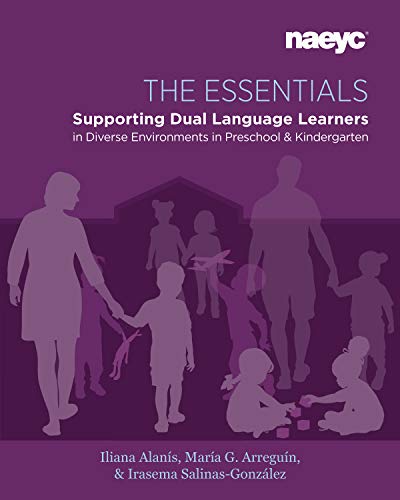
Synopsis
This book will be promoted via various NAEYC marketing efforts, including social media pages promotions (Facebook, Twitter, Instagram and Pinterest with a reach of over 200K followers); promotional emails; advertisements in Young Children, Teaching Young Children, and Exchange magazines; and NAEYC’s seasonal resource catalogs. The authors of the publication will also present a webinar on a topic covered in the book soon after its publication. Finally, the publication will be advertised and sold at various early childhood conferences and trade shows (NAEYC’s Annual Conference in Anaheim, CA, NAEYC’s Professional Learning Institute in Philadelphia, PA, Zero to Three, etc.).
"synopsis" may belong to another edition of this title.
About the Author
Iliana Alanís, PhD, a native of South Texas, is a professor of early childhood and elementary education in the department of interdisciplinary learning and teaching at the University of Texas–San Antonio. She taught children in bilingual first- and second-grade classrooms while earning a master’s degree in curriculum and instruction with a concentration in bilingual education from the University of Texas–Pan American.
María G. Arreguín, EdD, is an associate professor of early childhood and elementary education in the department of interdisciplinary learning and teaching at the University of Texas–San Antonio. She earned her doctoral degree in Bilingual Education at the Texas A&M University–Kingsville. Her research on dual language education, early childhood education, dyad learning and dialogue, and critical science pedagogy illuminates the intricacies of cultural and linguistic factors that influence minority children’s access to education in early childhood and elementary bilingual settings.
Irasema Salinas-González, EdD, is an associate professor and coordinator of the early care and early childhood studies program at the University of Texas–Rio Grande Valley (UTRGV). During her 29 years in the bilingual and early childhood education fields, she has been a preschool and kindergarten teacher and reading specialist, and has worked with preservice and in-service teachers. She received her MEd in Early Childhood Education from the University of Texas–Pan American and her EdD in Bilingual Education from Texas A&M University–Kingsville. Her work focuses on language and literacy development of young dual language learners through play, the development of cognitive skills of dual language learners through play-based learning, and creating engaging classroom environments for young dual language learners.
From the Back Cover
Gain a Richer Understanding of the Interdependent Relationship Among Culture, Language, and Learning
Learn how to implement intentional practices that nurture children’s bilingual identities and augment their growth in all developmental domains. Educators working with children ages 3 through 6 can apply the concepts and strategies explored in this valuable resource in a variety of early childhood settings and contexts.
Using current and foundational research, this book provides developmentally and linguistically appropriate guidance for intentional and purposeful practices with children, their families, and other members of the school community.
In each chapter, you’ll find
- Discussion of a key concept from a developmental and asset-based perspective that focuses on the role of a child’s home language and their family in the educational process
- Examples of children’s and teachers’ experiences within an educational context
- Idea Boxes that provide practical ways for educators to apply their understanding in practice
- Definitions of key terms
- Answers to frequently asked questions
- Connections to NAEYC Early Learning Program Accreditation Standards ul>
For faculty! A sample syllabus and sample activities connected to each chapter can be found online at NAEYC.org/essentials-supporting-DLLs
From the Inside Flap
This book is for early childhood educators who work or will work with the growing number of dual language learners, within the age range of three to five in family home centers, private preschool centers, Head Start classrooms, or state funded preschool and kindergarten programs. General education teachers, bilingual teachers, English as a second language teachers, and special education specialists will find the information useful. Instructional leaders, such as program directors and administrators, who work with children in preschool and kindergarten, will also find the information beneficial as they develop partnerships with families and colleagues.
This book answers the question what do early childhood educators need to understand to better address the linguistic, cognitive, and socio-emotional needs of all DLLs in their classrooms? The majority of the teachers in dual language programs with Spanish and English-dominant speakers learn academic content in two languages. It is through this lens that the authors have approached the writing of this text. There are however, over 350 languages spoken within the U.S (U.S. Census, 2015). This means emergent bilingual children come from a variety of cultural and linguistic backgrounds. While teachers cannot be expected to teach in all languages, the basic principles of this book help teachers gain a richer understanding of the interdependent relationship among culture, language, and learning. With this understanding, teachers can implement intentional practices that nurture children s bilingual identities and augment their growth in all developmental domains through the concepts and strategies presented in this text.
"About this title" may belong to another edition of this title.
Search results for The Essentials: Dual Language Learners in Diverse Environmen...

Stock Image
The Essentials: Dual Language Learners in Diverse Environments in Preschool and Kindergarten
Published by
The National Association for the, 2021
ISBN 10: 1938113810
ISBN 13: 9781938113819
Used
paperback
Seller: HPB-Red, Dallas, TX, U.S.A.
Seller rating 5 out of 5 stars

paperback. Condition: Good. Connecting readers with great books since 1972! Used textbooks may not include companion materials such as access codes, etc. May have some wear or writing/highlighting. We ship orders daily and Customer Service is our top priority! Seller Inventory # S_468433674
Stock Image
The Essentials: Dual Language Learners in Diverse Environments in Preschool and Kindergarten
Published by
National Association for the Education of You, 2021
ISBN 10: 1938113810
ISBN 13: 9781938113819
Used
Paperback
Seller: ThriftBooks-Dallas, Dallas, TX, U.S.A.
Seller rating 5 out of 5 stars
Paperback. Condition: Good. No Jacket. Pages can have notes/highlighting. Spine may show signs of wear. ~ ThriftBooks: Read More, Spend Less. Seller Inventory # G1938113810I3N00
Stock Image
The Essentials: Dual Language Learners in Diverse Environments in Preschool and Kindergarten
Published by
The National Association for the, 2021
ISBN 10: 1938113810
ISBN 13: 9781938113819
Used
paperback
Seller: Books From California, Simi Valley, CA, U.S.A.
Seller rating 4 out of 5 stars

paperback. Condition: Very Good. Seller Inventory # mon0004169124
Stock Image
The Essentials: Dual Language Learners in Diverse Environments in Preschool and Kindergarten
Published by
The National Association for the Education of Young Children, 2021
ISBN 10: 1938113810
ISBN 13: 9781938113819
New
Soft cover
Seller: Karl Theis, Torrance, CA, U.S.A.
Seller rating 5 out of 5 stars
Soft cover. Condition: New. A NEW BOOK. Seller Inventory # 049472
Seller Image
Essentials : Supprting Dual Language Learners in Diverse Environments in Preschool & Kindergarten
Published by
The National Association for the Education of Young Children, 2021
ISBN 10: 1938113810
ISBN 13: 9781938113819
Used
Softcover
Seller: GreatBookPrices, Columbia, MD, U.S.A.
Seller rating 5 out of 5 stars
Condition: good. May show signs of wear, highlighting, writing, and previous use. This item may be a former library book with typical markings. No guarantee on products that contain supplements Your satisfaction is 100% guaranteed. Twenty-five year bookseller with shipments to over fifty million happy customers. Seller Inventory # 41453671-5
Stock Image
The Essentials: Dual Language Learners in Diverse Environments in Preschool and Kindergarten
Published by
The National Association for the Education of Young Children, 2021
ISBN 10: 1938113810
ISBN 13: 9781938113819
New
paperback
Seller: Textbooks_Source, Columbia, MO, U.S.A.
Seller rating 5 out of 5 stars
paperback. Condition: New. Ships in a BOX from Central Missouri! UPS shipping for most packages, (Priority Mail for AK/HI/APO/PO Boxes). Seller Inventory # 011580072N
Seller Image
Essentials : Supprting Dual Language Learners in Diverse Environments in Preschool & Kindergarten
Published by
The National Association for the Education of Young Children, 2021
ISBN 10: 1938113810
ISBN 13: 9781938113819
Used
Softcover
Seller: GreatBookPrices, Columbia, MD, U.S.A.
Seller rating 5 out of 5 stars
Condition: As New. Unread book in perfect condition. Seller Inventory # 41453671
Stock Image
TheEssentials Format: Paperback
ISBN 10: 1938113810
ISBN 13: 9781938113819
Used
Seller: INDOO, Avenel, NJ, U.S.A.
Seller rating 5 out of 5 stars
Condition: As New. Unread copy in mint condition. Seller Inventory # PG9781938113819
Seller Image
Essentials : Supprting Dual Language Learners in Diverse Environments in Preschool & Kindergarten
Published by
The National Association for the Education of Young Children, 2021
ISBN 10: 1938113810
ISBN 13: 9781938113819
New
Softcover
Seller: GreatBookPrices, Columbia, MD, U.S.A.
Seller rating 5 out of 5 stars
Condition: New. Seller Inventory # 41453671-n
Stock Image
TheEssentials Format: Paperback
ISBN 10: 1938113810
ISBN 13: 9781938113819
New
Seller: INDOO, Avenel, NJ, U.S.A.
Seller rating 5 out of 5 stars
Condition: New. Brand New. Seller Inventory # 9781938113819