
Items related to The Confessions of St. Augustine
Synopsis
Confessions of St. Augustine 978-0-89942-169-8
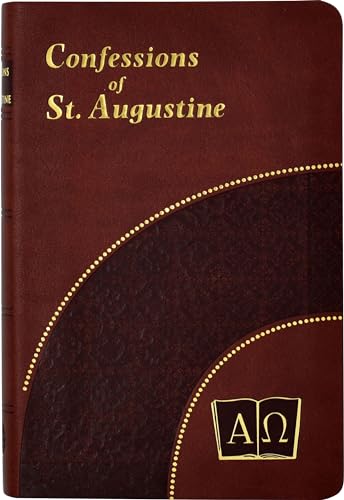
Confessions of St. Augustine is--after the Bible and The Imitation of Christ--the most widely translated and highly esteemed book in Christian history. Translated by Rev. J.M. Lelen, Ph.D., this edition is published in a prayer book format, offering a participatory reading and prayer experience based on St. Augustine's confessions of his youthful errors. With a burgundy Dura-Lux cover, this classic book will make a meaningful personal resource or gift.
St. Augustine of Hippo (354-430 AD) is one of the most influential Christian theologians and philosophers. His writings have profoundly shaped Christian doctrine, Western philosophy, and the intellectual tradition of the Church. His works address deep questions on God, grace, free will, and the nature of good and evil, making them essential to theological study.
- Sturdy flexible Dura-Lux cover
- Size 4-3/8" x 6-3/4"
- Durably sewn binding
- High-quality paper
- Informative Wisdom from St. Augustine
- Conveniently sized to accommodate nightstand or purse
- Nihil Obstat
- Imprimatur
- Visit our website for more spiritual resources and Bibles www.catholicbookpublishing.com
- Portability - A small, compact book is easy to carry, making it convenient for travel, commuting, or reading on the go.
- Accessibility - Its size allows for quick reference, whether for study, prayer, or casual reading, without the bulk of a larger volume.
- Discreetness - A compact book can be read in public or private without drawing much attention, making it ideal for personal reflection or study.
- Durability - Smaller books often have sturdier bindings and covers, allowing them to withstand frequent handling and travel.
- Efficiency - Concise and well-organized content ensures that the reader gets essential information without unnecessary bulk, making learning or devotion more focused and effective.
One of his most famous works, Confessions, is both a spiritual autobiography and a philosophical reflection on sin, grace, and conversion. In it, Augustine explores his journey from a life of worldly desires to his acceptance of Christian faith, showing the transformative power of God's mercy. His honesty and introspection make Confessions a timeless work that resonates with believers seeking a deeper relationship with God.
"synopsis" may belong to another edition of this title.
Review
In Naxos's new audio recording of The Confessions of St Augustine, British actor Mark Meadows offers a compelling, earnest interpretation of one of the most influential works in Christian theology and Western literature. Meadows's delivery is measured and impassioned, and forwards an engrossing sense of urgency. St Augustine's Confessions was written to be read aloud, and this recording makes it clear how involving and immersive it is to listen to Augustine's timeless words. Born in Hippo in North Africa in 354 CE, Augustine lived during a critical juncture in the history of Christianity. With a brilliant mind and access to the leading thinkers of the day, Augustine wrestled with several conflicting worldviews in the early years of his life. His narration recalls how he was raised a Christian before becoming attracted to Manichaeism in his teens; he also explored the neo-Platonic philosophies of Plotinus before returning to Christianity in his thirties. He wrote Confessions a decade later; in it, he reflects on the sinful and lustful choices he made during the early decades of his life. He also details his internal struggles with key tenets of Christian thought, from the natures of evil, beauty, and time to the experience of original sin, grace, and redemption. Drawing from R. S. Pine-Coffin's respected 1961 translation, Meadows animates the Confessions with an accessible and contemporary cadence. Augustine's words sound as relevant and involving today as they were nearly 1700 years ago. The nearly fifteen hours of recording are logically divided into ten-minute segments that are clearly titled and easy to navigate. In an era when we are deluged with information and often too eager to rush to judgement, Augustine s Confessions offers a refreshing, engrossing contemplation of the deeper questions around human nature. Meadows's clear, conversational exploration includes careful pauses that allow for reflection, providing an opportunity to internalise and wrestle with the sincere and brilliant questions raised in this classic work. --Kristen Rabe, Foreword
About the Author
Augustine was one of the first Christian ancient Latin authors with a very clear vision of theological anthropology. He saw the human being as a perfect unity of two substances: soul and body. In his late treatise On Care to Be Had for the Dead, section 5 ( he exhorted to respect the body on the grounds that it belonged to the very nature of the human person.[64] Augustine's favourite figure to describe body-soul unity is marriage: caro tua, coniunx tua — your body is your wife. Initially, the two elements were in perfect harmony. After the fall of humanity they are now experiencing dramatic combat between one another. They are two categorically different things. The body is a three-dimensional object composed of the four elements, whereas the soul has no spatial dimensions. Soul is a kind of substance, participating in reason, fit for ruling the body. Augustine was not preoccupied, as Plato and Descartes were, with going too much into details in efforts to explain the metaphysics of the soul-body union. It sufficed for him to admit that they are metaphysically distinct: to be a human is to be a composite of soul and body, and the soul is superior to the body. The latter statement is grounded in his hierarchical classification of things into those that merely exist, those that exist and live, and those that exist, live, and have intelligence or reason.Like other Church Fathers such as Athenagoras, St. Augustine "vigorously condemned the practice of induced abortion", and although he disapproved of an abortion during any stage of pregnancy, he made a distinction between early abortions and later ones. Nevertheless, he accepted the distinction between "formed" and "unformed" fetuses mentioned in the Septuagint translation of Exodus 21:22-23, a text that, he observed, did not classify as murder the abortion of an "unformed" fetus, since it could not be said with certainty that it had already received a soul (see, e.g., De Origine Animae 4.4).
"About this title" may belong to another edition of this title.
Search results for The Confessions of St. Augustine

Seller Image
The Confessions of St. Augustine
Published by
Catholic Book Publishing, 1997
ISBN 10: 1937913708
ISBN 13: 9781937913700
New
Hardcover
Seller: GreatBookPrices, Columbia, MD, U.S.A.
Seller rating 5 out of 5 stars

Condition: New. Seller Inventory # 21163849-n
Seller Image
The Confessions of St. Augustine (Leather / Fine Binding)
Published by
Catholic Book Publishing Corp 11/1/2013, 2013
ISBN 10: 1937913708
ISBN 13: 9781937913700
New
Hardcover
Seller: BargainBookStores, Grand Rapids, MI, U.S.A.
Seller rating 5 out of 5 stars
Leather / Fine Binding. Condition: New. The Confessions of St. Augustine. Book. Seller Inventory # BBS-9781937913700
Seller Image
The Confessions of St. Augustine
Published by
Catholic Book Publishing, US, 1997
ISBN 10: 1937913708
ISBN 13: 9781937913700
New
Hardcover
Seller: Rarewaves USA, HEBRON, KY, U.S.A.
Seller rating 5 out of 5 stars
Leather Bound. Condition: New. Seller Inventory # LU-9781937913700
Seller Image
The Confessions of St. Augustine
Published by
Catholic Book Publishing, 1997
ISBN 10: 1937913708
ISBN 13: 9781937913700
Used
Hardcover
Seller: GreatBookPrices, Columbia, MD, U.S.A.
Seller rating 5 out of 5 stars
Condition: As New. Unread book in perfect condition. Seller Inventory # 21163849
Stock Image
Confessions Of St. Augustine
Published by
Catholic Book Publishing, 1997
ISBN 10: 1937913708
ISBN 13: 9781937913700
New
Hardcover
Seller: California Books, Miami, FL, U.S.A.
Seller rating 5 out of 5 stars
Condition: New. Seller Inventory # I-9781937913700
Seller Image
The Confessions of St. Augustine (Leather)
Published by
Catholic Book Publishing, 1997
ISBN 10: 1937913708
ISBN 13: 9781937913700
New
Hardcover
Seller: Grand Eagle Retail, Bensenville, IL, U.S.A.
Seller rating 5 out of 5 stars
Leather. Condition: new. Leather. Confessions of St. Augustine 978-0-89942-169-8 Confessions of St. Augustine is--after the Bible and The Imitation of Christ--the most widely translated and highly esteemed book in Christian history. Translated by Rev. J.M. Lelen, Ph.D., this edition is published in a prayer book format, offering a participatory reading and prayer experience based on St. Augustine's confessions of his youthful errors. With a brown Dura-Lux cover, this classic book will make a meaningful personal resource or gift.St. Augustine of Hippo (354-430 AD) is one of the most influential Christian theologians and philosophers. His writings have profoundly shaped Christian doctrine, Western philosophy, and the intellectual tradition of the Church. His works address deep questions on God, grace, free will, and the nature of good and evil, making them essential to theological study. Among the features of this book are: Sturdy flexible Dura-Lux coverSize 4-3/8" x 6-3/4"Durably-sewn bindingHigh-quality paperInformative Wisdom from St. AugustineConveniently sized to accommodate nightstand or purseNihil ObstatImprimaturVisit our website for more spiritual resources and Bibles Benefits of a compact book: Portability - A small, compact book is easy to carry, making it convenient for travel, commuting, or reading on the go.Accessibility - Its size allows for quick reference, whether for study, prayer, or casual reading, without the bulk of a larger volume.Discreetness - A compact book can be read in public or private without drawing much attention, making it ideal for personal reflection or study.Durability - Smaller books often have sturdier bindings and covers, allowing them to withstand frequent handling and travel.Efficiency - Concise and well-organized content ensures that the reader gets essential information without unnecessary bulk, making learning or devotion more focused and effective. One of his most famous works, Confessions, is both a spiritual autobiography and a philosophical reflection on sin, grace, and conversion. In it, Augustine explores his journey from a life of worldly desires to his acceptance of Christian faith, showing the transformative power of God's mercy. His honesty and introspection make Confessions a timeless work that resonates with believers seeking a deeper relationship with God. Shipping may be from multiple locations in the US or from the UK, depending on stock availability. Seller Inventory # 9781937913700
Seller Image
The Confessions of St. Augustine
Published by
Catholic Book Publishing, US, 1997
ISBN 10: 1937913708
ISBN 13: 9781937913700
New
Hardcover
Seller: Rarewaves.com USA, London, LONDO, United Kingdom
Seller rating 5 out of 5 stars
Leather Bound. Condition: New. Seller Inventory # LU-9781937913700
Buy New
£ 22.39
Free Shipping
Ships from United Kingdom to U.S.A.
Ships from United Kingdom to U.S.A.
Quantity: Over 20 available
Stock Image
The Confessions of St. Augustine
Published by
Catholic Book Publishing Corp, 1997
ISBN 10: 1937913708
ISBN 13: 9781937913700
New
Hardcover
Seller: Revaluation Books, Exeter, United Kingdom
Seller rating 5 out of 5 stars
Leather Bound. Condition: Brand New. 448 pages. 6.77x4.33x1.02 inches. In Stock. Seller Inventory # __1937913708
Buy New
£ 15.56
£ 10 shipping
Ships from United Kingdom to U.S.A.
Ships from United Kingdom to U.S.A.
Quantity: 9 available
Stock Image
The Confessions of St. Augustine
Published by
Catholic Book Publishing Corp, 1997
ISBN 10: 1937913708
ISBN 13: 9781937913700
New
Hardcover
Seller: Revaluation Books, Exeter, United Kingdom
Seller rating 5 out of 5 stars
Leather Bound. Condition: Brand New. 448 pages. 6.77x4.33x1.02 inches. In Stock. Seller Inventory # x-1937913708
Buy New
£ 21.28
£ 10 shipping
Ships from United Kingdom to U.S.A.
Ships from United Kingdom to U.S.A.
Quantity: 2 available
Stock Image
The Confessions of St. Augustine
Published by
Catholic Book Publishing Corp, 1997
ISBN 10: 1937913708
ISBN 13: 9781937913700
New
Hardcover
Seller: Russell Books, Victoria, BC, Canada
Seller rating 5 out of 5 stars
Leather Bound. Condition: New. Special order direct from the distributor. Seller Inventory # ING9781937913700
Buy New
£ 16.17
£ 15.13 shipping
Ships from Canada to U.S.A.
Ships from Canada to U.S.A.
Quantity: Over 20 available