
Items related to Economics in One Lesson
Synopsis
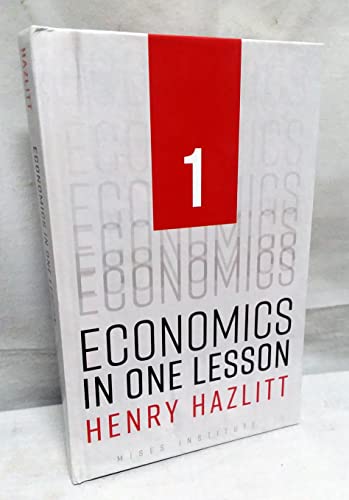
Here is a publishing event: the new Mises Institute edition of the classic book that has taught many millions sound economic thinking. It is a hardbound volume, priced very low thanks to special benefactors, and now available in quantity discounts for distribution to your friends, family, and anyone you meet who needs to understand what economics implies for the society, government, and civilization.
Henry Hazlitt wrote this book following his stint at the New York Times as an editorialist. His hope was to reduce the whole teaching of economics to a few principles and explain them in ways that people would never forget. It worked. He relied on some stories by Bastiat and his own impeccable capacity for logical thinking and crystal-clear prose.
He was writing under the influence of Mises himself, of course, but he brought his own special gifts to the project. As just one example, this is the book that made the idea of the "broken window fallacy" so famous.
What thrills us in particular about this new edition is that it is beautiful, it is hardcover, and it is newly typeset for modern readers. It has a full index. It includes a wonderful foreword by Walter Block. It's the right size, shape, and feel perfect for making this book central to all educational efforts of the future.
This is the book to send to reporters, politicians, pastors, political activists, teachers, or anyone else who needs to know.
Professor Block explains that it was this book that turned him on to economics as a science. He believes that it is probably the most important economics book ever written in the sense that it offers the greatest hope to educating everyone about the meaning of the science.
Written for the non-academic, it has served as the major antidote to fallacies in the popular press, and has appeared in dozens of languages and printings. It's still the quickest way to learn how to think like an economist. And this is why it has been used in the best classrooms more than sixty years.
Many writers have since attempted to beat this book as an introduction, but have never succeeded. Hazlitt's book remains the best. Even if you own this book already, or have several past editions, you will want to have this book as your own as a wonderful testament to its place in the world of ideas.
In putting this edition together, we chose to work from Hazlitt's own first edition because it contains the core of what is crucial here without later updates that only date the book. As with Mises and Human Action, the author's first instincts were the best ones.
"synopsis" may belong to another edition of this title.
Review
"A magnificent job of theoretical exposition."
--Ayn Rand
"I strongly recommend that every American acquire some basic knowledge of economics, monetary policy, and the intersection of politics with the economy. No formal classroom is required; a desire to read and learn will suffice. There are countless important books to consider, but the following are an excellent starting point: "The Law" by Frederic Bastiat; "Economics in One Lesson" by Henry Hazlitt; "What has Government Done to our Money?" by Murray Rothbard; "The Road to Serfdom" by Friedrich Hayek; and "Economics for Real People" by Gene Callahan.
If you simply read and comprehend these relatively short texts, you will know far more than most educated people about economics and government. You certainly will develop a far greater understanding of how supposedly benevolent government policies destroy prosperity. If you care about the future of this country, arm yourself with knowledge and fight back against economic ignorance. We disregard economics and history at our own peril."
--Ron Paul, Senator from Texas
"A magnificent job of theoretical exposition."
Ayn Rand
I strongly recommend that every American acquire some basic knowledge of economics, monetary policy, and the intersection of politics with the economy. No formal classroom is required; a desire to read and learn will suffice. There are countless important books to consider, but the following are an excellent starting point: "The Law"by Frederic Bastiat;"Economics in One Lesson"by Henry Hazlitt;"What has Government Done to our Money?"by Murray Rothbard;"The Road to Serfdom"by Friedrich Hayek; and"Economics for Real People"by Gene Callahan.
If you simply read and comprehend these relatively short texts, you will know far more than most educated people about economics and government. You certainly will develop a far greater understanding of how supposedly benevolent government policies destroy prosperity. If you care about the future of this country, arm yourself with knowledge and fight back against economic ignorance. We disregard economics and history at our own peril.
Ron Paul, Senator from Texas"
"A magnificent job of theoretical exposition."
Ayn Rand
I strongly recommend that every American acquire some basic knowledge of economics, monetary policy, and the intersection of politics with the economy. No formal classroom is required; a desire to read and learn will suffice. There are countless important books to consider, but the following are an excellent starting point: The Lawby Frederic Bastiat;Economics in One Lessonby Henry Hazlitt;What has Government Done to our Money?by Murray Rothbard;The Road to Serfdomby Friedrich Hayek; andEconomics for Real Peopleby Gene Callahan.
If you simply read and comprehend these relatively short texts, you will know far more than most educated people about economics and government. You certainly will develop a far greater understanding of how supposedly benevolent government policies destroy prosperity. If you care about the future of this country, arm yourself with knowledge and fight back against economic ignorance. We disregard economics and history at our own peril.
Ron Paul, Senator from Texas"
-A magnificent job of theoretical exposition.-
--Ayn Rand
-I strongly recommend that every American acquire some basic knowledge of economics, monetary policy, and the intersection of politics with the economy. No formal classroom is required; a desire to read and learn will suffice. There are countless important books to consider, but the following are an excellent starting point: The Law by Frederic Bastiat; Economics in One Lesson by Henry Hazlitt; What has Government Done to our Money? by Murray Rothbard; The Road to Serfdom by Friedrich Hayek; and Economics for Real People by Gene Callahan.
If you simply read and comprehend these relatively short texts, you will know far more than most educated people about economics and government. You certainly will develop a far greater understanding of how supposedly benevolent government policies destroy prosperity. If you care about the future of this country, arm yourself with knowledge and fight back against economic ignorance. We disregard economics and history at our own peril.-
--Ron Paul, Senator from Texas
"A magnificent job of theoretical exposition."
--Ayn Rand
About the Author
Henry Hazlitt (1894-1993), was a libertarian philosopher, an economist, and a journalist. He was the founding vice-president of the Foundation for Economic Education and an early editor of The Freeman magazine, an important libertarian publication. Hazlitt wrote Economics in One Lesson, his seminal text on free market economics, in 1946, bringing his ideas and those of the so-called Austrian School to the American scene. His work has influenced the likes of economist Ludwig von Mises, novelist and essayist Ayn Rand, and 2008 Libertarian Party Presidential nominee and congressman, Ron Paul. Hazlitt has been cited as one of the most influential literary critics and economic writers of his time.
"About this title" may belong to another edition of this title.
Search results for Economics in One Lesson

Stock Image
Economics in One Lesson
Published by
Ludwig von Mises Institute, 2008
ISBN 10: 193355021X
ISBN 13: 9781933550213
Used
Hardcover
Seller: World of Books (was SecondSale), Montgomery, IL, U.S.A.
Seller rating 5 out of 5 stars

Condition: Good. Item in good condition. Textbooks may not include supplemental items i.e. CDs, access codes etc. Seller Inventory # 00110299671
Stock Image
Economics in One Lesson
Published by
Ludwig von Mises Institute, 2008
ISBN 10: 193355021X
ISBN 13: 9781933550213
Used
Hardcover
Seller: HPB Inc., Dallas, TX, U.S.A.
Seller rating 5 out of 5 stars
Hardcover. Condition: Very Good. Connecting readers with great books since 1972! Used books may not include companion materials, and may have some shelf wear or limited writing. We ship orders daily and Customer Service is our top priority! Seller Inventory # S_479440764
Stock Image
Economics in One Lesson
Published by
Ludwig von Mises Institute, 2008
ISBN 10: 193355021X
ISBN 13: 9781933550213
Used
Hardcover
Seller: Better World Books: West, Reno, NV, U.S.A.
Seller rating 5 out of 5 stars
Condition: Good. Pages intact with minimal writing/highlighting. The binding may be loose and creased. Dust jackets/supplements are not included. Stock photo provided. Product includes identifying sticker. Better World Books: Buy Books. Do Good. Seller Inventory # 5308848-6
Stock Image
Economics in One Lesson
Published by
Ludwig von Mises Institute, 2008
ISBN 10: 193355021X
ISBN 13: 9781933550213
Used
Hardcover
Seller: Half Price Books Inc., Dallas, TX, U.S.A.
Seller rating 5 out of 5 stars
Hardcover. Condition: Very Good. Connecting readers with great books since 1972! Used books may not include companion materials, and may have some shelf wear or limited writing. We ship orders daily and Customer Service is our top priority! Seller Inventory # S_470976967
Stock Image
Economics in One Lesson
Published by
Ludwig von Mises Institute, 2008
ISBN 10: 193355021X
ISBN 13: 9781933550213
New
Hardcover
Seller: The Book Spot, Sioux Falls, MN, U.S.A.
Seller rating 4 out of 5 stars

Hardcover. Condition: New. Seller Inventory # Abebooks568818
Stock Image
Economics in One Lesson: The Shortest and Surest Way to Understand Basic Economics von Henry Hazlitt
Seller: BUCHSERVICE / ANTIQUARIAT Lars Lutzer, Wahlstedt, Germany
Seller rating 5 out of 5 stars
Softcover. Condition: gut. 1988. Economics in One LessonThe Shortest and Surest Way to Understand Basic Economics Henry Hazlitt In englischer Sprache. 218 pages. 22,4 x 15 x 2 cm. Seller Inventory # BN42803