
Items related to A Discourse on Inequality
Synopsis
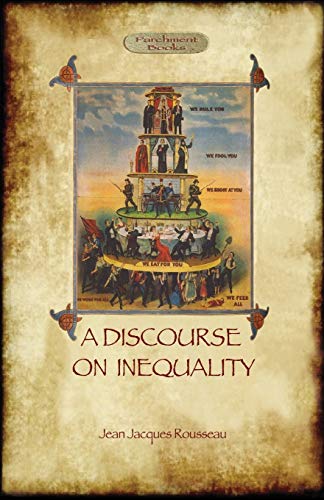
Jean-Jacques Rousseau was the son of a Genevan watchmaker who became one of the foremost French writers and political theorists of the Enlightenment, penning such classics as 'The Social Contract' and 'Emile'. His 'Discourse on the Origin of Inequality' was written some eight years earlier, and takes as its theme the degradation of humanity through the corrupting influences of civilisation. Rousseau traces the origins of inequality and its increasing prominence over the historical period. His wide-ranging analysis covers a swathe of disparate topics, from compassion and sensitivity, through despotism and war, to private property, the origin of goodness and the perfectibility of humanity. The Discourse became hugely influential - it helped lay the philosophical foundations for the French Revolution, and inspired similar insurrections well into the nineteenth century.
"synopsis" may belong to another edition of this title.
About the Author
JEAN-JACQUES ROUSSEAU was born in Geneva in 1712. Abandoned by his father at the age of ten he tried his hand as an engraver's apprentice before he left the city in 1728. From then on he was to wander Europe seeking an elusive happiness. At Turin he became a Catholic convert; and as a footman, seminarist, music teacher or tutor visited many parts of Switzerland and France. In 1732 he settled for eight years at Chambéry or Les Charmettes, the country house of Madame de Warens, remembered by Rousseau as an idyllic place in the Confessions. In 1741 he set out for Paris where he met Diderot who commissioned him to write the musical articles for the Encyclopédie. In the meantime he fathered five children by Thérèse Levasseur, a servant girl, and abandoned them to a foundling home. The 1750s witnessed a breach with Voltaire and Diderot and his writing struck a new note of defiant independence. In his Discours sur les sciences et les arts and the Discours sur l'origine de l'inégalité he showed how the growth of civilization corrupted natural goodness and increased inequality between men. In 1758 he attacked his former friends, the Encyclopaedists, in the Lettre à d'Alembert sur les spectacles which pilloried cultured society. In 1757 he moved to Montmorency and these five years were the most fruitful of his life. His remarkable novel La nouvelle Héloise (1761), met with immediate and enormous success. In this and in Émile, which followed a year later, Rousseau invoked the inviolability of personal ideals against the power of the state and the pressures of society. The crowning achievement of his political philosophy was The Social Contract, published in 1762. That same year he wrote an attack on revealed religion, the Profession de foi du vicaire savoyard. He was driven from Switzerland and fled to England where he only succeeded in making an enemy of Hume and returned to his continental peregrinations. In 1770 Rousseau completed his Confessions. His last years were spent largely in France where he died in 1778.
"About this title" may belong to another edition of this title.
Search results for A Discourse on Inequality

Stock Image
A Discourse on Inequality
Published by
Aziloth Books (edition ), 2013
ISBN 10: 1909735078
ISBN 13: 9781909735071
Used
Paperback
Seller: BooksRun, Philadelphia, PA, U.S.A.
Seller rating 5 out of 5 stars

Paperback. Condition: Very Good. It's a well-cared-for item that has seen limited use. The item may show minor signs of wear. All the text is legible, with all pages included. It may have slight markings and/or highlighting. Seller Inventory # 1909735078-11-1
Seller Image
A Discourse On Inequality
Seller: GreatBookPrices, Columbia, MD, U.S.A.
Seller rating 5 out of 5 stars
Condition: New. Seller Inventory # 19714671-n
Seller Image
A Discourse on Inequality (Paperback or Softback)
Published by
Aziloth Books 5/8/2013, 2013
ISBN 10: 1909735078
ISBN 13: 9781909735071
New
Paperback or Softback
Seller: BargainBookStores, Grand Rapids, MI, U.S.A.
Seller rating 5 out of 5 stars
Paperback or Softback. Condition: New. A Discourse on Inequality. Book. Seller Inventory # BBS-9781909735071
Seller Image
A Discourse On Inequality
Seller: GreatBookPrices, Columbia, MD, U.S.A.
Seller rating 5 out of 5 stars
Condition: As New. Unread book in perfect condition. Seller Inventory # 19714671
Seller Image
A Discourse on Inequality
Seller: Rarewaves.com USA, London, LONDO, United Kingdom
Seller rating 5 out of 5 stars
Paperback. Condition: New. Seller Inventory # LU-9781909735071
Buy New
£ 11.10
Free Shipping
Ships from United Kingdom to U.S.A.
Ships from United Kingdom to U.S.A.
Quantity: Over 20 available
Stock Image
A Discourse on Inequality
Print on DemandSeller: PBShop.store US, Wood Dale, IL, U.S.A.
Seller rating 5 out of 5 stars
PAP. Condition: New. New Book. Shipped from UK. THIS BOOK IS PRINTED ON DEMAND. Established seller since 2000. Seller Inventory # L0-9781909735071
Stock Image
A Discourse on Inequality
Seller: California Books, Miami, FL, U.S.A.
Seller rating 5 out of 5 stars
Condition: New. Seller Inventory # I-9781909735071
Stock Image
A Discourse on Inequality
Published by
Aziloth Books 2013-05-08, 2013
ISBN 10: 1909735078
ISBN 13: 9781909735071
New
Paperback
Seller: Chiron Media, Wallingford, United Kingdom
Seller rating 5 out of 5 stars
Paperback. Condition: New. Brand new book, sourced directly from publisher. Dispatch time is 24-48 hours from our warehouse. Book will be sent in robust, secure packaging to ensure it reaches you securely. Seller Inventory # 6666-GRD-9781909735071
Buy New
£ 8.17
£ 4.49 shipping
Ships from United Kingdom to U.S.A.
Ships from United Kingdom to U.S.A.
Quantity: 1 available
Stock Image
A Discourse on Inequality
Print on DemandSeller: PBShop.store UK, Fairford, GLOS, United Kingdom
Seller rating 5 out of 5 stars
PAP. Condition: New. New Book. Delivered from our UK warehouse in 4 to 14 business days. THIS BOOK IS PRINTED ON DEMAND. Established seller since 2000. Seller Inventory # L0-9781909735071
Buy New
£ 11.04
£ 3.29 shipping
Ships from United Kingdom to U.S.A.
Ships from United Kingdom to U.S.A.
Quantity: Over 20 available
Stock Image
A Discourse on Inequality
Print on DemandSeller: Majestic Books, Hounslow, United Kingdom
Seller rating 4 out of 5 stars

Condition: New. Print on Demand pp. 114 21:B&W 5.06 x 7.81 in or 198 x 129 mm Perfect Bound on White w/Gloss Lam. Seller Inventory # 108641355
Buy New
£ 10.89
£ 6.50 shipping
Ships from United Kingdom to U.S.A.
Ships from United Kingdom to U.S.A.
Quantity: 4 available