
Items related to Forgiveness & Reconciliation: Public Policy &...
Synopsis
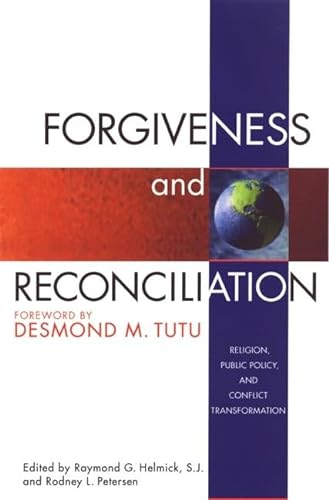
This book brings together a unique combination of experts in conflict resolution and focuses on the role forgiveness can play in the process. It deals with theology, public policy, psychological and social theory, and social policy implementation of forgiveness. This book is essential for libraries, scholars, conflict negotiators, and all people who hope to understand the role of forgiveness in the peace process.
The book's first section explores how ideas like "forgiveness" and "reconciliation" are moving out from the seminary and academy into the world of public policy and how these terms have been used and defined in the past. The second section looks at forgiveness and public policy. One of the chapters, by Donald W. Shriver Jr., addresses forgiveness in a secular political forum.
The third section of the book draws us to a more thorough analysis of the relationship between forgiveness and reconciliation from voices in the academic and theological community, and the final section highlights the work of practitioners currently working with religion, public policy, and conflict transformation, particularly in areas such as Ireland and Africa.
Contributors include Desmond M. Tutu, Rodney L. Petersen, Miroslav Volf, Stanley S. Harakas, Raymond G. Helmick, SJ, Joseph V. Montville, Douglas M. Johnston, Donna Hicks, Donald W. Shriver, Jr., Everett L. Worthington, Jr., John Paul Lederach, Ervin Staub, Laurie Anne Pearlman, John Dawson, Audrey R. Chapman, Olga Botcharova, Anthony da Silva, SJ, Geraldine Smythe, OP, Andrea Bartoli, Ofelia Ortega, and George F. R. Ellis.
"synopsis" may belong to another edition of this title.
About the Author
Raymond G. Helmick, SJ, taught conflict resolution in the Department of Theology at Boston College. He has mediated in a number of conflicts in Northern Ireland, various Middle Eastern conflicts, and the Balkan countries, among many others. He is on the executive board of the U.S. Interreligious Committee for Peace in the Middle East and served as senior associate of the Center for Strategic and International Studies from 2000–2004. He is the author of numerous monographs and articles.
Rodney L. Petersen is an American scholar in the area of history, ethics, and religious conflict. He is the author or editor of numerous articles and books, including Consumption, Population, and Sustainability and Earth at Risk.
Excerpt. © Reprinted by permission. All rights reserved.
FORGIVENESS AND RECONCILIATION
Religion, Public Policy, & Conflict Transformation
By Raymond G. Helmick, Rodney L. PetersenTempleton Foundation Press
Copyright © 2001 Templeton Foundation Press
All rights reserved.
ISBN: 978-1-890151-84-3All rights reserved.
Contents
| Foreword Archbishop Desmond M. Tutu....................................... | ix |
| Acknowledgments............................................................ | xv |
| Introduction Raymond G. Helmick, S.J.,& Rodney L. Petersen................ | xvii |
| Part I. The Theology of Forgiveness........................................ | |
| 1. A Theology of Forgiveness: Terminology, Rhetoric, and the Dialectic of Interfaith Relationships Rodney L. Petersen............................... | 3 |
| 2. Forgiveness, Reconciliation, and Justice: A Christian Contribution to a More Peaceful Social Environment Miroslav Volf............................ | 27 |
| 3. Forgiveness and Reconciliation: An Orthodox Perspective Stanley S. Harakas.................................................................... | 51 |
| Part II. Forgiveness and Public Policy..................................... | |
| 4. Does Religion Fuel or Heal in Conflicts? Raymond G. Helmick, S.J....... | 81 |
| 5. Religion and Peacemaking Joseph V. Montville........................... | 97 |
| 6. Religion and Foreign Policy Douglas M. Johnston Jr..................... | 117 |
| 7. The Role of Identity Reconstruction in Promoting Reconciliation Donna Hicks...................................................................... | 129 |
| 8. Forgiveness: A Bridge Across Abysses of Revenge Donald W. Shriver Jr... | 151 |
| Part III. Forgiveness and Reconciliation................................... | |
| 9. Unforgiveness, Forgiveness, and Reconciliation and Their Implications for Societal Interventions Everett L. Worthington Jr...................... | 171 |
| 10. Five Qualities of Practice in Support of Reconciliation Processes John Paul Lederach......................................................... | 193 |
| 11. Healing, Reconciliation, and Forgiving after Genocide and Other Collective Violence Ervin Staub and Laurie Anne Pearlman.................. | 205 |
| 12. Hatred's End: A Christian Proposal to Peacemaking in a New Century John Dawson................................................................ | 229 |
| Part IV. Seeking Forgiveness after Tragedy................................. | |
| 13. Truth Commissions as Instruments of Forgiveness and Reconciliation Audrey R. Chapman.......................................................... | 257 |
| 14. Implementation of Track Two Diplomacy: Developing a Model of Forgiveness Olga Botcharova............................................... | 279 |
| 15. Through Nonviolence to Truth: Gandhi's Vision of Reconciliation Anthony da Silva, S.J...................................................... | 305 |
| 16. Brokenness, Forgiveness, Healing, and Peace in Ireland Geraldine Smyth, O.P................................................................. | 329 |
| 17. Forgiveness and Reconciliation in the Mozambique Peace Process Andrea Bartoli.................................................................... | 361 |
| 18. Conversion as a Way of Life in Cultures of Violence Ofelia Ortega..... | 383 |
| Afterword: Exploring the Unique Role of Forgiveness George F. R. Ellis.... | 395 |
| Appendix................................................................... | 411 |
| List of Contributors....................................................... | 433 |
| Index...................................................................... | 441 |
CHAPTER 1
A Theology of Forgiveness
Terminology, Rhetoric,& the Dialectic of Interfaith Relationships
Rodney L. Petersen
Across all of the grand wisdom traditions run termsthat reflect a desire to heal broken relationships and to findways of acceptance that enable us to live together. In Islam we find greatemphasis on the quality of mercy, reflective of the merciful nature of God.Buddhism stresses the importance of compassion. And Judaism, according toRabbi Harold Kushner, finds that the key to breaking the spell that locks usup in patterns of resentment is forgiveness. The "discoverer" of the role of forgivenessin the realm of human affairs, according to political theorist HannahArendt, was Jesus of Nazareth. Whether this is quite true, or true in only aparticular way given the attention all religions pay to forgiveness at somelevel, does not detract from the insight it raises as we look back on the mostconsciously violent of centuries since the "discoverer" alluded to by Arendt.
Many in the public policy community in North America now believethat the term forgiveness will be central to working with the political orderof the twenty-first century. Joseph Montville and others have made thepractice of forgiveness central to what they define as "track two" diplomacy.Its efficacy, however, as a tool for diplomatic practice, or for a deepeningof our understanding of human health, will depend in large measureon how we conceive of the topic in its ontological foundation and the waysin which the possibility of forgiveness can cross confessional, or religious,and conceptual boundaries. Therefore, while the purpose of this chapter isto note the ontological foundation for forgiveness in Christian theologyand to understand its terminology and rhetoric within a community of commonnarrative, that is, the church, the chapter will also sketch the ways bywhich a dialectic of forgiveness can cross confessional boundaries.
In the history of the church the practice of forgiveness has been clearlytied to penitence, most often privatized as a part of individual religiouspractice since the early medieval period. Throughout what became recognizedas "Christendom," the public significance of forgiveness often languishedas more retributive conceptions of justice dominated social theory,power politics, and practice. Forgiveness was often "spiritualized" andremoved from the practice of everyday life. While forgiveness might happenbetween God and an individual penitent, among persons and groups insociety only some lesser form of condoning, dismissal, or forgettingappeared possible. The recovery of particular patterns of religious behaviorand theology in the Protestant reforms caused Christians to rethink thetopic. While it has often been said that all of Luther's thoughts "radiatelike the rays of the sun from one glowing core, namely the gospel of the forgivenessof sins," a juridical and sacrificial view of the atonement continuedinto the early modern period, as seen in the classic liturgies andtheologies of the newly established national churches in the West. Nevertheless,the Protestant Reformation and Roman counter-reforms stimulatedsimultaneously in the church a recovery of the term forgiveness andthoughts about its practice, although this often occurred in more pietistic-orientedcircles, apart from the institutional churches.
As we move into the modern period, a division in theological thinkingand practice has been evident between those who join forgiveness to justification,with a personal and vertical view of salvation, and those who connectit with justice and the search for reconciliation but in language thatoften moves from transcendence to a prevailing political rhetoric, a spiritualdivision lamented by those seeking a more integrated spirituality. Generallythe tradition of reflection in systematic theology and ethics is moreremarkable for its omission than its treatment of the topic of forgiveness.
Nevertheless, interest in forgiveness is currently growing through thecourse of political events. In North America it is also arising from reflectionand analysis in the health-care sciences. The Christian community is notalone in calling attention to the corporate value and theological foundationof forgiveness for personal and social life in the twenty-first century.Indeed, one might say that the value of forgiveness was implied in theremark by the French minister of culture, André Malraux, who observedthat the twenty-first century would be religious or it would not be at all.This might not appear so surprising if we reflect back on the nature of theviolence that has pervaded the twentieth century. Forgiveness, long irrelevantto public and foreign policy, of little direct concern in health, andreduced to the confessional in the church, is now an aspect of public policydiscourse and psychological analysis. A few points of departure might benamed.
The Second World War brought not only history's most evident anddocumented holocaust but also some of our most contemporary examplesof what living a life of forgiveness might look like in such persons as DietrichBonhoeffer, Corrie Ten Boom, and Simone Weil. Notable in the field ofholocaust studies, Simon Wiesenthal asks what forgiveness would mean forthe victim as well as the perpetrator of the crimes in the Nazi concentrationcamps? Taken from his work detail to the bedside of a dying member of theSS who wanted to confess and obtain absolution from a Jew, Wiesenthalsaid nothing, betraying neither compassion nor criticism but leaving alone"an uncanny silence in the room." It is in this context that the youngGerman theologian Dietrich Bonhoeffer began to lay the groundwork fora theology of forgiveness in forms of what he called "costly grace" (TheCost of Discipleship) and in a pattern of spirituality that committed us tohealing relationships (Life Together). The simple trust and evangelical obedienceof Corrie Ten Boom has left an inspiring legacy in popular piety. Itis through suffering and forgiveness that Simone Weil found the means toa spiritual unity with God.
A more recent point of departure began the day that Nelson Mandelaleft Robben Island, opening the way to the National Unity and ReconciliationAct of July 26, 1995, and the establishment of the Truth and ReconciliationCommission in South Africa. Other national tragedies exist inChili, Argentina, the Middle East, Rwanda, the Balkans, and Chechnya, toname but a few. But the political and religious leadership in South Africa haspointedly raised the issue of public forgiveness as the only way to a constructivefuture. This is the point made by Anglican Archbishop DesmondTutu in his assessment of the transition being made in South Africa in NoFuture Without Forgiveness. In a recent book that examines nationaltragedies, legal scholar Martha Minow balances difficult pairs of responsesto horrific violence, remembering and forgetting, judging and forgiving,reconciling and avenging. In her chapter, "Vengeance and Forgiveness," shemarks these as ends on a spectrum of human responses to atrocity that callfor therapy, politics, cross-communal reconciliation, recognition of cruelty,and lack of closure. Donald Shriver writes of the leftover debris of nationalpasts that continues to clog the relationships of diverse groups of humansaround the world that these will never get cleaned up and animosity willnever drain away "until forgiveness enters those relationships in some politicalform." Such debris contributes to the spiraling cycles of conflict analyzedby social scientists.
Brian Frost reminds us that forgiveness in politics, as in personal life, isa process "rather than something to be applied temporarily, like a poultice."This process draws us to another point of departure in forgivenessstudies, that which has taken root in the medical and health-care fields.Work among health professionals over the past quarter century has drawnincreasing attention to forgiveness as a powerful psychotherapeutic tool.This recognition has often come with respect to trauma studies. RichardFitzgibbons points to major mechanisms for dealing with anger that affecthealth and well-being. These draw upon forgiveness, particularly cognitive,emotional, and spiritual levels in the process of healing. Particular studiesin interpersonal relations, marriage and the family, and private and socialbehavior are pointing to the deep connection between personal psychologicalhealth, social bonding, and healthy civic life and forgiveness. Learningto forgive one's self, or self-acceptance, and addiction and personaldepression, or violent and abusive behavior are seen to be increasingly connectedand with social and even public policy consequence.
Still, acceptance of the need for forgiveness is not universal. PsychologistLewis Smedes writes that people who are inclined to write off forgivenessoften do not know what they are rejecting. He outlines whatforgiveness is and is not. Numerous pastoral counselors, like Smedes, havecome to the fore in recent years, mixing the inherited wisdom of Christianity,most often oriented to personal trauma, with developing understandingfrom the fields of psychology and psychiatry, with some relatingforgiveness to theories of psychological maturation and stages in a processthat intermingles popular psychology with spiritual wisdom. While helpful,such mixing has also been scored for adding to the internalization andprivatization of forgiveness, a criticism that has been raised of Smedes'swork and one that is common for much of the treatment of the topic in thetherapeutic community.
These points of departure in the fields of public policy and health caredraw us to consider forgiveness in Christian theology and practice, its terminology,rhetoric, and dialectic. If we have not talked much about theologyproper to this point, it is because the argument of this chapter followsthe logic set forth by the Reformed Swiss theologian John Calvin, that ourknowledge of God and of ourselves often run parallel, that it is difficult toknow one without the other. In other words, if public policy and thehealth-care sciences are discovering forgiveness, they are also recovering, orperhaps uncovering, a place for theology in contemporary discourse. In aninteresting twist of culture, if our own modern period might be said to havebegun with Ludwig Feuerbach's Materialist dictum that theologians shouldbecome "anthropologians," we are beginning the twenty-first century witha recovery of spiritual sensitivity and the need for theological analysis onmany different levels.
For forgiveness and conflict studies the work of cultural anthropologistand literary critic René Girard might be said to unite the fields of psychologyand politics and bring us most clearly to the domain of theology. Girardstresses, first, the relationship between desire and imitation, or what he calls"mimetic desire." Desire is self-seeking but socially constructed. One desiressomething because another possesses it. What another person has shapesthe desire of the object to be possessed. The resulting conflict in mimeticdesire leads to social conflict. Girard argues that human society finds cohesionin the face of conflict through the "victimage mechanism" whereby aperson or group become a scapegoat, blamed for whatever seems to threatenor disrupt the group. As society unites to seize, accuse, and kill the scapegoat,it fails to deal with the deeper social cleavage that results from mimeticdesire. The sacrifice of the scapegoat becomes, in Girard's understanding,the origin and description of religion. Biblical religion is unique, arguesGirard, in that it does not side with the powerful who benefit from the violenceof scapegoating but aligns itself with victims. A point of special interestfor Girard is that he finds in Jesus one who refuses to enter the spiral ofviolence, one who breaks this spiral by yielding to it despite his evidentguiltlessness, and so through forgiveness opens the way to reconciliation.
While forgiveness is not listed as one of the Ten Commandments, it doesunderlie biblical religion as argued by Girard. When forgiveness in humanrelationships is grounded in a deep ontological understanding of life, reconciliationbecomes more than conciliation, a hasty peace, a managedprocess, or even liberation. It is rooted in a costly self-immolation in theheart of being itself. It affects my being and the one with whom I exist in astate of alienation insofar as I will allow it. In fact, the whole thrust of theself-understanding of biblical religion in theory and in its manifest communitiesgrows out of a conception that God is in the world "reconciling itto God's self" (2 Cor. 5:19), which is the very process of forgiveness.
THE TERMS OF FORGIVENESS
What are the terms of forgiveness? I was forced to wrestle with thisquestion while teaching in Geneva, Switzerland. Many of the students in myclasses had come from situations of violence and trauma across the globe.They were often locked in patterns of behavior shaped by their pasts, andI encouraged them to begin to listen to their selves and to become moreaware of their verbal maps of the future. These maps often included scenarioswhere the cost of forgiveness appeared too great a sacrifice to makeand so many believed themselves to be in situations that offered little hope.There was often a certain unreality: their past was gone, their future was onhold. The topic of forgiveness often came up and I was reminded of theobservation made by Hannah Arendt that we were created with the powerto remember the past, but left powerless to change it; and that we are createdwith the power to imagine the future, but left powerless to control it.As she concludes with need for forgiveness as the only effective response tothe past, so these students required the faculty of forgiveness and, throughit, the same means to open up an effective future.
The terms of forgiveness are shaped by our perception of the past andthe future and given form in our language. Permit me to share an examplefrom a recent workshop put together by the Boston Theological Institute(BTI) to South Africa and Ghana.
The group of students, faculty, and friends left South Africa for Ghanain order to "process" what they had heard and seen in another African setting.Ghana, a home for "pan-Africanism," was the historical setting formuch of the African slave trade. While at the Cape Coast Castles, holdingdungeons and shipping points for the newly enslaved, a certain discomfortbegan to develop between the Euro-Americans and African Americans in ourgroup. This was only to come out fully the next day as we joined the studentsand staff of the Akrofi-Christeller Memorial Institute (Akuapem). There,gathered for morning devotions, our group was taken aback as Ghanaianstudents began to confess to their African American brothers and sisterstheir sorrow for the fact that their ancestors had sold the ancestors of theAfrican Americans into slavery. This began a time of mutual confession, forgiveness,and repentance among all races present. There was not a dry eyein the room as those of European and African background confessed to oneanother their sorrow for the past, ways it was impacting the present andshaping the future. As we left we were given literature by a young Ghanaianstudent reminding us that Abraham's third wife had been a woman ofAfrican descent, that Moses's wife was of the darker peoples of Midian, andthat the first apostolic sending had occurred with dark hands in the majorityof those laid on Paul for his first missionary journey into Europe.
(Continues...)
Excerpted from FORGIVENESS AND RECONCILIATION by Raymond G. Helmick, Rodney L. Petersen. Copyright © 2001 Templeton Foundation Press. Excerpted by permission of Templeton Foundation Press.
All rights reserved. No part of this excerpt may be reproduced or reprinted without permission in writing from the publisher.
Excerpts are provided by Dial-A-Book Inc. solely for the personal use of visitors to this web site.
"About this title" may belong to another edition of this title.
Search results for Forgiveness & Reconciliation: Public Policy &...

Stock Image
Forgiveness & Reconciliation: Public Policy & Conflict Transformation
Seller: Indiana Book Company, Marion, IN, U.S.A.
Seller rating 5 out of 5 stars

Condition: Good. Ships same or next business day with delivery confirmation. Good condition. May or may not contain highlighting. Expedited shipping available. Seller Inventory # 1000011122082-651
Seller Image
Forgiveness & Reconciliation: Public Policy & Conflict Transformation
Seller: Greenworld Books, Arlington, TX, U.S.A.
Seller rating 5 out of 5 stars
Condition: very_good. Fast Free Shipping â" Very Good condition book with a firm cover and clean pages. Shows normal use and some light wear or limited notes markings. A solid, nice copy to enjoy. Seller Inventory # GWV.189015184X.VG
Stock Image
Forgiveness & Reconciliation:
Seller: World of Books (was SecondSale), Montgomery, IL, U.S.A.
Seller rating 5 out of 5 stars
Condition: Very Good. Item in very good condition! Textbooks may not include supplemental items i.e. CDs, access codes etc. Seller Inventory # 00102914640
Stock Image
Forgiveness and Reconciliation: Religion, Public Policy, and Conflict Transformation
Seller: ThriftBooks-Atlanta, AUSTELL, GA, U.S.A.
Seller rating 5 out of 5 stars
Paperback. Condition: Good. No Jacket. Pages can have notes/highlighting. Spine may show signs of wear. ~ ThriftBooks: Read More, Spend Less. Seller Inventory # G189015184XI3N00
Stock Image
Forgiveness and Reconciliation : Public Policy and Conflict Transformation
Seller: Better World Books, Mishawaka, IN, U.S.A.
Seller rating 5 out of 5 stars
Condition: Very Good. Pages intact with possible writing/highlighting. Binding strong with minor wear. Dust jackets/supplements may not be included. Stock photo provided. Product includes identifying sticker. Better World Books: Buy Books. Do Good. Seller Inventory # 5341340-6
Stock Image
Forgiveness and Reconciliation : Public Policy and Conflict Transformation
Seller: Better World Books, Mishawaka, IN, U.S.A.
Seller rating 5 out of 5 stars
Condition: Good. Pages intact with minimal writing/highlighting. The binding may be loose and creased. Dust jackets/supplements are not included. Stock photo provided. Product includes identifying sticker. Better World Books: Buy Books. Do Good. Seller Inventory # 5588260-6
Stock Image
Forgiveness and Reconciliation : Public Policy and Conflict Transformation
Seller: Better World Books, Mishawaka, IN, U.S.A.
Seller rating 5 out of 5 stars
Condition: Very Good. Former library copy. Pages intact with possible writing/highlighting. Binding strong with minor wear. Dust jackets/supplements may not be included. Includes library markings. Stock photo provided. Product includes identifying sticker. Better World Books: Buy Books. Do Good. Seller Inventory # 11415039-6
Stock Image
Forgiveness & Reconciliation: Public Policy & Conflict Transformation
Seller: Midtown Scholar Bookstore, Harrisburg, PA, U.S.A.
Seller rating 5 out of 5 stars
Paperback. Condition: Very Good. Very Good - Crisp, clean, unread book with some shelfwear/edgewear, may have a remainder mark - NICE Standard-sized. Seller Inventory # M189015184XZ2
Stock Image
Forgiveness & Reconciliation: Public Policy & Conflict Transformation
Seller: Midtown Scholar Bookstore, Harrisburg, PA, U.S.A.
Seller rating 5 out of 5 stars
Paperback. Condition: Good. Good - Bumped and creased book with tears to the extremities, but not affecting the text block, may have remainder mark or previous owner's name - GOOD Standard-sized. Seller Inventory # M189015184XZ3
Stock Image
Forgiveness & Reconciliation: Public Policy & Conflict Transformation
Seller: One Planet Books, Columbia, MO, U.S.A.
Seller rating 5 out of 5 stars
paperback. Condition: Good. Ships in a BOX from Central Missouri! May not include working access code. Will not include dust jacket. Has used sticker(s) and some writing and/or highlighting. UPS shipping for most packages, (Priority Mail for AK/HI/APO/PO Boxes). Seller Inventory # 000583371U