
Items related to Duino Elegies
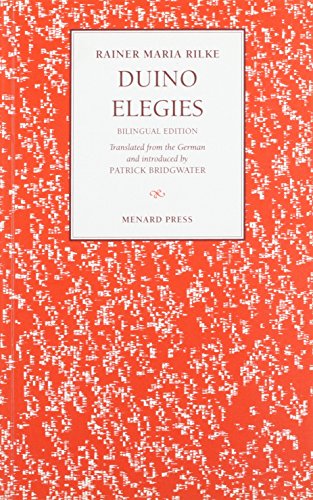
Synopsis
Poetry. Rainer Maria Rilke, along with Yeats, Mandelstam, and Pessoa, is regarded as one of the great European poets of his century, and by many as the outstanding German poet between Holderlin and Celan. DUINO ELEGIES is Rilke's masterpiece. This cycle of poems, language grasped at its speech-seed, was composed in a three-week blaze of creative energy in 1922, the annus mirabilis which saw the first publication of The Wasteland, Ulysses, and Pound's early Cantos. Rilke, the Santa Claus of loneliness, in Auden's cheeky phrase, said that the elegies were dictated to him, entrusted to him. Of all English versions of Rilke's elegaic symphony, these by the German scholar and poet Patrick Bridgwater may well incarnate the deepest reconciliation of that necessarily warring menage a trois: beauty, truth, and fidelity.
"synopsis" may belong to another edition of this title.
About the Author
Rainer Maria Rilke (also Rainer Maria von Rilke) (4 December 1875 - 29 December 1926) is considered one of the German language's greatest 20th century poets. His haunting images focus on the difficulty of communion with the ineffable in an age of disbelief, solitude, and profound anxiety - themes that tend to position him as a transitional figure between the traditional and the modernist poets. He wrote in both verse and a highly lyrical prose. His two most famous verse sequences are the Sonnets to Orpheus and the Duino Elegies; his two most famous prose works are the Letters to a Young Poet and the semi-autobiographical The Notebooks of Malte Laurids Brigge. He also wrote more than 400 poems in French, dedicated to his homeland of choice, the canton of Valais in Switzerland.
From the Back Cover
Named for the Castle of Duino, on a rocky headland of the Adriatic, the Duino Elegies speaks in a voice that is both intimate and majestic on the mysteries of human life and our attempt, in the words of the translator, 'to use our self-consciousness to some advantage: to transcend, through art and the imagination, our self-deception and our fear.'
"About this title" may belong to another edition of this title.
Search results for Duino Elegies

Seller Image
Duino Elegies. Bilingual Edition. Transl. from the German and introduced by Patrick Bridgwater.
Published by
The Menard Press; London, 1999
ISBN 10: 1874320268
ISBN 13: 9781874320265
Used
Softcover
Signed
Seller: Borkert, Schwarz und Zerfaß GbR, Berlin, Germany
Seller rating 5 out of 5 stars

Condition: Gut. XIX; 105 S.; 21,5 cm; kart. Ein gutes Exemplar. - erste Seite mit Widmung und SIGNIERT von Patrick Bridgwater. - Englisch - deutsch. - Patrick Bridgwater was, until his recent early retirement, Professor of German at the University of Durham . He is the author of several articles on Rilke, whose Duino Elegies he taught throughout his career. . (S. 1) // DUINO ELEGIES. Rainer Maria Rilke (1875-1926), along with Yeats, Mandelstam and Pessoa, is regarded by all as one of the great European poets of the century, and by many as the outstanding German poet between Holderlin and Celan. Duino Elegies is Rilke's masterpiece. This cycle of poems, 'language grasped in its speech-seed', was completed in a three-week blaze of creative energy in 1922, the annus mirabilis which saw the first publication of The Waste Land, Ulysses and Pound's early Cantos. Rilke, 'the Santa Claus of loneliness' (Auden's cheeky phrase), said that the Elegies were 'dictated' to him, 'entrusted' to him. Of all the English versions of Rilke's 'elegaic symphony', these by the German scholar and poet Patrick Bridgwater may well incarnate the deepest reconciliation of that necessarily warring menage a trois: beauty, truth and fidelity. (Verlagstext) / INHALT : INTRODUCTION --- THE ELEGIES --- Wer, wenn ich schriee, hörte mich denn aus der Engel --- Who, if I cried, would hear me among the Orders of --- Jeder Engel ist schrecklich. Und dennoch, weh mir --- Every Angel is terrible. And yet, alas --- Eines ist, die Geliebte zu singen. Ein anderes, wehe --- It is one thing to sing the beloved, another, alas --- O Bäume Lebens, o wann winterlich? --- O trees of life, when will our winter be? --- Wer aber sind sie, sag mir, die Fahrenden, diese ein wenig --- Who are they, though, teil me, these acrobats . . . --- Feigenbaum, seit wie lange schon ists mir bedeutend --- Fig tree, how long now it has been important to me --- Werbung nicht mehr, nicht Werbung, entwachsene Stimme --- Wooing no longer, not wooing, from wooing weaned --- Mit allen Augen sieht die Kreatur --- With every eye the creature sees the open --- Warum, wenn es angeht, also die Frist des Daseins --- Why, if it's possible to spend our span of life --- Daß ich dereinst, an dem Ausgang der grimmigen Einsicht --- Oh that I may, emerging at last from this vision of terror --- NOTES --- INDEX OF FIRST LINES OF THE ELEGIES. ISBN 1874320268 Sprache: Deutsch Gewicht in Gramm: 550. Seller Inventory # 1199204