
Items related to Ghana - Culture Smart! The Essential Guide to Customs...
Synopsis
The Gateway to Africa, Ghana welcomes around a million tourists, aid workers, and business travelers a year visitors who invariably come away with glowing reports of a fertile land, tropical scenic beauty, rich culture and traditions, and many first-rate tourist attractions. It is, however, the Ghanaians themselves who make the biggest impression. It is through their hospitality and love of peace that Ghana has a claim to be the safest and friendliest country in Africa. Ghanaians are welcoming to foreign guests, respectful to each other, strong followers of tradition, and have deep familial and communal values. For most visitors, Ghana comes as a wonderfully refreshing change, with valuable lessons to teach the outside world. Ghanaians like to do things their own way, and Ghana is a proud country that does not cater exclusively to tourists but rather expects them to fit in with the Ghanaian pace and way of life. Thus a visit to Ghana is not without its downsides, and visitors can experience frustrations and barriers. This revised and updated edition of "Culture Smart! Ghana" explains the complexities and nuances of Ghanaian society with clarity and humor. Visitors are expected to be sympathetic to their customs and beliefs, and their hosts will have no hesitation in saying, We don t do that here, should a faux pas be made or a taboo broken. It is important to Ghanaians that they, and their guests, follow certain rules and codes of conduct. "Culture Smart! Ghana" describes these rules, explains where they come from, helps to disperse the frustrations and barriers, and offers the reader an opportunity to enjoy more fully all that this beautiful country has to offer."
"synopsis" may belong to another edition of this title.
About the Author
IAN UTLEY studied at the University of Wales and trained as a teacher at Bishop Grosseteste University College, Lincoln. He worked in education in Ghana for many years, published a book for learners of the Twi language, was a columnist for the Ghanaian newspaper "Weekend World," and was an advisor to the Ministry of Tourism and Diasporan Relations in Accra. He also organized cultural, ecotourism, and language-learning activities for foreigners. Now back in Britain, he is the Cultural Services Advisor to Lincolnshire County Council.
Excerpt. © Reprinted by permission. All rights reserved.
Ghana
By Ian UtleyBravo Ltd
Copyright © 2016 Kuperard
All rights reserved.
ISBN: 978-1-85733-707-5All rights reserved.
Contents
Cover,
Title Page,
Copyright,
About the Author,
Map of Ghana,
Introduction,
Key Facts,
Chapter 1: LAND AND PEOPLE,
Chapter 2: VALUES AND ATTITUDES,
Chapter 3: CUSTOMS AND TRADITIONS,
Chapter 4: MAKING FRIENDS,
Chapter 5: PRIVATE AND FAMILY LIFE,
Chapter 6: TIME OUT,
Chapter 7: TRAVEL, HEALTH, AND SAFETY,
Chapter 8: BUSINESS BRIEFING,
Chapter 9: COMMUNICATING,
Further Reading,
Acknowledgments,
CHAPTER 1
LAND & PEOPLE
GEOGRAPHY
"Welcome to Ghana — the Center of the World!" is a message you're bound to hear or see from the proud people of this wonderful country at some stage during your visit. Although some very patriotic sign writers have been known to "stretch" the map of Ghana down a bit to support this claim, the actual "center of the world" referred to is some 200 miles (320 km) south of the port city of Tema, in the waters of the Gulf of Guinea. Ghana can, however, rightfully boast to be the closest landmass to the artificial "center" created by the intersection of the Equator and the Greenwich Meridian.
Ghana can be referred to as being under the "armpit" of Africa, in the middle of the West African sub-Saharan region. (West Africa: Best Africa.) The "trigger" of Africa is another term used, imagining that Africa could be held as a gun. This term also alludes to Ghana's reputation as a respected and influential nation on the continent. Ghana is surrounded by French-speaking countries: Côte d'Ivoire to the west, Burkina Faso, then Mali and Niger to the north, and Togo, then Benin to the east. (Despite these neighbors, hardly any Ghanaians speak French.) The waters of the Gulf of Guinea on the south coast become the Atlantic Ocean.
The landscape of Ghana is predominantly formed by the ancient Precambrian shield, rich in mineral resources. The country has a total area of 92,100 sq. miles (238,540 sq. km), similar to the size of Britain or the US state of Oregon, and is roughly rectangular, around 419 miles (670 km) north to south and 312 miles (500 km) east to west. It lies between latitudes 4 and 11 degrees north and 3 and 1 degrees east. The southern border is slightly longer than the northern border, with around 344 miles (550 km) of beautiful coastline to explore.
This rectangle passes through several vegetation zones differentiated mainly by their rainfall. Southerly winds bring moisture-laden Atlantic air, while northerly winds bring hot, dry Saharan air. Very broadly speaking, the south is forested owing to high rainfall and the north is drier savanna. Further north and into Burkina Faso, the Sahara desert is slowly encroaching. A road journey from the coast to the north (about twelve hours by bus) shows this change in vegetation quite strikingly.
The most mountainous area is in the east along the Togo border, where several green peaks rise over 2,438 feet (800 m) to give an impressive view of Lake Volta. This is the largest artificial lake in the world, at 2,100,400 acres (850,000 hectares), fed by the White Volta, Black Volta, and Red Volta rivers and serving the Akosombo hydroelectric dam, which is 1,214 feet (370 m) wide and 400 feet (124 m) tall. It stretches almost two-thirds of the length of the country, with the equally impressive, lush Akuapem and Akyem mountain ranges on its western side. Ghana also has the largest crater lake in the world, the sacred Lake Bosomtwe, 19 square miles (50 sq. km) in area and 262 feet (80 m) deep south of Kumasi. The most heavily forested area is the rain forest in the far southwest, continuing into Côte d'Ivoire and beyond. The rest of the heavily built-up coastal strip is grassland extending about 25 miles (40 km) inland.
Administratively, Ghana consists of ten regions. The capital lies in Greater Accra Region, and Ghana's second city, Kumasi, is in Ashanti Region. With Brong-Ahafo Region, above Ashanti, these are the only regions to take their name from the name of an indigenous people. The others are the imaginatively named Western Region, Central Region, Eastern Region, Northern Region, Upper East Region, Upper West Region, and Volta Region. Each region is subdivided into districts, with a total of 138 self-administrating districts.
Ghana is a very fertile and rich land, particularly in the south, and is noted for its plentiful supply of yams, cassava, cocoa, rubber, maize, palm products, pineapples, oranges, papayas, avocados, plantains, bananas, and pepper, to mention but a few. Mineral resources are also synonymous with Ghana. It did not get its previous name, the Gold Coast, for nothing. Diamonds, manganese, bauxite, and timber are also found in large quantities. The 2007 discovery of large, good-quality oil deposits off the coast was supposed to launch Ghana into a new economic era, although Ghanaians are still waiting to feel the difference in their pockets, with the oil only predicted to last for around twenty years.
CLIMATE
Ghana is hot. Although it's true that some periods and some areas can be cooler than others, even sometimes requiring a bedcover at nighttime, if you are coming to Ghana, prepare to sweat and take precautions against the sun. When the rain comes, it can be an awesome spectacle. It can also be very devastating, as the 2007 floods in the north attest. Cool breezes can be found on coast and mountaintop.
In general, the south (above the coastal strip) is more humid with higher rainfall. The north is hotter and drier. Temperatures reach 69.8°F (21°C) at night and up to 104°F (40°C) in the daytime. December to February is the coolest and driest time, and the time of the Harmattan, a red dust covering the sky as it is blown south from the Sahara desert. Then it's very hot until around April, when the first rains start, with two rainy seasons in the south (April–June and October–November) and one in the north (August–September). Global climate change has not bypassed Ghana, and what were once regular seasons are becoming unpredictable.
THE PEOPLE
Ghana's population is growing rapidly, and census results are soon out of date. Around 60 percent (and falling) of the population live in rural areas. The most densely populated areas are the cities of Accra, Kumasi, Sekondi-Takoradi, Tamale, and Tema. The literacy rate is 80 percent for males and 69 percent for females (2012).
Ghana is a nation that was created only in the last century, with very little regard for the indigenous people and languages within its borders. Thus, around fifty distinct groups are to be found in modern Ghana, each with its own dialect, culture, history, and traditions. To give an authoritative account of the people of Ghana would probably require writing around fifty books, and the author would have to apologize for not having sufficient room to allow the reader to appreciate these myriad cultures fully. All tribes speak languages from the widely distributed Niger–Congo group. As an introduction, we can mention the five major groups, each composed of smaller ethnic groups.
Almost half of all Ghanaians (47 percent) are from the Akan tribe and speak varieties of Twi (pronounced "Chwee"). Twi is also learned as a second language by many other Ghanaians and is considered the country's unofficial lingua franca. Akan customs can also, in most cases, be taken as being representative of those of the country. The Akans are thought to have emigrated from around the area of modern Chad in the eleventh century and now occupy most of the forestland in the south and center of the country. They include the Akyems, Akuapims, Fantes, and Ashantis.
The Ga-Adangbe people (8 percent) who live in the coastal plains between Accra and Tema were originally from the Yoruba empire in modern southern Nigeria, moving west during the fourteenth century. The Ewe people (13 percent) also came from the same expanding empire in the sixteenth century and are now settled around the southern Volta Region. The Mole-Dagbani (16 percent) and Gonja people (4 percent) are the main northern tribes, who came from the north during the fifteenth and sixteenth centuries to dominate existing tribes in the area. Trade, particularly in gold, as well as expanding populations and empires elsewhere, were major reasons for this influx of people over the past thousand years. Scant information is known about the peoples living in the area before these migrations, or their fate afterward.
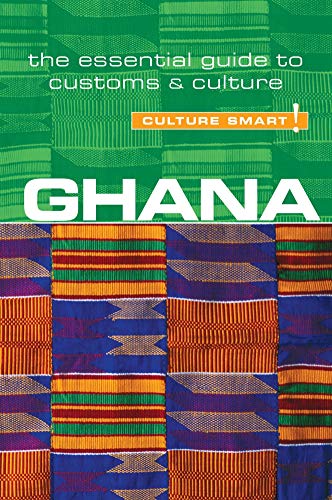
Stereotypical images of these tribal groups can also be made. A cocoa farmer wearing a toga of the brightly colored Kente cloth (shown on the cover), eating pounded yam and plantain (fufu) and drinking palm wine, is probably an Akan. His northern cousin is more likely to be a cattle rearer, wearing the heavy wide-bottomed dress known as a fugu or batakari and eating tuo zaafi ("TZ") and drinking pito, both made from millet. You are just as likely to see them both, however, wearing suits and speaking perfect English in the line at Barclays Bank. The Gas are renowned for never backing down in a fight, and have indeed produced some world-class boxers. In the south of Ghana, "Northerners" are often held in low esteem and can be the butt of jokes. However, they also have a reputation for being very hard and loyal workers.
Of course, in the twenty-first century, old tribal barriers are nowhere near as restrictive as they used to be, and people move freely throughout the country. You can hear Gonja and Hausa being spoken in the south, and Twi and Ewe in the north. Mixed marriages are common (apart from those between Christians and Muslims), and many of the current generation will tell you, for example, that their mother is Ga and their father is Fante, or they are half Ewe and half Ashanti. Such children will usually learn both parents' languages. The official language for all is English, and there is a strong feeling of "One Nation, One People, One Destiny," despite tribal and linguistic differences.
The population is growing steadily, and the 2010 Census put it at just over twenty-four million, around half of whom are under sixteen years of age. From a traditionally agricultural, rural population, more and more people are now gravitating toward urban life. This gives rise to noticeable overcrowding and unemployment in the cities. A birthrate of 16 in 1,000 and a death rate of 8 in 1,000 is resulting in a steady rise in population. The infant mortality rate is 39 in 1,000, and life expectancy is 66 years (2013).
The Ghanaian Diaspora
Many Ghanaians live outside Ghana. Travel opportunities were seized during colonial times, and thousands continue to leave the country every year, mainly to North America and Europe for educational and financial reasons. These people are referred to as Ghanaians in the Diaspora, or as Diasporans.
Ghana is rightly proud of its famous sons and daughters in the Diaspora who have made their mark on world affairs. One of the most celebrated examples is the former UN Secretary General, Kofi Annan. Others are, to name but a few, footballers (soccer players) Michael Essien, Tony Yeboah, Marcel Desailly, and Freddy Adu; Paul Sackey of England rugby; three-time world champion boxer Azumah Nelson; Super Bowl winner Joe Addai; fashion designer Ozwald Boateng; British parliamentarian Paul Boateng; UK television presenter June Sarpong and actors Freema Agyeman (Doctor Who) and Belinda Owusu (EastEnders), and the much missed BBC news reporter Komla Dumor.
Of course, in the wake of a 400-year atrocity that has seen many millions of Africans brutally ripped out of their homeland, who knows how far and wide the Ghanaian seed has spread? Certainly, some aspects of Ghanaian cooking, stories, language, and customs are direct influences in parts of the Caribbean and America. Many African-Americans bear striking resemblances to modern Ghanaians.
National Flag
The design of the Ghanaian flag, the first flag created for an independent sub-Saharan African nation, is laden with meaning and has since been adopted and adapted by many of its neighbors. It consists of red, gold, and green horizontal stripes with a black star in the middle. Red signifies the blood of those who died in the country's struggle for independence. Gold represents Ghana's great mineral wealth, and green denotes its lush forests and farmland. The black, five-pointed lodestar is the symbol of African emancipation and unity in the struggle against colonialism. The national football team refers to itself as "Black Stars," and indeed any Ghanaian will do the same.
A BRIEF HISTORY
The Republic of Ghana that we know today officially came into being on March 6, 1957, when the then Gold Coast gained its independence from its British colonial masters. Well before these artificial entities were created and mapped by the Europeans, however, the peoples of Ghana were part of a much wider West African civilization.
Prehistory
Archaeologists still have much to discover throughout Africa, but discoveries so far, including evidence of toolmaking, farming, pottery, wooden canoes, and iron smelting, point to sedentary habitation of the area for at least the last 40,000 years, with the emergence of tribal groups at least 2,000 years ago. Long ago, the whole belt of southern West Africa was thick primary forest and the Sahara desert was much further away than it is now. It is thought that areas to the north and east of this almost impenetrable forest were populated first, with later migrations into the forest area as populations grew and competed.
Ancient Ghana
The first written accounts of the region by eighth-century Arab explorers describe the ancient empire of Ghana — "The land of the king" in the Mande language ("Ghana" being the title of the ruler). Situated 500 miles (800 km) to the northwest of modern Ghana, this is said to have been the first great West African empire, existing before the later Islamic West African empires of Mali and Songhai that controlled trade and ruled over the various peoples of the area from the eleventh century. From the second century to the eleventh, ancient Ghana was a huge empire with a powerful military force and strong trade links to the north. It occupied land around the modern states of Senegal, Mali, and Mauritania. These ancient kingdoms were famous for their rich trade routes and for welcoming visitors from around the known world to their universities and luxurious palaces, at a time when Europe was wallowing in medieval squalor.
Some evidence, and much popular opinion, points to a migration southward of peoples from ancient Ghana to the area of modern Ghana, as a result of their refusal to be subjugated by these mighty Islamic empires and because of their wish to explore new resources and trade routes. This link was Kwame Nkrumah's inspiration when naming his new nation in 1957.
Tribal Groups
From the twelfth century onward, records show a settled population in what is now Ghana conducting an established trade in items such as gold and kola nuts with the fabled city of Timbuktu and North Africa. At this time, coastal trade from outside was unknown, but there were thriving fishing communities. Different peoples migrated into and out of the area during hundreds of years of war, peace, trade, and the establishment of tribal boundaries, to create a region populated by groups such as the Fante and Ga-Adangbe on the coast, Ewe in the eastern mountains, Ashanti in the central forests, and Moshi-Dagomba in the north.
In fact, all these cultures at the time mirrored the development of European states, where common ancestry, language, traditions, and not a few wars, had established agreed upon states and state boundaries. Had this ancient political system been allowed to remain and develop according to the will and needs of its own peoples, today's Ghana, Togo, Burkina Faso, and other countries would not exist. It would have been far more natural for states of Akan, Ewe, Frafra, and Nzema to have developed, just as political processes have shaped the countries of, for example, England, Germany, Spain, and Poland. Unfortunately, the economic desires of the Europeans did not allow Africa to develop along its own lines, and what we see now as modern African countries were simply carved out by Europeans. Thus, on that fateful day in 1471, when the first Portuguese seafarers landed on the shores of Ghana, a new, very disturbing, and world-changing era began.
European Contact
Trade was initially for foods and natural resources only, causing names such as Gold Coast, Ivory Coast, Pepper Coast, Grain Coast, and Oil Rivers to appear on early European maps of the region. Powers including the British, French, Dutch, Danes, Germans, and Swedes built a series of forts and castles, many still standing today, along the coast to control the trade and protect themselves from the "savage natives." Ghana's rich natural resources and ease of access for ships meant that the vast majority of forts on the West African coast were built there. The earliest was Elmina, "the Mine," built by the Portuguese in 1482 to safeguard their haul of gold. Elmina is thought to be the oldest surviving European building outside Europe. For a while, the Europeans were content to exchange their guns, tobacco, alcohol, shells, and metal trinkets for Africa's rich natural resources. However, with the increased demand for labor in the American plantations, the sixteenth to nineteenth centuries saw the trade in human beings become the dominant global economic factor. The white man's guns were brought into the country in generous quantities, fuelling savage wars between tribes. The name "Slave Coast" appeared on the maps. The coastal forts increased in number and were filled with Africans, rather than African goods, destined for export.
(Continues...)
Excerpted from Ghana by Ian Utley. Copyright © 2016 Kuperard. Excerpted by permission of Bravo Ltd.
All rights reserved. No part of this excerpt may be reproduced or reprinted without permission in writing from the publisher.
Excerpts are provided by Dial-A-Book Inc. solely for the personal use of visitors to this web site.
"About this title" may belong to another edition of this title.
Search results for Ghana - Culture Smart! The Essential Guide to Customs...

Stock Image
Ghana - Culture Smart!: The Essential Guide to Customs & Culture
Seller: World of Books (was SecondSale), Montgomery, IL, U.S.A.
Seller rating 5 out of 5 stars

Condition: Very Good. Item in very good condition! Textbooks may not include supplemental items i.e. CDs, access codes etc. Seller Inventory # 00094162524
Stock Image
Ghana - Culture Smart!: The Essential Guide to Customs & Culture
Seller: World of Books (was SecondSale), Montgomery, IL, U.S.A.
Seller rating 5 out of 5 stars
Condition: Acceptable. Item in acceptable condition! Textbooks may not include supplemental items i.e. CDs, access codes etc. Seller Inventory # 00080450319
Stock Image
Ghana - Culture Smart!: The Essential Guide to Customs & Culture
Seller: World of Books (was SecondSale), Montgomery, IL, U.S.A.
Seller rating 5 out of 5 stars
Condition: Good. Item in good condition. Textbooks may not include supplemental items i.e. CDs, access codes etc. Seller Inventory # 00102685771
Seller Image
Ghana - Culture Smart!: The Essential Guide to Customs & Culture
Seller: Greenworld Books, Arlington, TX, U.S.A.
Seller rating 5 out of 5 stars
Condition: very_good. Fast Free Shipping â" Very Good condition book with a firm cover and clean pages. Shows normal use and some light wear or limited notes markings. A solid, nice copy to enjoy. Seller Inventory # GWV.1857337077.VG
Stock Image
Ghana - Culture Smart! : The Essential Guide to Customs and Culture
Seller: World of Books Inc, Montgomery, IL, U.S.A.
Seller rating 4 out of 5 stars

Paperback. Condition: Fair. Culture Smart guides help travellers have a more meaningful and successful time abroad through a better understanding of the local culture. Chapters on values, attitudes, customs, and daily life will help you make the most of your visit, while tips on etiquette and communication will help you navigate unfamiliar situations and avoid faux pas. Seller Inventory # CIN1857337077A
Stock Image
Ghana - Culture Smart! : The Essential Guide to Customs and Culture
Seller: World of Books Inc, Montgomery, IL, U.S.A.
Seller rating 4 out of 5 stars
Paperback. Condition: Very Good. Culture Smart guides help travellers have a more meaningful and successful time abroad through a better understanding of the local culture. Chapters on values, attitudes, customs, and daily life will help you make the most of your visit, while tips on etiquette and communication will help you navigate unfamiliar situations and avoid faux pas. Seller Inventory # CIN1857337077VG
Stock Image
Ghana - Culture Smart! : The Essential Guide to Customs and Culture
Seller: World of Books Inc, Montgomery, IL, U.S.A.
Seller rating 4 out of 5 stars
Paperback. Condition: Good. Culture Smart guides help travellers have a more meaningful and successful time abroad through a better understanding of the local culture. Chapters on values, attitudes, customs, and daily life will help you make the most of your visit, while tips on etiquette and communication will help you navigate unfamiliar situations and avoid faux pas. Seller Inventory # CIN1857337077G
Stock Image
Ghana - Culture Smart! : The Essential Guide to Customs and Culture
Seller: Better World Books, Mishawaka, IN, U.S.A.
Seller rating 5 out of 5 stars
Condition: Good. Pages intact with minimal writing/highlighting. The binding may be loose and creased. Dust jackets/supplements are not included. Stock photo provided. Product includes identifying sticker. Better World Books: Buy Books. Do Good. Seller Inventory # 54502645-6
Stock Image
Ghana - Culture Smart! : The Essential Guide to Customs and Culture
Seller: Better World Books, Mishawaka, IN, U.S.A.
Seller rating 5 out of 5 stars
Condition: Very Good. Former library copy. Pages intact with possible writing/highlighting. Binding strong with minor wear. Dust jackets/supplements may not be included. Includes library markings. Stock photo provided. Product includes identifying sticker. Better World Books: Buy Books. Do Good. Seller Inventory # 18261517-75
Seller Image
Ghana - Culture Smart!: The Essential Guide to Customs & Culture
Seller: Goodwill Books, Hillsboro, OR, U.S.A.
Seller rating 5 out of 5 stars
Condition: acceptable. Fairly worn, but readable and intact. If applicable: Dust jacket, disc or access code may not be included. Seller Inventory # GICWV.1857337077.A