
Synopsis
Selected by Malcolm Harper, this compilation on the major developments in microfinance in the last twelve years, show how certain aspects of the field have changed dramatically, the issues that have continued throughout the period to preoccupy practitioners and policy makers, and critical and worrying concerns about the future of microfinance.
"synopsis" may belong to another edition of this title.
About the Author
Malcolm Harper taught at Cranfield School of Management until 1995, and since then has worked mainly in India. He has published on enterprise development and microfinance. He was Chairman of Basix Finance from 1996 until 2006, and is Chairman of M-CRIL, the microfinance credit rating agency.
Excerpt. © Reprinted by permission. All rights reserved.
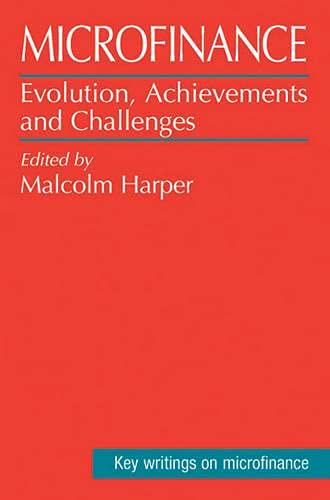
Microfinance
Evolution, Achievements and Challenges
By Malcolm HarperPractical Action Publishing Ltd
Copyright © 2003 ITDG Publishing
All rights reserved.
ISBN: 978-1-85339-561-1All rights reserved.
Contents
Preface, vii,
Introduction MALCOLM HARPER, 1,
1 Financial innovations for microenterprises – linking formal and informal financial institutions HANS DIETER SEIBEL AND UBEN PARHUSIP, 11,
2 Savings mobilization and microenterprise programmes MARIA OTERO, 25,
3 Raising the curtain on the 'microfinancial services era' STUART RUTHERFORD, 37,
4 Towards a more market-oriented approach to credit and savings for the poor HENRY R. JACKELEN AND ELISABETH RHYNE, 52,
5 Microinsurance – the risks, perils and opportunities WARREN BROWN, 72,
6 Regulating microfinance – the options ROBERT PECK CHRISTEN AND RICHARD ROSENBERG, 87,
7 Commercial banks and women microentrepreneurs in Latin America GLORIA ALMEYDA STEMPER, 109,
8 Credit for the rural poor – the case of BRAC in Bangladesh A.M.R. CHOWDHURY, M. MAHMOOD AND F.H. ABED, 121,
9 The effects of liberalization on access to bank credit in Kenya PENINAH W. KARIUKI, 132,
10 'Are you poor enough?' – client selection by microfinance institutions GRAHAM A.N. WRIGHT AND ALEKE DONDO, 142,
11 The holy grail of microfinance: 'helping the poor' and 'sustainable'? CHRISTOPHER DUNFORD, 150,
12 Is microdebt good for poor people? A note on the dark side of microfinance DAVID HULME, 155,
13 The managed ASCA model – innovation in Kenya's microfinance industry SUSAN JOHNSON, NTHENYA MULE, ROBERT HICKSON AND WAMBUI MWANGI, 159,
14 Empowered to default? Evidence from BRAC's micro-credit programmes SHAHIN YAQUB, 172,
CHAPTER 1
Financial innovations for microenterprises – linking formal and informal financial institutions
HANS DIETER SEIBEL and UBEN PARHUSIP
This paper was first published in June 1990.
In the past, credit programmes including subsidies and neglecting savings mobilization have undermined rural finance. In recent years, the number of countries has been growing in which banks mobilize savings and practise commercial banking; but the rural poor still have to rely on informal financial institutions, which are better adjusted to local conditions. During the early 1980s, a novel approach entered into the debate: linking informal and formal financial institutions, with financial self-help groups acting as intermediaries between microentrepreneurs and the banks. This reduces transaction costs substantially, for the benefit of both. Within APRACA (Asian and Pacific Regional Agricultural Credit Association), Indonesia has been the first to implement such a pilot project. In a favourable policy climate, a project was designed which incorporates the major features of sustainability, such as reliance on institutional capacity, co-operation between governmental and private voluntary bodies and pre-existing grassroots organizations, domestic resource mobilization, market forces, flexibility and socio-cultural adjustment. In 1989, 30 bankers, 30 private voluntary organization (PVO) staff and 815 self-help group staff were trained. From May to September, a first set of some 20 bank units, 10 PVOs and 100 self-help groups entered into their initial financial transactions.
In most developing countries, policies for rural financial development have been based on three fallacies concerning their target groups: rural micro-entrepreneurs are unable to organize themselves; they are too poor to save; and they need cheap credit for their income-generating activities or small enterprises.
Three financial policies resulted from these assumptions: credit-oriented development banks and special programmes were set up which ignored savings mobilization; credit was subsidized; and generous credit guarantee schemes were set up to cover anticipated losses. The consequences of these policies did not contribute to the self-sustained growth of rural finance, nor did they sufficiently benefit the rural poor:
* Subsidization meant that the scope of credit remained severely restricted. There was no built-in growth factor which would have resulted from internal resource mobilization. The level of credit was directly tied to the amount of subsidies available. Small numbers of relatively large loans went to medium and large enterprises; and the masses had no, or little, access to institutional finance.
* Banks were not motivated to give their customers a thorough screening and to recover their losses, while borrowers felt little motivation to repay their loans. This resulted in high default rates and in continuous programme decapitalization.
* Subsidies led to the misallocation of production factors.
Around 1980, a reorientation among rural financial policy makers began. Mounting international debts, increasing shortages of internal and external credit supplies and a growing dissatisfaction with state-nurtured and seemingly ineffective credit programmes led to a rethinking, centring around such concepts as self-help, self-sustained growth and institutional viability. In terms of financial systems, this meant an emphasis on savings mobilization in particular, as a prime mechanism of internal resource generation. Development assistance was intended to promote, not to replace, self-help and personal effort.
It was then found that although microentrepreneurs in developing countries may be poor, they are able to save, and they are capable of forming their own self-help organizations. However, they usually face a number of problems:
* Institutional finance is inaccessible to the majority of microenterprises.
* Concessionary financial programmes for microenterprises have largely failed. They are not viable economically; in terms of impact, they reach only a minute proportion of their target group.
* There is a wealth of human, organizational and institutional resources which, as long as it is not mobilized and appropriately linked, may remain untapped. Such resources include microenterprises, informal, semi-formal and formal financial institutions, private voluntary organizations and governmental agencies and programmes.
* Conventional approaches to rural microenterprise finance face high transactional costs for both lenders and borrowers. At low interest rates they are unviable for banks; at market rates, they may be unviable for most of the potential borrowers.
* Credit programmes without a savings component ignore savings as a means of internal resource mobilization; at the same time, they ignore the savings habit as a psychological basis for investment and repayment behaviour.
* Confined to their own resources and membership, and barred from access to banks, most self-help groups of microentrepreneurs have been unable to make the most of their potential. Operating outside the formal sector, they have tended to keep the economy near stationary, and to contribute more to its stabilization than to rapid development.
The APRACA programme
APRACA (Asian and Pacific Regional Agricultural Credit Association) is an association of central banks, rural development banks and rural commercial banks, and is one of four Regional Agricultural Credit Associations (RACA) originally promoted by the United Nations Food and Agriculture Organization (FAO). Established in 1977 with an emphasis on agricultural credit, it subsequently broadened its scope towards rural finance. At a workshop held in May 1986 in Nanjing, China, the member countries adopted a novel programme of access to formal financial institutions for the poorer sections of the population. This involved a financial system built around self-help groups as grassroots intermediaries between banks and rural microentrepreneurs.
Subsequently several APRACA members carried out surveys in their respective countries. They found that what stands in the way of the full utilization of resources for microenterprises is financial market segmentation. There are formal financial markets for the upper 5 to 20 per cent of the population. These markets fall under the control of state credit and related financial laws and are supervised by the central bank. They comprise central, commercial, development, savings and secondary banks as well as non-banking institutions. In addition, there is a small but growing semi-formal financial market, which comprises governmental and private voluntary organizations, and so-called self-help promoting institutions which have their own savings and credit programmes. They do not fall under the state's credit law but operate with the approval of the state and its organs.
Informal financial markets comprise financial self-help groups, other self-help groups with secondary financial functions and individual financial agents, such as moneylenders, deposit collectors and trade-, crop- or land-related financial arrangements. From a policy viewpoint, financial self-help groups are of particular importance. They are found in most Asian countries and in most cultures or ethnic groups within them. Their main financial functions are usually the accumulation and depositing of savings, the granting of loans and, to some extent, the rendering of insurance services. They may be found in urban and rural areas, among traders and market-women, farmers and fishermen, craftsmen and small industrialists, wage and salary earners, and among bank employees. Despite being part of the informal financial sector and lacking legal status, most associations do possess organizational structure. Typically, they are headed by a staff of elected executives; they have written rules and regulations; they keep membership lists and they practise some form of bookkeeping. Local social control mechanisms effectively prevent defaulting or fraud, which plague so many formal credit programmes.
For more effective financial coverage of the poorer sections of the population, three different approaches have been discerned in the APRACA discussions on rural finance:
* upgrading financial self-help groups of microentrepreneurs
* linking existing self-help groups and banks
* the adaptation of banks to their environment ('downgrading').
The participants decided on the linkage programme as a focal approach which may eventually comprise both upgrading and institutional adaptation.
Policies were discussed and procedures worked out for linking banks and self-help groups within the member countries. This led to baseline research and policy discussions on the national level, the results of which were fed back to the international organization. In addition to a variety of conferences, meetings and workshops, two instruments of communication deserve particular attention: one is an international training programme, the other a new journal, Asia Pacific Rural Finance.
Guiding principles
APRACA members have discussed the essentials of a sound policy for financial market development, and several guiding principles have emerged:
* Working through existing formal and informal institutions rather than establishing new institutions.
* Promoting savings mobilization by observing two prerequisites: savings should not yield negative real returns (relative to the rate of inflation); and savings mobilization must not be 'undermined' by cheap (i.e. subsidized) credit from the central banks or from donors. Thus, the interest rate on liquidity credits should equal the cost of mobilizing rural savings.
* Promoting credit delivery at market rates. Financial institutions should be encouraged to apply market rates of interest in order to achieve a balance of the supply of, and demand for, credit in rural areas.
* Linking savings and credit. Credit should be linked to savings: no credit without savings, no savings without credit. Participating institutions may agree upon a savings-to-credit ratio, reflecting the creditworthiness of the borrower.
* Substituting group liability for conventional collateral. It is suggested that no other physical collateral will be requested over and above the savings deposited. For the remaining balance, the self-help group will act as a joint liability group.
* Ensuring institutional viability. All financial intermediaries involved – self-help groups, PVOs and banks – should cover their costs of intermediation through an adequate interest margin. Over and above the costs of funds, intermediation costs include transaction costs, reserves for bad debts and the costs of extension services.
* Covering the risk from the margin. The risk of default shall be borne by the financial intermediaries themselves. External credit guarantees, though sometimes necessary for banks as an inducement to participate in an experimental phase, are seen as contrary to programme sustainability and self-reliance.
The first APRACA countries to design pilot projects were Indonesia, Nepal, the Philippines and Thailand. In Indonesia, the pilot project started in 1988; Nepal, the Philippines and Thailand were expected to follow in 1989–90.
Pilot project in Indonesia
The Republic of Indonesia surpasses most other developing countries in terms of population size (175 million in 1988), geographical extension and ethnic or cultural diversity. The number of enterprises exceeds 30 million; more than 90 per cent are microenterprises; and most belong to the informal sector.
Until 1983, financial markets were tightly regulated. Since then, they have been gradually deregulated, and exchange rates are now allowed to fluctuate according to the market. This has led to substantially higher levels of domestic savings mobilization. Interest rate restrictions have been removed; minimum reserve requirements have been lowered to 2 per cent; and the ban on establishing new banks has been lifted. Indonesia now has the highest interest rates in the region (e.g. time deposit rates from 16 to 24 per cent), which has reduced capital flight.
For 20 years, the Government of Indonesia has experimented with financial schemes for small enterprises. Most of its credit programmes were subsidized and had no savings component; and the banks served mainly as channels for the distribution of government funds. They had little, if any, motivation to mobilize savings, to search actively for borrowers or, equipped with generous credit guarantee schemes, to scrutinize loan applications and enforce repayment. As a result, loan repayment performance was usually poor. Access to loans by the masses of the population in rural areas, and even more so by the urban informal sector, remained severely restricted – with a negative impact on productive investments and income generating activities.
In the new era of financial market deregulation, disenchantment with subsidized programmes and with their questionable effectiveness has been growing both in government and bank circles. They are now being gradually dismantled in Indonesia. The new policy environment encourages banks to embark on vigorous campaigns of domestic savings mobilization, to expand credit delivery at market rates and to experiment with innovative approaches to rural and urban finance.
The financial markets in Indonesia at present bear the marks of both old and new, regulated and free market policies. They are segmented into formal, informal and semi-formal financial markets. Banks are the core institutions of the formal financial sector. This sector also includes a number of small second-tier institutions defined as non-banks, which are supervised by primary banks, as well as registered co-operatives which fall under the co-operative law.
There are numerous informal financial institutions that operate without legal status and outside state control: moneylenders, financial self-help groups (rotating and non-rotating savings and credit associations, unregistered credit unions) and numerous other groups with secondary financial functions. In terms of origin, they may be indigenous, state- or PVO-initiated, with considerable overlaps between these three categories.
Semi-formal financial institutions include PVOs as well as governmental organizations, and act as intermediaries between domestic or foreign donors and informal self-help groups or final individual borrowers. They are extra-legal in their financial activities, but so far have obviously enjoyed the tacit tolerance of the state. In addition, officially recognized but unregistered pre-co-operatives are included in this sector.
There is a wide network of institutional resources in Indonesia: there are more than 15,000 bank and non-bank institutions; and probably more than one million which have generated their own funds from various sources and self-help groups which have built up their own savings and credit businesses. There is a small number of self-help promoting institutions which, acting as semi-formal financial institutions, have made substantial contributions to the development of a selected number of self-help groups in such fields as group formation, personal development, skills training, income generating activities and finance. For the purposes of this article they will be included with PVOs.
Both informal and semi-formal financial institutions share a number of shortcomings.
* They are not linked to the banking sector, except, in some cases, with regard to fund depositing or transfer.
* They have no access to the refinancing facilities of the central bank: at best they depend, to a moderate extent, on external donors.
* They are restricted in their savings and credit activities because of shortages of funds.
* They have no access to bank training facilities; consequently they lack financial skill and banking experience.
(Continues...)
Excerpted from Microfinance by Malcolm Harper. Copyright © 2003 ITDG Publishing. Excerpted by permission of Practical Action Publishing Ltd.
All rights reserved. No part of this excerpt may be reproduced or reprinted without permission in writing from the publisher.
Excerpts are provided by Dial-A-Book Inc. solely for the personal use of visitors to this web site.
"About this title" may belong to another edition of this title.
Other Popular Editions of the Same Title

Search results for Microfinance: Evolution, achievement and challenges...

Stock Image
Microfinance: Evolution, achievement and challenges (Key Writings on Microfinance)
Seller: suffolkbooks, Center moriches, NY, U.S.A.
Seller rating 4 out of 5 stars

paperback. Condition: Very Good. Fast Shipping - Safe and Secure 7 days a week! Seller Inventory # 3TWOWA002552
Stock Image
Microfinance: Evolution, Achievement and Challenges
Seller: Anybook.com, Lincoln, United Kingdom
Seller rating 5 out of 5 stars

Condition: Good. This is an ex-library book and may have the usual library/used-book markings inside.This book has soft covers. Clean from markings. In good all round condition. Please note the Image in this listing is a stock photo and may not match the covers of the actual item,450grams, ISBN:9781853395611. Seller Inventory # 9825102
Buy Used
£ 20.35
£ 13.60 shipping
Ships from United Kingdom to U.S.A.
Ships from United Kingdom to U.S.A.
Quantity: 1 available