
Items related to Return to My Native Land (Bloodaxe Contemporary French...
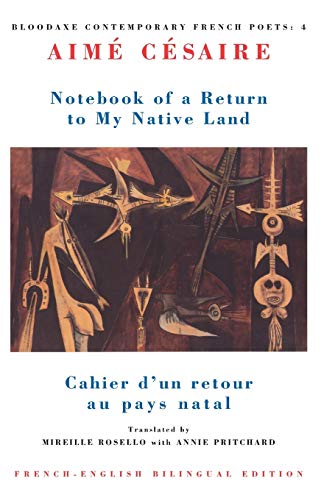
Return to My Native Land (Bloodaxe Contemporary French Poets): Cahier d'un retour au pays natal: 4 - Softcover
Synopsis
French-English bilingual edition
André Breton called Césaire's Cahier 'nothing less than the greatest lyrical monument of this time'. It is a seminal text in Surrealist, French and Black literatures - published in full in English for the first time in Bloodaxe’s bilingual Contemporary French Poets series.
Aimé Césaire (1913-2008) was born in in Basse-Pointe, a village on the north coast of Martinique, a former French colony in the Caribbean (now an overseas département of France). His book Discourse on Colonialism (1950) is a classic of French political literature. Notebook of a Return to My Native Land (1956) is the foundation stone of francophone Black literature: it is here that the word Négritude appeared for the first time. Négritude has come to mean the cultural, philosophical and political movement co-founded in Paris in the 1930s by three Black students from French colonies: the poets Léon-Gontran Damas from French Guiana; Léopold Senghor, later President of Senegal; and Aimé Césaire, who became a deputy in the French National Assembly for the Revolutionary Party of Martinique and was repeatedly elected Mayor of Fort-de-France.
As a poet, Césaire believed in the revolutionary power of language, and in the Notebook he combined high literary French with Martinican colloquialisms, and archaic turns of phrase with dazzling new coinages. The result is a challenging and deeply moving poem on the theme of the future of the negro race which presents and enacts the poignant search for a Martinican identity. The Notebook opposes the ideology of colonialism by inventing a language that refuses assimilation to a dominant cultural norm, a language that teaches resistance and liberation.
"synopsis" may belong to another edition of this title.
About the Author
Aimé Césaire (1913-2008) was born in Basse-Pointe, a village on the north coast of Martinique, a former French colony in the Caribbean (now an overseas département of France). His book Discourse on Colonialism (1950) is a classic of French political literature. Notebook of a Return to My Native Land (1956) is the foundation stone of francophone Black literature: it is here that the word Négritude appeared for the first time. Négritude has come to mean the cultural, philosophical and political movement co-founded in Paris in the 1930s by three Black students from French colonies: the poets Léon-Gontran Damas from French Guiana; Léopold Senghor, later President of Senegal; and Aimé Césaire, who became a deputy in the French National Assembly for the Revolutionary Party of Martinique and was repeatedly elected Mayor of Fort-de-France.
Césaire attended high school and college in France, returning to Martinique during the Second World War. He was mayor of Fort-de-France from 1945 to 2001, except for a break from 1983 to 1984. He helped Martinique shed its colonial status in 1946 to become an overseas département of France. He was affiliated with the French Communist Party early in his career but became disillusioned in the 1950s and founded the Martinique Progressive Party in 1958. He later allied with the Socialist Party in France s National Assembly, where he served from 1946 to 1956 and from 1958 to 1993. He died in 2008, aged 94.
"About this title" may belong to another edition of this title.
Search results for Return to My Native Land (Bloodaxe Contemporary French...

Seller Image
Return to My Native Land
Seller: Zoom Books Company, Lynden, WA, U.S.A.
Seller rating 5 out of 5 stars

Condition: very_good. Book is in very good condition and may include minimal underlining highlighting. The book can also include "From the library of" labels. May not contain miscellaneous items toys, dvds, etc. . We offer 100% money back guarantee and 24 7 customer service. Seller Inventory # ZBV.1852241845.VG
Stock Image
Return to My Native Land (Bloodaxe Contemporary French Poets): Cahier d'un retour au pays natal: 4
Seller: WorldofBooks, Goring-By-Sea, WS, United Kingdom
Seller rating 5 out of 5 stars
Paperback. Condition: Very Good. The book has been read, but is in excellent condition. Pages are intact and not marred by notes or highlighting. The spine remains undamaged. Seller Inventory # GOR001324516
Buy Used
£ 2.70
£ 5.60 shipping
Ships from United Kingdom to U.S.A.
Ships from United Kingdom to U.S.A.
Quantity: 1 available
Stock Image
Return to My Native Land
Seller: HPB-Emerald, Dallas, TX, U.S.A.
Seller rating 5 out of 5 stars
paperback. Condition: Very Good. Connecting readers with great books since 1972! Used books may not include companion materials, and may have some shelf wear or limited writing. We ship orders daily and Customer Service is our top priority! Seller Inventory # S_482580741
Stock Image
Return to My Native Land
Seller: Books Liquidation, Sacramento, CA, U.S.A.
Seller rating 4 out of 5 stars

paperback. Condition: Very Good. Seller Inventory # mon0000028925
Stock Image
Notebook of a Return to My Native Land: Cahier d'Un Retour Au Pays Natal
Seller: ThriftBooks-Dallas, Dallas, TX, U.S.A.
Seller rating 5 out of 5 stars
Paperback. Condition: Very Good. No Jacket. May have limited writing in cover pages. Pages are unmarked. ~ ThriftBooks: Read More, Spend Less. Seller Inventory # G1852241845I4N00
Stock Image
Return to My Native Land (Bloodaxe Contemporary French Poets)
Seller: AwesomeBooks, Wallingford, United Kingdom
Seller rating 5 out of 5 stars
Paperback. Condition: Very Good. Return to My Native Land (Bloodaxe Contemporary French Poets) This book is in very good condition and will be shipped within 24 hours of ordering. The cover may have some limited signs of wear but the pages are clean, intact and the spine remains undamaged. This book has clearly been well maintained and looked after thus far. Money back guarantee if you are not satisfied. See all our books here, order more than 1 book and get discounted shipping. . Seller Inventory # 7719-9781852241841
Buy Used
£ 6.99
£ 4.12 shipping
Ships from United Kingdom to U.S.A.
Ships from United Kingdom to U.S.A.
Quantity: 1 available
Seller Image
Notebook of a Return to My Native Land : Cahier D'un Retour Au Pays Natal
Seller: GreatBookPrices, Columbia, MD, U.S.A.
Seller rating 5 out of 5 stars
Condition: New. Seller Inventory # 1480721-n
Seller Image
Notebook of a Return to My Native Land
Seller: Rarewaves.com USA, London, LONDO, United Kingdom
Seller rating 5 out of 5 stars
Paperback. Condition: New. French-English bilingual edition. André Breton called Césaire's Cahier 'nothing less than the greatest lyrical monument of this time'. It is a seminal text in Surrealist, French and Black literatures - published in full in English for the first time in Bloodaxe's bilingual Contemporary French Poets series. Aimé Césaire (1913-2008) was born in in Basse-Pointe, a village on the north coast of Martinique, a former French colony in the Caribbean (now an overseas departement of France). His book Discourse on Colonialism (1950) is a classic of French political literature. Notebook of a Return to My Native Land (1956) is the foundation stone of francophone Black literature: it is here that the word Negritude appeared for the first time. Negritude has come to mean the cultural, philosophical and political movement co-founded in Paris in the 1930s by three Black students from French colonies: the poets Léon-Gontran Damas from French Guiana; Leopold Senghor, later President of Senegal; and Aimé Césaire, who became a deputy in the French National Assembly for the Revolutionary Party of Martinique and was repeatedly elected Mayor of Fort-de-France. As a poet, Cesaire believed in the revolutionary power of language, and in the Notebook he combined high literary French with Martinican colloquialisms, and archaic turns of phrase with dazzling new coinages. The result is a challenging and deeply moving poem on the theme of the future of the negro race which presents and enacts the poignant search for a Martinican identity. The Notebook opposes the ideology of colonialism by inventing a language that refuses assimilation to a dominant cultural norm, a language that teaches resistance and liberation. Seller Inventory # LU-9781852241841
Buy New
£ 12.71
Free Shipping
Ships from United Kingdom to U.S.A.
Ships from United Kingdom to U.S.A.
Quantity: Over 20 available
Stock Image
Return to My Native Land (Bloodaxe Contemporary French Poets): Cahier d'un retour au pays natal: 4
Seller: Chiron Media, Wallingford, United Kingdom
Seller rating 5 out of 5 stars
paperback. Condition: New. Brand new book, sourced directly from publisher. Dispatch time is 6-7 days from our warehouse. Book will be sent in robust, secure packaging to ensure it reaches you securely. Seller Inventory # 6666-MAC-9781852241841
Buy New
£ 8.75
£ 4.49 shipping
Ships from United Kingdom to U.S.A.
Ships from United Kingdom to U.S.A.
Quantity: 10 available
Stock Image
Notebook of a Return to My Native Land : Cahier D'un Retour Au Pays Natal
Seller: GreatBookPrices, Columbia, MD, U.S.A.
Seller rating 5 out of 5 stars
Condition: As New. Unread book in perfect condition. Seller Inventory # 1480721