
Items related to Advanced Asset Pricing Theory: 2 (Series In Quantitative...
Synopsis
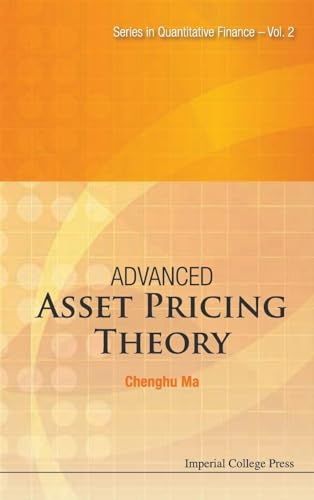
This book provides a broad introduction of modern asset pricing theory with equal treatments for both discrete-time and continuous-time modeling. Both the no-arbitrage and the general equilibrium approaches of asset pricing theory are treated coherently within the general equilibrium framework. The analyses and coverage are up to date, comprehensive and in-depth. Topics include microeconomic foundation of asset pricing theory, the no-arbitrage principle and fundamental theorem, risk measurement and risk management, sequential portfolio choice, equity premium decomposition, option pricing, bond pricing and term structure of interest rates. The merits and limitations are expounded with respect to allocation and information market efficiency, along with the classical expectations hypothesis concerning the information content of yield curve and bond prices. Efforts are also made towards the resolution of several well-documented puzzles in empirical finance, which include the equity premium puzzle, the risk free rate puzzle, and the money-ness bias phenomenon of BlackScholes option pricing model. The theory is self-contained and unified in presentation. The inclusion of proofs and derivations to enhance the transparency of the underlying arguments and conditions for the validity of the economic theory makes an ideal advanced textbook or reference book for graduate students specializing in financial economics and quantitative finance. The explanations are detailed enough to capture the interest of those curious readers, and complete enough to provide necessary background material needed to explore further the subject and research literature.
"synopsis" may belong to another edition of this title.
From the Back Cover
This book provides a broad introduction to modern asset pricing theory. The theory is self-contained and unified in presentation. Both the no-arbitrage and the general equilibrium approaches of asset pricing theory are treated coherently within the general equilibrium framework. It fills a gap in the body of literature on asset pricing for being both advanced and comprehensive. The absence of arbitrage opportunities represents a necessary condition for equilibrium in the financial markets. However, the absence of arbitrage is not a sufficient condition for establishing equilibrium. These interrelationships are overlooked by the proponents of the no-arbitrage approach to asset pricing.
This book also tackles recent advancement on inversion problems raised in asset pricing theory, which include the information role of financial options and the information content of term structure of interest rates and interest rates contingent claims.
The inclusion of the proofs and derivations to enhance the transparency of the underlying arguments and conditions for the validity of the economic theory made it an ideal advanced textbook or reference book for graduate students specializing in financial economics and quantitative finance. The detailed explanations will capture the interest of the curious reader, and it is complete enough to provide the necessary background material needed to delve deeper into the subject and explore the research literature.
Postgraduate students in economics with a good grasp of calculus, linear algebra, and probability and statistics will find themselves ready to tackle topics covered in this book. They will certainly benefit from the mathematical coverage in stochastic processes and stochastic differential equation with applications in finance. Postgraduate students in financial mathematics and financial engineering will also benefit, not only from the mathematical tools introduced in this book, but also from the economic ideas underpinning the e
"About this title" may belong to another edition of this title.
Search results for Advanced Asset Pricing Theory: 2 (Series In Quantitative...

Stock Image
Advanced Asset Pricing Theory
Seller: GreatBookPrices, Columbia, MD, U.S.A.
Seller rating 5 out of 5 stars

Condition: New. Seller Inventory # 10249914-n
Stock Image
Advanced Asset Pricing Theory
Seller: PBShop.store US, Wood Dale, IL, U.S.A.
Seller rating 5 out of 5 stars
HRD. Condition: New. New Book. Shipped from UK. Established seller since 2000. Seller Inventory # CX-9781848166325
Seller Image
Advanced Asset Pricing Theory
Seller: GreatBookPrices, Columbia, MD, U.S.A.
Seller rating 5 out of 5 stars
Condition: As New. Unread book in perfect condition. Seller Inventory # 10249914
Stock Image
ADVANCED ASSET PRICING THEORY (Quantitative Finance)
Seller: California Books, Miami, FL, U.S.A.
Seller rating 4 out of 5 stars

Condition: New. Seller Inventory # I-9781848166325
Stock Image
ADVANCED ASSET PRICING THEORY (Quantitative Finance)
Seller: Ria Christie Collections, Uxbridge, United Kingdom
Seller rating 5 out of 5 stars
Condition: New. In. Seller Inventory # ria9781848166325_new
Buy New
£ 112.25
£ 11.98 shipping
Ships from United Kingdom to U.S.A.
Ships from United Kingdom to U.S.A.
Quantity: Over 20 available
Stock Image
Advanced Asset Pricing Theory
Seller: GreatBookPricesUK, Woodford Green, United Kingdom
Seller rating 5 out of 5 stars
Condition: As New. Unread book in perfect condition. Seller Inventory # 10249914
Buy Used
£ 109.98
£ 15 shipping
Ships from United Kingdom to U.S.A.
Ships from United Kingdom to U.S.A.
Quantity: 8 available
Seller Image
Advanced Asset Pricing Theory
Seller: GreatBookPricesUK, Woodford Green, United Kingdom
Seller rating 5 out of 5 stars
Condition: New. Seller Inventory # 10249914-n
Buy New
£ 110.02
£ 15 shipping
Ships from United Kingdom to U.S.A.
Ships from United Kingdom to U.S.A.
Quantity: 8 available
Stock Image
Advanced Asset Pricing Theory
Seller: PBShop.store UK, Fairford, GLOS, United Kingdom
Seller rating 5 out of 5 stars
HRD. Condition: New. New Book. Shipped from UK. Established seller since 2000. Seller Inventory # CX-9781848166325
Buy New
£ 124.52
£ 7.63 shipping
Ships from United Kingdom to U.S.A.
Ships from United Kingdom to U.S.A.
Quantity: 15 available
Seller Image
Advanced Asset Pricing Theory
Print on DemandSeller: moluna, Greven, Germany
Seller rating 5 out of 5 stars
Gebunden. Condition: New. Dieser Artikel ist ein Print on Demand Artikel und wird nach Ihrer Bestellung fuer Sie gedruckt. Presents an introduction to modern asset pricing theory. This book also tackles recent advancement on inversion problems raised in asset pricing theory, which include the information role of financial options and the information content of term structure of. Seller Inventory # 448372761
Buy New
£ 102.57
£ 41.90 shipping
Ships from Germany to U.S.A.
Ships from Germany to U.S.A.
Quantity: Over 20 available
Seller Image
ADVANCED ASSET PRICING THEORY (V2)
Print on DemandSeller: preigu, Osnabrück, Germany
Seller rating 5 out of 5 stars
Buch. Condition: Neu. ADVANCED ASSET PRICING THEORY (V2) | Ma Chenghu | Buch | Gebunden | Englisch | 2011 | ICP | EAN 9781848166325 | Verantwortliche Person für die EU: Libri GmbH, Europaallee 1, 36244 Bad Hersfeld, gpsr[at]libri[dot]de | Anbieter: preigu Print on Demand. Seller Inventory # 107230272