
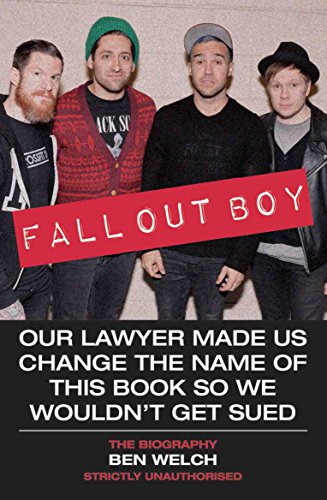
Items related to Fall Out Boy: The Biography
Synopsis
Fall Out Boy were front-and-centre of the emo scene of the mid-2000s, gaining a devoted following with their infectious brand of pop-punk. After a tumultuous decade, the band are now stronger than ever and winning new fans across the globe. Despite a stream of worldwide hits including `Sugar, We’re Goin Down’ and `Dance, Dance’, internal fighting, health issues and the backlash against the emo scene threatened to destroy Fall Out Boy. Instead, they came back stronger with a new sound and discovered an even wider fan base. Fall Out Boy are still a commercial force to be reckoned with - their last album American Beauty/American Psycho was certified Gold in the US, UK and Australia in 2015. This is the first biography on the band and an in-depth account of their story, from its beginnings in Chicago, to worldwide fame, addictions and disillusionment with the music industry to their recent resurgence.
"synopsis" may belong to another edition of this title.
About the Author
Ben Welch is the author of Bring Me the Horizon and Bullet for My Valentine.
Excerpt. © Reprinted by permission. All rights reserved.
Fall Out Boy
Our Lawyers Made Us Change the Name of this Book So We Wouldn't Get Sued
By Ben WelchJohn Blake Publishing Ltd
Copyright © 2016 Ben Welch
All rights reserved.
ISBN: 978-1-78606-125-6All rights reserved.
Contents
Title Page,
Introduction,
Chapter One: HOLDEN CAULFIELD WITH A BASS GUITAR,
Chapter Two: THE METAL DRUMMER AND THE BEAST,
Chapter Three: ARMA ANGELUS,
Chapter Four: A NIGHTMARE SCENARIO,
Chapter Five: THE OLDEST TRICK IN THE BOOKSHOP,
Chapter Six: EVERYTHING'S COMING UP MILHOUSE,
Chapter Seven: RECORDING FALL OUT BOY'S EVENING OUT ...,
Chapter Eight: GRAND THEFT RAMEN,
Chapter Nine: AS LOUD AS THE GRAVE,
Chapter Ten: HARDCORE KIDS,
Chapter Eleven: A DIFFERENT ANIMAL,
Chapter Twelve: THE FRUIT OF THE CORK TREE,
Chapter Thirteen: BUILDING AN EMPIRE,
Chapter Fourteen: A LITTLE BUMP AND GRIND,
Chapter Fifteen: FROM HERE TO INFINITY,
Chapter Sixteen: SEVEN CONTINENTS,
Chapter Seventeen: A DREAM RECORD,
Chapter Eighteen: SHARED MADNESS,
Chapter Nineteen: SWAN SONG,
Chapter Twenty: THE BLESSED AND THE DAMNED,
Chapter Twenty-One: 'MR MOM',
Chapter Twenty-Two: THE RISK IT TOOK TO BLOOM,
Chapter Twenty-Three: ELVIS'S PYJAMAS,
Chapter Twenty-Four: PLUGGING BACK IN,
Chapter Twenty-Five: HALLELUJAH,
Plates,
Copyright,
CHAPTER 1
HOLDEN CAULFIELD WITH A BASS GUITAR
Head north out of downtown Chicago, along the shore of the vast expanse of Lake Michigan, and in about forty minutes you will reach Wilmette. It's a pleasant and well-to-do suburb, one of the so-called North Shore communities that cluster at the western edge of the lake, a village of tree-lined residential streets and well-manicured front gardens. It was in Wilmette that on 5 June 1979 Peter Lewis Kingston Wentz III was born. His mother, Dale, had family ties to Jamaica and was related to Colin Powell, who became the US Secretary of State from 2001 to 2005. His father was the second Pete Wentz, and the two had met whilst working for Democrat Joe Biden in the seventies. They were a liberal island in the sea of Wilmette's conservatism, values that would have a great impact on the younger Wentz's outlook in later years. Dale worked as an admissions dean for a local private school and Wentz II was in the legal profession. For the most part, home life was a picture of suburban normality: his dad spent a lot of time working, while his mum was 'in the kitchen baking stuff'. It was, as he told The Independent, 'very non-exceptional'. As a kid, he loved Thunder Cats and had a crush on spotted-haired Cheetara; he enjoyed many a happy dinner eating burgers at local diner the Chuck Wagon in Wilmette; and he spent one blissful summer at the age of four visiting his aunt in Switzerland. But his early years were not without their troubles. On his sixth birthday his parents separated, and though they would reunite a few months later, he would hate birthdays from that day on.
His first memory of music is a vague and hazy one, sitting in the middle back seat of his dad's car and listening to Otis Redding's '(Sittin' On) The Dock of the Bay' on AM radio. But it was a chance encounter with the King of Pop whilst watching the Calgary Winter Olympics on TV in 1988 that really left a deep impression on him. He saw German ice skater Katarina Witt perform a routine to Michael Jackson's 1987 smash 'Bad', and something stirred in him. I want to make music, he thought, no doubt spurred on by the sight of a leather jacket-clad Witt high-kicking and moonwalking across the ice (Witt would win the gold that year). A fascination with Jackson and his genre-hopping futurism soon followed, but as his teenage years beckoned, his tastes would turn to music with a nastier edge.
First came a chance encounter with Guns N' Roses. Extravagant, brawny, larger-than-life and with more killer riffs and catchy choruses than any one band has a right to, Guns N' Roses are the ultimate gateway band to rock 'n' roll – the kind of act that changes the minds of impressionable kids forever. And when Wentz saw Axl Rose stepping off the bus in the 'Welcome to the Jungle' video, his vague desire to make music became a burning obsession. 'It made me want to be in Guns N' Roses or something,' he said to BPM TV. 'I think that Axl Rose walking off the bus is an epic moment in rock 'n' roll history.' Metallica's 'Enter Sandman' was another defining moment because the song was so big that it reached every sleepy corner of America, even well-heeled Wilmette. 'I remember being in the back of my parents' station wagon and blasting "Enter Sandman" and it was cool because it was like "this is my music",' he told NME. '"Enter Sandman" was so pervasive because it was played on this radio station in Chicago called B96, which usually played more urban music, but they played "Enter Sandman" because everyone had to play it because it was such a big song. There was something about it that made me be like, "I can make music, [this is] the kind of music that I want to make."' When he was old enough to have money of his own to spend, he made his first pilgrimage to a local record store called Coconut Records and bagged himself a copy of Slayer's Decade of Aggression. Wentz hadn't realised that it was a double live album, but his friend was into Slayer and he knew a few of the songs listed, enough to convince him to part with his cash.
But there was still one more left turn that he needed to take in his musical development, and it came when someone handed him a Minor Threat tape. Minor Threat were a Washington DC-based punk band active for a short period in the early eighties, but during just a few years of putting out material they would have an immeasurably big impact on the development of punk rock. In the mid to late seventies punk had moved from its brash and rebellious origins into more experimental territory, with post-punk bands like Television and Talking Heads in the States, and Joy Division and Gang of Four in the UK. Meanwhile, other first-wave punk acts were moving closer to the world of pop, formulating a sound that would later come to be known as new wave. But a third new branch of punk emerged, doubling down on the aggression and abrasiveness whilst upping the tempos. This new form would come to be called hardcore, and Minor Threat were one of its driving forces. In contrast to the art-school sensibilities of post-punk and the mainstream flirtation of new wave, hardcore was fiercely political and anti-establishment, and Minor Threat went one step further by disavowing the excesses of some parts of the rock and punk world. 'Straight Edge', from their first EP, laid their philosophy on substance-abuse bare: 'I'm a person just like you / But I've got better things to do / Than sit around and fuck my head / Hang out with the living dead / Snort white shit up my nose / Pass out at the shows,' barked icon-to-be Ian MacKaye, and the straight edge movement was born. Wentz's love for punk rock soon grew to include everything from the pop punk of Green Day to the more melodic hardcore of Gorilla Biscuits, as well Metallica's thrash metal and Earth Crisis's hybrid of metal and hardcore. Wentz's tastes were becoming omnivorous. As long as it was fast and loud, he'd listen. 'I was basically into fireworks and skateboarding,' he told FasterLouder. 'I needed a soundtrack to vandalism, basically.' At the age of fourteen he scratched his first tattoo, a black 'x', into his ankle with Indian ink. Wentz now had the mark of a punk rocker.
But while he was finding a love of music Wentz was also struggling to find his place in the world. He was a student at New Trier High School in Wilmette, but by his freshman year he had started skipping class and would also be diagnosed with attention deficit hyperactivity disorder, a condition marked by difficulties in focusing and controlling one's behaviour. He would sneak out late at night through a window to the basement of his house. When his dad found out he screwed the window shut, but Wentz would simply undo the screws or kick the window out. Eventually it was decided that something had to be done. A guidance counsellor recommended that his parents send him away to a boot camp to shock him out of his misbehaviour, but the long two months he spent there would have a traumatic effect on the young Wentz. 'Every kid there was so much more fucked up than me – demented, satanic kids,' he explained to Rolling Stone. 'I got beat up a couple of times. I'd call my parents every day, crying and saying I wanted to come home. I would beg. I felt isolated. It created these dependency and attachment issues.' He thinks that the experience made him emotionally withdrawn, prone to suppressing and bottling up his feelings. But it would also push him towards music as a cathartic outlet for the things he couldn't otherwise express.
Wentz moved to a private school and also began escaping the suburban bubble of Wilmette for the lights and noise of Chicago. He became a regular face at punk rock shows at local venues like the Fireside Bowl and the Metro, the latter a one-thousand-capacity theatre on Clark Street that had been an essential part of the Chicago music scene since the eighties. Pop-punk bands like Screeching Weasel from Prospect Heights and Alkaline Trio from McHenry, towns close to Chicago, would come through the city on a regular basis and gave Wentz the chance to see the bands he loved first-hand. At the age of fifteen or sixteen he'd started playing the bass too. As a kid he'd taken piano lessons, though it had never really stuck, and had also dabbled on a normal six-string guitar before realising an instrument with a couple less strings might suit him better. His first bass was 'a cheap knockoff that said "Naugahyde" on the headstock,' he told Premier Guitar. 'I had never heard of it before – but I really don't think anyone has.' It was Duff McKagan who had the biggest influence on his playing, and it's no wonder. McKagan's role in Guns N' Roses was so much more than simply a support for the guitar work, weaving as it did in and out of the riffs and giving the songs melodic accents where you least expect them. Green Day's Mike Dirnt was another bassist he admired, with his lightning-fast right hand and brittle, metallic tone.
But music wasn't Pete's sole obsession; in another world Fall Out Boy might never have existed had Wentz pursued his other passion: soccer. As he moved towards graduation, Wentz had become something of a sporting ace in his school, claiming all-state honours and the captaincy of the school team. It's hard to imagine, but to Wentz a career in professional football represented the 'easier option' over music. 'If I hadn't become a musician I'm sure I could have carved out a decent career as a footballer,' he told the Daily Mail. 'I loved playing the sport and there was no feeling that came close to scoring a great goal or going on a great run down the right wing and putting over a perfect cross. Doing things with the ball was a natural instinct for me.' Chicago's DePaul University had offered him a soccer scholarship, and he had grand plans of heading over to Europe to launch a professional career there. But whatever sporting successes Wentz was enjoying on the field, he was still struggling to process his emotions. The image of the tortured artist channelling his pain into deeply moving work is an enduring one. But Wentz would later say that he's probably closer to a confused kid, more like the subject of JD Salinger's novel The Catcher in the Rye – Holden Caulfield with a bass guitar.
CHAPTER 2THE METAL DRUMMER AND THE BEAST
Beyond Wilmette, Chicago had its own very active hardcore scene, a truly DIY environment where musicians and fans would meet to play, listen and mosh. That scene would prove fertile soil, producing dozens and dozens of bands both shortand long-lived; some would dissolve with little by way of recordings with which to remember them and others would leave a lasting legacy. Some would even become global phenomena, whereas others were more interested in shocking and stirring up debate than getting a deal and breaking out of Chicago. One notorious example of the latter was Racetraitor. Superficially it's hard to imagine a band less likely to be an antecedent to Fall Out Boy. Look closer and you see that they had a big part to play in Fall Out Boy's development, and their relevance to the band as it exists today.
Racetraitor was formed around the core membership of Dan Binaei, Karl Hlavinka and Brent Decker, with Mani Mostofi – a former student of New Trier High School – on vocals. It began life in the power violence/grindcore tradition, delivering thunderous blasts of uncompromising noise over extremely short songs. And as the band's name suggests, they were a highly politically and socially aware group who used the platform of the hardcore scene to raise issues surrounding race and privilege in the US. 'There was a band before Racetraitor called Hinckley,' Mostofi explains when asked about the origins and aims of Racetraitor. 'I wasn't in that band, I put out their seven-inch – but Karl, Brent and Dan were in that band. Hinckley kinda just broke up, in the way that bands do, you know; members got in personal disputes and whatever. And they wanted to continue what Hinckley was doing but up the ante in terms of how political it was. And that's where the concept of Racetraitor came from.'
He goes on, 'Look at what a lot of people talk about in terms of US politics today: white privilege, the Black Lives Matter movement, mass incarceration and even wars of intervention. I'm following the US presidential debates and these are the things they're talking about. Well, that's everything that Racetraitor was fixated with twenty years ago. We were really angry and no one was talking about it, and we wanted an avenue to do that.'
Mostofi and his bandmates had been heavily influenced by a short-lived Chicago band called Anger House, as well as Los Crudos, a 'really dirty, raw hardcore band' that sang in Spanish and were also highly socially conscious. But they soon found themselves in the position of elders, mentoring younger musicians coming up through the scene.
Hlavinka was initially the drummer, but there was a decision made within the band that he should switch instruments. 'He was playing drums in Racetraitor but he was actually a guitar player, so we decided to have him move to guitar,' Mostofi explains. 'And he said, "I know this drummer." He called him "the metal drummer". He didn't have a name at first. He was just a kid, like fifteen years old. But he said, "You guys should check him out, he's really good, we should get him to play."' The 'metal drummer' was named Andy Hurley.
Hurley had grown up almost a hundred miles due north of Chicago in Menomonee Falls, Milwaukee, another city on the shore of Lake Michigan. Hurley was born on 31 May 1980 and raised by his mother, a nurse, as his father had passed away when he was five years old. He had first fallen in love with music, like so many others, through the titans of American thrash Metallica; the first albums he ever bought for himself were Metallica's Ride the Lightning and Van Halen's self-titled 1978 debut. But it was Slayer's Dave Lombardo, famous for his mastery of the double kick technique, who compelled him to want to sit on a drum stool. Hurley had first been a saxophone player, but by the time he was attending Menomonie High School he had switched to the drums and was already forging his reputation as a musician of note. He joined the marching band, where the emphasis was on technical ability and a solid knowledge of the rudiments; combined with his love of thrash, he was developing into a fearsome player. Unfortunately his mother was not, at first, so keen on his taste in music. As a boy he would put on a shirt and tie and dance with her to classical music, and now he was asking to go to Metallica concerts. To this day he hasn't quite got over missing his chance to see Metallica on the And Justice for All tour.
Hurley did not have the easiest childhood. Two years after his father died his grandmother also passed away in his house, and around two years after that, his mother was diagnosed with breast cancer. His dad had been the father of nine children in total, but after his death Hurley's stepbrothers and sisters moved away from the area, leaving Hurley and his mother alone. The result of these traumatic experiences was, according to his mother, a very angry child. But Hurley was also starting to forge an identity through music. It was the discovery of the ultra-influential metallic hardcore band Earth Crisis that would give his life purpose and direction. The New York act had released Destroy the Machines in 1995, something of a landmark album which had combined the aggression and energy of hardcore punk with the musicianship and sinister atmosphere of metal, arguably giving birth to the metalcore genre in the process. But the band were known as much for their politics as their music. They were committed vegans and promoted animal rights through their music, as well as a straight edge lifestyle – the no drink, no drugs principles as laid out by Minor Threat. 'I used to like, smoke pot and drink when I was pretty young,' Hurley would later explain to the Expansion Project Podcast. 'But I kinda fractured my relationship with my mom, and she was really bummed out. [...] I think she was really nervous that she was losing me. And I was into hardcore and a lot of straight edge bands, but it wasn't until Earth Crisis [that I went straight edge] because that really solidified it and politicised it in a way that really spoke to me. I was like, "Yeah, fuck that, I don't need that stuff. Drugs are not more important to me than my relationship with my mother."'
(Continues...)
Excerpted from Fall Out Boy by Ben Welch. Copyright © 2016 Ben Welch. Excerpted by permission of John Blake Publishing Ltd.
All rights reserved. No part of this excerpt may be reproduced or reprinted without permission in writing from the publisher.
Excerpts are provided by Dial-A-Book Inc. solely for the personal use of visitors to this web site.
"About this title" may belong to another edition of this title.
Search results for Fall Out Boy: The Biography

Stock Image
Fall Out Boy: The Biography
Seller: Corner of a Foreign Field, Tokyo, TOKYO, Japan
Seller rating 4 out of 5 stars

Soft cover. Condition: Good. No Jacket. 2016.Softcover.Good condition.264 pages.Ships from Japan.Usually ships in 1-2 working days. Seller Inventory # 31583
Seller Image
Fall Out Boy: The Biography
Seller: -OnTimeBooks-, Phoenix, AZ, U.S.A.
Seller rating 5 out of 5 stars

Condition: good. A copy that has been read, remains in good condition. All pages are intact, and the cover is intact. The spine and cover show signs of wear. Pages can include notes and highlighting and show signs of wear, and the copy can include "From the library of" labels or previous owner inscriptions. 100% GUARANTEE! Shipped with delivery confirmation, if you're not satisfied with purchase please return item! Ships via media mail. Seller Inventory # OTV.1786061252.G
Seller Image
Fall Out Boy: The Biography
Seller: Blue Vase Books, Interlochen, MI, U.S.A.
Seller rating 5 out of 5 stars
Condition: good. The item shows wear from consistent use, but it remains in good condition and works perfectly. All pages and cover are intact including the dust cover, if applicable . Spine may show signs of wear. Pages may include limited notes and highlighting. May NOT include discs, access code or other supplemental materials. Seller Inventory # BVV.1786061252.G